

Key Takeaways:
- Has Lewis Hamilton had a hair transplant? Lewis has never confirmed undergoing a hair transplant procedure. Analysis of his hair over the years suggests a hair transplant was performed around 2015.
- How Much Hair Loss Did He Have? Lewis Hamilton seems to be about a Norwood 4 before his hair transplant. He had recession in the front hairline as well as the temples and crown region.
- Which technique might have been used? If he did receive a hair transplant procedure to restore hair loss, our surgeons believe it would have been Follicular Unit Excision (FUE).
- Were there Any Issues Due to him having Afro Hair? Just like any other type of hair, Afro-textured hair can also have a successful hair transplant. However, Afro hair transplants require more expertise and take more time. So it is important to choose an experienced surgeon.
Lewis Hamilton is widely considered to be one of the greatest Formula One drivers of all time. The seven-time World Champion holds records for most race wins and pole positions and is also a celebrity outside of racing, with regular magazine covers.
Since his 2007 debut, his hair has evolved from an afro to braids to a buzzed fade throughout his trophy-laden career.
Has Lewis Hamilton Been Open About Having a Hair Transplant?
Lewis Hamilton has never publicly acknowledged having a transplant procedure. However, in a 2019 Instagram post, he posted about his years of poor hair care routine. He talked about using bathing soap on his hair, which led to a dry scalp over the years.
Analysing Lewis Hamilton’s Hair Loss Timeline
Hair loss can start to appear early. About a quarter of men who experience male pattern baldness notice the signs before the age of 21.
Male pattern baldness also presents differently in men. Some men may experience thinning along the temples initially or thinning along their frontal hairline, while some may experience this on the crown.
In most cases, changes to the frontal hairline and temple area are the most common form of hair loss and can be seen in the analysis of Lewis’ hairline below
2007 to 2009: A full hairline
He was in his early twenties at this time and presented no signs of hair loss. He had a full head of hair at this time, and a close look at his frontal hairline and temple area did not show early signs of significant hair thinning.
Around 2010
Around 2010, he was well into his mid-20s and started to present some level of recession in the temples and thinning in the crown area. The hair loss looked like a typical m-shape which is common among men suffering from this condition.
It is important to note that hair loss is simply a genetic condition where hair follicles that are sensitive to DHT will, over time, miniaturise, resulting in finer and shorter hairs growing from the affected hair follicles.
From 2010 to 2015
Lewis’ hair loss continued to progress around this time. The temporal recession and frontal hairline continued to move back. Pictorial observation of his hairline also shows that his crown area had increased thinning.
Our surgeons estimate his hair loss at this stage to be about Norwood 4.
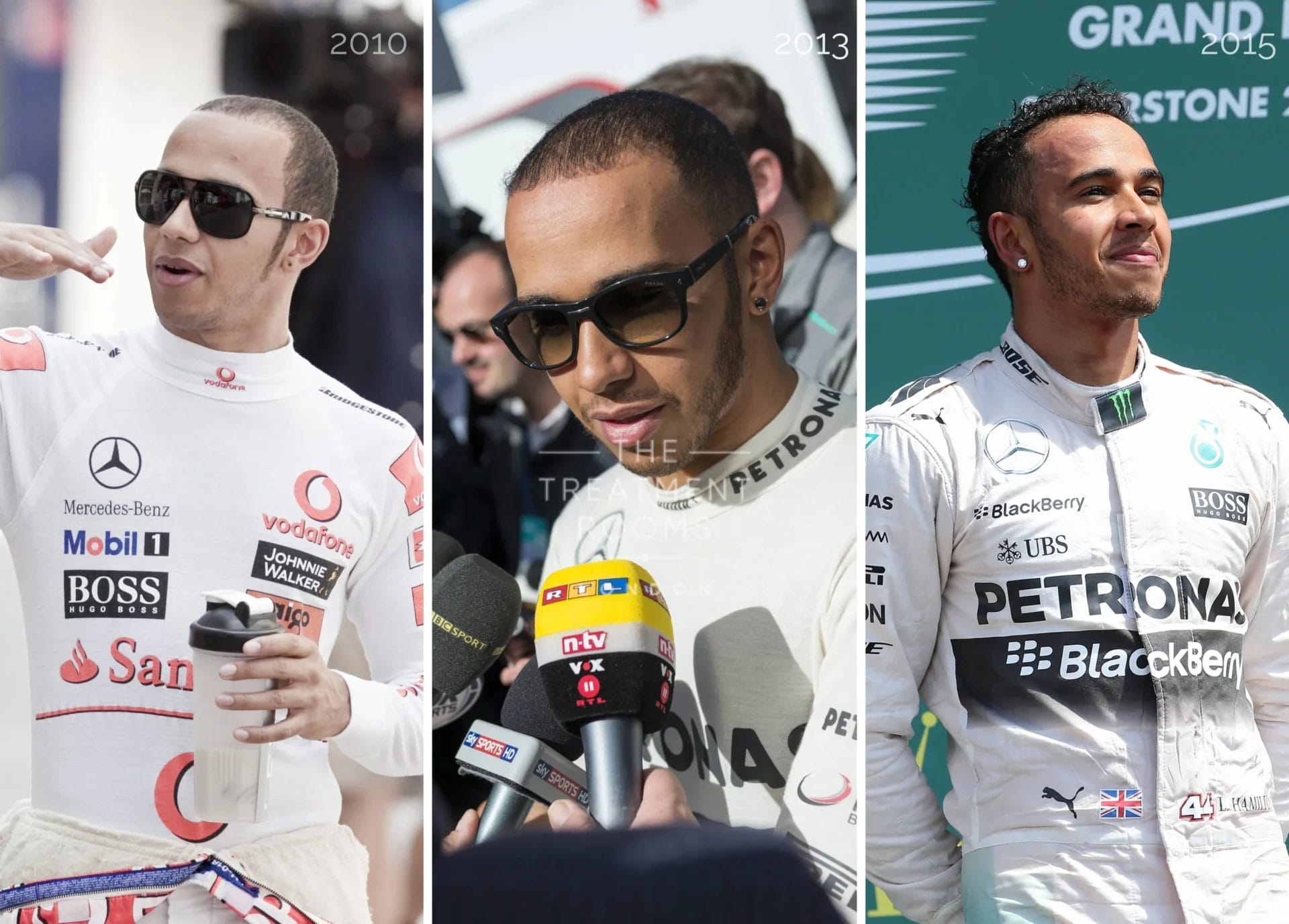
“Looking at the pictures of Lewis Hamilton and his receding hairline, he looks like he was between a Norwood 3 and 4 at a time just before he started treatment for it. This is also a similar level of hair loss that our patients will reach out for help in our clinic.”
Dr Roshan Vara, Co-Founder and Hair Transplant Surgeon at The Treatment Rooms London
Closely Shaven Style In 2015
In 2015, he appeared to have acted on his hair loss, as he presented a closely shaven hairstyle and a better-defined hairline, with thicker hair on the crown and temples. This is despite the hair loss, which had progressed over the previous years.
Biologically, male pattern baldness does not stop by itself, and patients are not likely to grow a thick head of hair with only medical intervention. This level of change in Lewis is likely secondary to a hair transplant procedure.
Available evidence indicates he likely had a hair transplant and opted for the shaven hairstyle to manage the change.
2016 Onwards
During this time, his hair appeared to be visibly fuller along the areas with hair loss.

“The pictures we do have suggest it was a well-planned procedure, and he may have had a minimal shave or unshaven FUE transplant to minimise downtime/presence in public. For our patients who are public figures, this is very important. We will take into consideration their public engagement and map out a plan that allows them to hide the surgery and quickly get back to their roles, whether it be on TV or playing sports”
Dr Roshan Vara, Co-Founder and Hair Transplant Surgeon at The Treatment Rooms London
Are You Inspired by Lewis Hamilton’s Hair Restoration?
If you are wondering if having a hair transplant is the right choice at this stage of your hair loss recovery, it is worth doing your due diligence about your best options and the right clinic if you decide to have one.
If you are in the UK, ensure the clinic is CQC registered and the surgeons are GMC registered as well.
Having a successful hair transplant starts with choosing a qualified and high-quality clinic where your health is prioritised.
The right clinic should advise on the best solution for you and, if a hair transplant is the right choice, advise you on the number of grafts to be harvested, the technique to be used for best results, and address other medical concerns around your suitability for the procedure.
References
- Asfour L, Cranwell W, Sinclair R. Male androgenetic alopecia. [Updated 2023 Jan 25]. In: Feingold KR, Anawalt B, Blackman MR, et al., editors. Endotext [Internet]. South Dartmouth (MA): MDText.com, Inc.; 2000– [cited 2026 Sep 4]. Available from: https://www.ncbi.nlm.nih.gov/books/NBK278957
- Ho CH, Zito PM. Androgenetic alopecia. In: StatPearls [Internet]. Treasure Island (FL): StatPearls Publishing; 2024 [cited 2026 Sep 4]. Available from: https://www.ncbi.nlm.nih.gov/books/NBK430924
- Jimenez F, Alam M, Vogel JE, Avram M. Hair transplantation: basic overview. J Am Acad Dermatol. 2021 Oct;85(4):803–814. doi:10.1016/j.jaad.2021.03.124
Share:
Authored by

Dr Roshan Vara
Dr. Roshan Vara is a renowned hair transplant surgeon in London and the Co-Founder of our award winning hair transplant clinic, The Treatment Rooms London.He has over 10 years of experience in hair transplant surgery and is recognised for delivering natural-looking results through ethical, patient-centred care. He is a Full Medical Member of BAHRS and an Associate Member of ISHRS, reflecting his commitment to the highest standards in modern hair restoration.
Reviewed by

Dr Dilan Fernando
Dr. Dilan Fernando is regarded as one of the best hair transplant surgeons in London and Co-Founder of The Treatment Rooms London. He has over 10 years of experience in hair transplant surgery and is known for his meticulous technique and commitment to ethical practice. He served on the Executive Committee of BAHRS from 2020 to 2024, helping to shape industry standards for patient safety and quality of care. Dr. Fernando personally performs each surgery, ensuring natural results built on trust and experience.
Book a Consultation
Related Blogs

A Guide to the Norwood Hamilton Scale: Understanding Hair Loss Stages
October 19, 2026
Key takeaways: The Norwood scale (also known as the Hamilton-Norwood scale) is the main classification system used…
When Do Scabs Fall Off After Having a Hair Transplant?
October 17, 2026
Key takeaways: Scabs will form immediately after having a hair transplant and should wash away after 7-10…

What Happens If You Stop Using Minoxidil
October 13, 2026
Key Takeaways: If you’ve been consistently applying minoxidil to support your hair growth and have been doing…

Hair Transplant After 7 Days: What To Expect
October 9, 2026
Key takeaways: 7 days after your hair transplant, you can expect to see the scabs in your…

Minoxidil Side Effects: What to Expect, Risks, and How to Manage Them
October 9, 2026
Key takeaways Medications are often a first step people take when tackling pattern baldness. They can help…
What Is A Hair Graft In A Hair Transplant?
October 7, 2026
Key takeaways: What is a Hair Graft in a Hair Transplant? Hair loss can be a distressing…

Widow’s Peak Hair Transplant for Women: Everything You Need to Know
October 6, 2026
Key takeaways: There is no absolute definition of a widow’s peak in women. It is often based…

Has Steve Carell Had a Hair Transplant? What the Evidence Really Shows
October 6, 2026
Key Takeaways Steve Carell is arguably one of the most liked and versatile actors of his generation….

When Can You Drink Alcohol After Your Hair Transplant?
October 6, 2026
Key takeaways: It’s common for our patients to ask us when it is okay to resume drinking…