

Key Takeaways
- Nutrafol is a dietary supplement, not a licensed hair loss medication.
Nutrafol contains plant-based ingredients and vitamins designed to support hair health, but it is not FDA- or MHRA-approved for treating hair loss. - Clinical evidence is modest but encouraging.
Some studies show improvements in hair thickness, density, and reduced shedding, particularly in women with mild to moderate thinning, though independent research remains limited. - Results take time.
If effective, visible changes usually appear after 3–6 months of consistent daily use. Benefits typically continue only as long as the supplement is taken. - It supports multiple hair loss pathways.
Nutrafol targets stress, oxidative damage, inflammation, hormonal balance (DHT), and nutritional deficiencies rather than directly stimulating follicles. - Generally well tolerated, but caution is advised.
Mild digestive upset or acne may occur. Standard formulas are not recommended during pregnancy or breastfeeding (except Nutrafol Postpartum). - Not a cure for baldness.
Established androgenetic alopecia usually requires evidence-based treatments such as Minoxidil or Finasteride. - Best used as part of a broader strategy.
Nutrafol may work best alongside healthy lifestyle habits and, when appropriate, medical treatment.
Hair thinning can feel frustrating and confusing. You might notice more hair falling out in the shower, see more of your scalp when you part your hair, or have a receding hairline, all early signs of hair loss.
Nutrafol is one of the most talked-about hair growth supplements. But before you commit to taking it for several months, it’s important to understand what it actually does and whether it’s likely to help you.
What is Nutrafol?
Nutrafol is an oral hair growth supplement developed by Nutraceutical Wellness Inc. It comes in capsule form, and the manufacturer’s labelled serving size is four capsules per day. Before starting any supplement, you should consider your individual medical history and, where appropriate, speak with a qualified healthcare professional to ensure it’s suitable for you.
Unlike treatments such as minoxidil or finasteride, Nutrafol is not FDA- or MHRA-approved for treating hair loss. It’s classified as a dietary supplement, which means it’s regulated differently from medications.
Nutrafol works from the inside out rather than directly stimulating your hair follicles, as topical treatments do. It provides nutrients, plant compounds, and antioxidants that help your body create a healthier environment for hair growth. This can support your existing hair, reduce shedding, and improve overall hair strength over time.
How Does Nutrafol Work for Hair Growth?
When you experience hair thinning, it’s rarely caused by just one factor. Hormones, stress, inflammation, and nutrition can all play a role. Nutrafol tries to target several of these at once.
Hormones (DHT)
If you have genetic pattern hair loss, a hormone called DHT gradually shrinks your hair follicles. Nutrafol contains saw palmetto, which may mildly reduce DHT activity.3
However, you should know that this effect is much weaker than prescription medications like finasteride.
Stress
If you’ve been under prolonged stress, your hair may shift into the shedding phase more quickly. Nutrafol includes ashwagandha, an adaptogen that may help regulate cortisol levels.4

If your thinning is stress-related, this is where you might see benefit.
Inflammation and Oxidative Stress
Chronic scalp inflammation and oxidative damage can weaken hair over time. Ingredients like curcumin and tocotrienols act as antioxidants, potentially supporting a healthier scalp environment.
Nutritional Support
If your hair thinning is partly related to nutritional deficiencies, vitamins and minerals such as biotin, zinc, and selenium may help support stronger strands.
But here’s the key point: if your hair loss is primarily genetic and advanced, nutritional support alone won’t reverse it.
Does Nutrafol Really Work?
Although many people report positive experiences with Nutrafol online, personal testimonials do not provide reliable evidence of effectiveness. For a clearer picture, it is important to consider clinical research.
One randomised, double-blind, placebo-controlled study examined the safety and effectiveness of Nutrafol for women over six months. The findings suggested that some participants experienced improved hair growth, with the supplement targeting factors such as stress, micro-inflammation, and oxidative damage.2
What are the benefits of Nutrafol ingredients for your hair?
It can be difficult to say exactly how much Nutrafol will help you, mainly because the full ingredient amounts aren’t publicly disclosed, and there isn’t a large body of independent research on the full formula. That said, based on what we know about the individual ingredients, here’s how it may support your hair and what that realistically means for you.
Supports hair follicles
Some ingredients are designed to provide your hair follicles with the nutrients they need to function well. If your follicles are still active but under stress or slightly weakened, you may benefit from creating a healthier environment for growth.
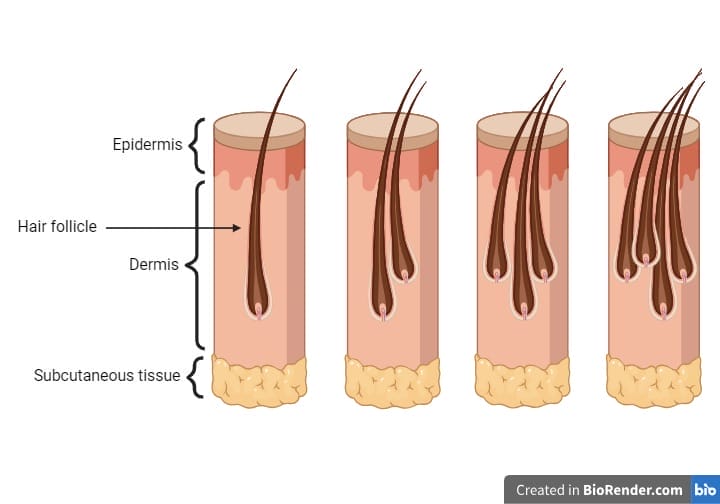
Helping protect against oxidative stress
Your hair follicles are sensitive to inflammation and oxidative stress, which can contribute to thinning over time. The antioxidant ingredients in Nutrafol may help reduce that stress. While this doesn’t guarantee regrowth, it may help protect the hair you currently have.
Encourages a healthier growth cycle
Your hair grows in cycles: a growth phase (anagen) and a resting/shedding phase (telogen). Some ingredients in the formula are thought to support a better balance between these phases. In practical terms, this could mean less excessive shedding and potentially stronger growth over time.
Nutritional gaps
If part of your thinning is linked to low levels of certain vitamins or minerals, the Nutrafol formula may help. Supplements tend to work best when there is an actual deficiency; they are less likely to make a dramatic difference if your levels are already normal.
Stress-related shedding
If stress has triggered increased hair shedding, the adaptogenic ingredients may help your body regulate stress responses. By supporting your stress resilience, you may indirectly reduce stress-related hair fall.
How Long Does Nutrafol Take to Work?
Most Nutrafol studies report visible changes around 3–6 months.5 This aligns with the natural hair cycle. If improvements occur, they typically continue only while the supplement is taken, and stopping usually means returning to baseline shedding patterns.
If no change is seen after six months of consistent use, it is unlikely to start working suddenly.
Nutrafol Side Effects
Most people tolerate Nutrafol well. However, you could experience:
Because it contains saw palmetto, you should avoid it during pregnancy or breastfeeding unless advised by a healthcare professional.
If you’re taking hormone-related medication, speak to a clinician before combining treatments.
Frequently Asked Questions (FAQ)
1. Is Nutrafol authorised by the FDA or the MHRA?
Nutrafol is classified as a dietary supplement and does not require approval from the FDA (U.S.) or the MHRA (UK). By comparison, hair loss medications such as Minoxidil and Finasteride are both FDA- and MHRA-approved, with well-established clinical evidence supporting their effectiveness.
2. Can Nutrafol have sexual side effects for men?
Independent research is limited. Some ingredients, notably saw palmetto, have been associated with potential sexual side effects in other contexts, though this has not been conclusively demonstrated 10
3. Can I take Nutrafol alongside Finasteride?
It is advisable to consult a trichologist or healthcare professional before combining Nutrafol with any hair growth treatment, particularly prescription medications such as Finasteride. While using both together is unlikely to cause harm, it may be unnecessary, as Finasteride alone is generally effective at reducing DHT levels and supporting hair growth.
Conclusion
Studies have shown that Nutrafol can support hair health and scalp coverage in people with mild to moderate thinning. Results are only achieved after consistent use for several months, especially when combined with healthy habits and, where appropriate, medical treatments.
For best outcomes, consider Nutrafol as part of a comprehensive hair restoration plan, not a standalone fix. If you’re unsure whether it’s right for you, do not hesitate to reach out to a dermatologist who can help tailor your regimen to your specific hair loss type.
Reference
- Nutrafol. Nutrafol Women Hair Growth Supplements — Suggested Use. Nutrafol official website. Available from: https://nutrafol.com/products/hair-kit/
- Ablon G, Kogan S. A six‑month, randomized, double‑blind, placebo‑controlled study evaluating the safety and efficacy of a nutraceutical supplement for promoting hair growth in women with self‑perceived thinning hair. J Drugs Dermatol. 2018;17(5):558‑565. Available from: https://jddonline.com/articles/a-six-month-randomized-double-blind-placebo-controlled-study-evaluating-the-safety-and-efficacy-of-a-S1545961618P0558X
- Prager N, Bicknell KA, French D, et al. Natural hair supplement — friend or foe? Saw palmetto and hair loss. Skin Appendage Disord. 2020;6(6):329‑335. Available from: https://karger.com/sad/article‑abstract/6/6/329/295228/Natural‑Hair‑Supplement‑Friend‑or‑Foe‑Saw‑Palmetto
- National Institutes of Health, Office of Dietary Supplements. Ashwagandha (Withania somnifera): Fact Sheet for Health Professionals [Internet]. Bethesda (MD): NIH; 2023 [cited 2026 Feb 6]. Available from: https://ods.od.nih.gov/factsheets/Ashwagandha‑HealthProfessional/
- Nutrafol. Hair Growth Results [Internet]. Nutrafol; 2026 [cited 2026 Feb 6]. Available from: https://nutrafol.com/hair-growth-results/
- Sivamani RK, Ablon G, Nong Y, Maloh J, Hazan A, Raymond I. A prospective, multi‑center study to evaluate the safety and efficacy of a vegan nutraceutical to improve hair growth and quality in females following a plant‑based diet. J Drugs Dermatol. 2024;23(8):661‑668. doi:10.36849/JDD.8421. Available from: https://pubmed.ncbi.nlm.nih.gov/39093662/
- Bhatia N, Ablon G, Farris PK, Hazan A, Raymond I. A randomized, double‑blind, placebo‑controlled study to evaluate the safety and efficacy of a nutraceutical supplement with standardized botanicals in males with thinning hair. J Cosmet Dermatol. 2025;24(1):329‑335. doi:10.1111/jocd.16778. Available from: https://pubmed.ncbi.nlm.nih.gov/39757794/
- Olsen EA, Dunlap FE, Funicella T, Koperski JA, Swinehart JM, Tschen E, et al. A randomized clinical trial of 5% topical minoxidil versus 2% topical minoxidil and placebo in the treatment of androgenetic alopecia in men. J Am Acad Dermatol. 2002;47(3):377‑385. doi: 10.1067/mjd.2002.124754. Available from: https://pubmed.ncbi.nlm.nih.gov/12196747/
- Kaufman KD, Olsen EA, Whiting D, Savin R, DeVillez R, Bergfeld W, et al. Finasteride in the treatment of men with androgenetic alopecia. J Am Acad Dermatol. 1998;39(4 Pt 1):578‑589. doi: 10.1016/s0190-9622(98)70202-0. Available from: https://pubmed.ncbi.nlm.nih.gov/9787860/
- Favalli EG, Biggioggero M, Crotti C, et al. Safety of saw palmetto extract: critical evaluation of pharmacovigilance data and published clinical studies. Br J Clin Pharmacol. 2021;87(1):14‑24. doi:10.1111/bcp.15129. Available from: https://bpspubs.onlinelibrary.wiley.com/doi/10.1111/bcp.15129
Share:
Authored by

Dr Roshan Vara
Dr. Roshan Vara is a renowned hair transplant surgeon in London and the Co-Founder of our award winning hair transplant clinic, The Treatment Rooms London.He has over 10 years of experience in hair transplant surgery and is recognised for delivering natural-looking results through ethical, patient-centred care. He is a Full Medical Member of BAHRS and an Associate Member of ISHRS, reflecting his commitment to the highest standards in modern hair restoration.
Reviewed by

Dr Dilan Fernando
Dr. Dilan Fernando is regarded as one of the best hair transplant surgeons in London and Co-Founder of The Treatment Rooms London. He has over 10 years of experience in hair transplant surgery and is known for his meticulous technique and commitment to ethical practice. He served on the Executive Committee of BAHRS from 2020 to 2024, helping to shape industry standards for patient safety and quality of care. Dr. Fernando personally performs each surgery, ensuring natural results built on trust and experience.
Book a Consultation
Related Blogs

Jude Law Hair Transplant: Before, After, and His New Hairline
March 31, 2026
Jude Law, the British actor known for roles in The Talented Mr Ripley, Sherlock Holmes, and Fantastic…
Hair Loss In Your 20s- What You Need To Know
March 24, 2026
Key Takeaways Hair thinning or excessive hair shedding in your 20s is often due to genetics, stress,…
How Long Does a Hair Transplant Take? The Average FUE & FUT Surgery Duration Explained
March 24, 2026
Key Takeaways Are you considering a hair transplant and wondering how long the process takes? The answer…

Steve Carell Hair Transplant: Before, After, and His New Hairline
March 2, 2026
Steve Carell, best known as Michael Scott in The Office, began sparking curiosity amongst fans when his…

Peppermint oil for hair growth: Evidence, Benefits, Uses & Safety
February 24, 2026
Key Takeaways What Is Peppermint Oil? Peppermint oil, also known as Mentha piperita oil, is an essential…

Why Winter Hair Loss Happens and All You Need to Know
February 6, 2026
Key Takeaways As temperatures drop and indoor heating kicks in, many people notice their hair feels drier,…

Can You Take Finasteride With Minoxidil For Hair Loss?
February 5, 2026
Key Takeaways Consistency Matters: Stopping treatment often leads to a recurrence of hair loss; ongoing medical guidance…
Does Finasteride Cause Erectile Dysfunction?
February 3, 2026
Key Takeaways Finasteride can cause erectile dysfunction in some men, but it isn’t common. Most men who…
What is a Hair Transplant? How it Works, Success Rate & What to Expect
February 2, 2026
Key Takeaways Cost: Varies from £3,000 to £10,000, depending on the number of grafts and the technique….