

Quick Summary: What is Retrograde Alopecia?
- Retrograde alopecia: A distinct form of hair loss affecting the nape of the neck, above the ears and sometimes the temples. This type of alopecia is different from male or female pattern baldness.
- Causes: May include genetic factors, hormonal imbalances, autoimmune disorders, and external factors like tight hairstyles or infections.
- Diagnosis: Scalp examination, dermoscopy, and sometimes a biopsy can confirm the condition and help to understand its severity.
- Treatment options: Topical treatments like minoxidil, corticosteroids for autoimmune responses, and hair transplant surgery in severe cases can treat this type of hair loss.
- Lifestyle modifications: Avoiding tight hairstyles, lowering stress, and maintaining a healthy diet can support hair health and prevent further damage.
Hair loss can be a source of significant distress, and understanding its various forms is crucial for effective treatment. One less commonly discussed condition is retrograde alopecia, a type of hair loss that affects the nape of the neck and the sides of the scalp. This article delves into the intricacies of retrograde alopecia, exploring its causes, how it differs from other types of hair loss, and the treatment options available.
Understanding Retrograde Alopecia
Retrograde alopecia is a form of hair loss that occurs along the perimeter of the scalp, particularly at the nape of the neck, above the ears and sometimes at the temples. It shares some similarities with male-pattern hair loss—such as its gradual onset after puberty, increased vellus-like hair, and decreased terminal hair. However, unlike androgenetic alopecia, which primarily affects the crown and hairline, retrograde alopecia involves hair thinning or complete hair loss in a band-like pattern at the back of the head, with hair loss progressing up the back of the head. Furthermore, it affects areas beyond the defined borders of the Norwood Hamilton hair loss chart1,2.
How is Retrograde Alopecia Different?
While most people are familiar with male or female pattern baldness (androgenetic alopecia), retrograde alopecia presents a unique pattern of hair loss affecting the following areas:
- Nape of the neck
- Above and in front of the ears
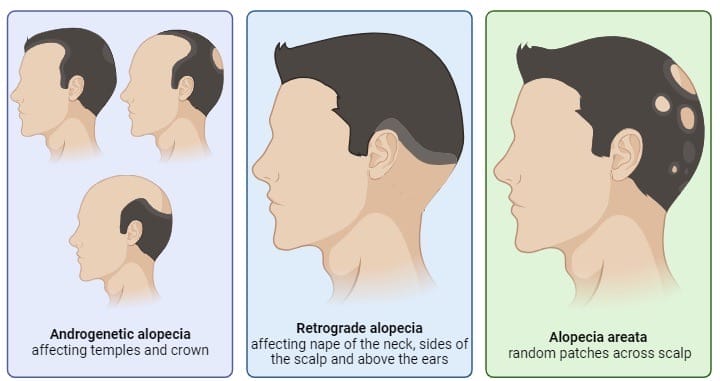
Explore some of our comprehensive blogs below to learn more about other types of hair loss and their unique characteristics:
- Androgenetic Alopecia: The most common form of hair loss, also known as male or female pattern baldness, influenced by genetics and hormones.
- Traction Alopecia: Hair loss caused by continuous pulling or tension on the hair, often due to tight hairstyles like braids or ponytails.
- Trichotillomania: A mental health condition that causes people to have an overwhelming desire to pull out their hair. This can include hair from the scalp, eyebrows, eyelashes or other areas of the body.
- Alopecia Areata: An autoimmune disorder where the body’s immune system attacks hair follicles, leading to patchy hair loss anywhere on the scalp.
- Alopecia Universalis: A more severe form of alopecia areata, resulting in complete hair loss on the scalp and body.
- Telogen Effluvium: A temporary hair loss condition triggered by stress, illness, or hormonal changes, where a large number of hairs enter the shedding phase.
- Temporal Triangular Alopecia: A rare, non-scarring form of hair loss that typically presents as a triangular or oval patch of fine, vellus hair in the temporal region. It commonly appears in childhood and is believed to be congenital, meaning present at birth.
Causes of Retrograde Alopecia
The exact cause of retrograde alopecia is not well understood, but it is believed to be related to factors that affect hair follicles’ health and function.
- Genetic Factors: Genetics play a significant role in many forms of hair loss, including retrograde alopecia. Individuals with a family history of hair loss, particularly those with relatives who share similar hair loss patterns, may be more predisposed to develop retrograde alopecia.
- Hormonal Influence: Hormones, particularly androgens, influence hair growth cycles. While retrograde alopecia is not as strongly linked to androgens as androgenetic alopecia, hormonal imbalances could contribute to the weakening of hair follicles along the scalp’s perimeter.
- Autoimmune Disorders: In some cases, retrograde alopecia may be associated with autoimmune disorders, in which the body’s immune system mistakenly attacks hair follicles. This autoimmune response can lead to the gradual thinning or loss of hair along the occipital region and other affected areas.
- External Factors: External factors such as traction (from tight hairstyles), scalp infections, and chronic irritation can also contribute to retrograde alopecia. Repeated stress on hair follicles due to tight ponytails, braids, or other hairstyles can weaken the hair shaft and lead to hair loss over time3.
Diagnosing Retrograde Alopecia
Accurate diagnosis is key to effectively managing retrograde alopecia. A dermatologist or hair-loss specialist will typically begin with a thorough medical history and a physical examination of the scalp. Specific diagnostic methods may include:
- Scalp Examination: A close examination of the scalp helps identify the pattern and extent of hair loss. In retrograde alopecia, thinning hair is often observed in a band-like pattern around the nape of the neck and occasionally above and in front of the ears.
- Dermoscopy: A non-invasive imaging technique that allows specialists to examine the scalp’s surface closely. This method helps assess the health of hair follicles and the presence of inflammation or scarring that might indicate retrograde alopecia.
- Biopsy: In some cases, a scalp biopsy may be necessary to confirm the diagnosis. A small sample of scalp tissue is taken and examined under a microscope to determine the exact cause of hair loss, such as the presence of inflammation or changes in the hair follicles4.
Treatment Options for Retrograde Alopecia
Once diagnosed, treatment for retrograde alopecia aims to halt further hair loss and, in some cases, stimulate regrowth. Treatment options vary depending on the severity and underlying cause of the condition.
- Topical Treatments: Minoxidil may help stimulate hair growth in areas affected by retrograde alopecia. While it is more commonly used for androgenetic alopecia, minoxidil can be effective in promoting hair growth by increasing the blood flow to hair follicles5.
- Corticosteroids: For cases of retrograde alopecia linked to autoimmune responses, corticosteroids may be prescribed. These anti-inflammatory medications can reduce the immune system’s attack on hair follicles, thereby slowing or stopping hair loss. Corticosteroids can be administered topically, orally, or via injections directly into the affected area.
- Hair Transplant Surgery: In more advanced cases of significant hair loss, hair transplant surgery may be considered. This procedure involves transplanting hair follicles from a donor area (typically the back or sides of the scalp) to the thinning or balding regions affected by retrograde alopecia. Hair transplant surgery is often considered when other treatments have not been effective6.
- Lifestyle Modifications: Addressing external factors that contribute to hair loss is also crucial. For instance, avoiding tight hairstyles, reducing the use of harsh hair treatments, and maintaining a healthy diet rich in vitamins and minerals can help support overall hair health and prevent further damage to hair follicles.
Hair Transplant donor area considerations when you have retrograde alopecia
If retrograde alopecia has significantly affected the sides and back of the scalp, where donor hair is typically harvested for transplantation, it becomes challenging to harvest enough healthy hair follicles to achieve successful, natural-looking results.
This is important for long-term planning of hair-loss goals if you wish to undergo a hair transplant, as you may have less hair available in the donor area for future surgery.
Ultimately, for patients with severe retrograde alopecia, a hair transplant may not be a viable option due to the lack of sufficient donor hair.
Conclusion
Retrograde alopecia is a distinct form of hair loss that affects the nape of the neck and sometimes the temple area above and in front of the ears. While the exact cause is not entirely understood, genetic factors, hormonal influences, autoimmune disorders, and external factors all play a role. Accurate diagnosis and tailored treatment are essential for managing this condition effectively. Whether through topical therapies, corticosteroids, or hair transplant surgery, there are options available to help those affected by retrograde alopecia.
References
- Abbasi, A. and Avram, M. (2021) ‘Retrograde Androgenetic Alopecia’,Dermatologic Surgery, 47(11), pp. 1521-1522. Available at: https://journals.lww.com/dermatologicsurgery/citation/2021/11000/retrograde_androgenetic_alopecia.32.aspx
- Mohamed, A., Al Khalawany, M., & Abdalkarim, I. (2023) ‘Retrograde Alopecia: Prevalence, Patterns, Dermoscopic Features among Egyptian Men: A Cross-Sectional Study’, International Journal of Medical Arts, 5(5), pp. 3286-3290. Available at: https://ijma.journals.ekb.eg/article_307064.html
- Gokce N, Basgoz N, Kenanoglu S, Akalin H, Ozkul Y, Ergoren MC, Beccari T, Bertelli M, Dundar M. (2022) ‘An overview of the genetic aspects of hair loss and its connection with nutrition’, J Prev Med Hyg, 63(suppl.3), pp. E228-E238. Available at: https://doi.org/10.15167/2421-4248/jpmh2022.63.2S3.2765
- Sperling, L. C. (2023) ‘The role of the scalp biopsy in the evaluation of alopecia’, Journal of the American Academy of Dermatology, 89(2S), pp. S16–S19. Available at: https://doi.org/10.1016/j.jaad.2023.05.047
- Minoxidil for hair loss (no date) NHS Choices. Available at: https://www.gloshospitals.nhs.uk/your-visit/patient-information-leaflets/minoxidil-for-hair-loss-ghpi1649/
- Rassman, W.R. et al. (2002) ‘Follicular unit extraction: Minimally invasive surgery for hair transplantation’, Dermatologic Surgery, 28(8), pp. 720–728. Available at: https://pubmed.ncbi.nlm.nih.gov/12174065/
Share:
Authored by

Dr Roshan Vara
Dr. Roshan Vara is a renowned hair transplant surgeon in London and the Co-Founder of our award winning hair transplant clinic, The Treatment Rooms London.He has over 10 years of experience in hair transplant surgery and is recognised for delivering natural-looking results through ethical, patient-centred care. He is a Full Medical Member of BAHRS and an Associate Member of ISHRS, reflecting his commitment to the highest standards in modern hair restoration.
Reviewed by

Dr Dilan Fernando
Dr. Dilan Fernando is regarded as one of the best hair transplant surgeons in London and Co-Founder of The Treatment Rooms London. He has over 10 years of experience in hair transplant surgery and is known for his meticulous technique and commitment to ethical practice. He served on the Executive Committee of BAHRS from 2020 to 2024, helping to shape industry standards for patient safety and quality of care. Dr. Fernando personally performs each surgery, ensuring natural results built on trust and experience.
Book a Consultation
Related Blogs

What Is Nutrafol and Does It Really Work for Hair Growth?
February 24, 2026
Key Takeaways Hair thinning can feel frustrating and confusing. You might notice more hair falling out in…

Peppermint oil for hair growth: Evidence, Benefits, Uses & Safety
February 24, 2026
Key Takeaways What Is Peppermint Oil? Peppermint oil, also known as Mentha piperita oil, is an essential…

Why Winter Hair Loss Happens and All You Need to Know
February 6, 2026
Key Takeaways As temperatures drop and indoor heating kicks in, many people notice their hair feels drier,…

Can You Take Finasteride With Minoxidil For Hair Loss?
February 5, 2026
Key Takeaways Consistency Matters: Stopping treatment often leads to a recurrence of hair loss; ongoing medical guidance…
Does Finasteride Cause Erectile Dysfunction?
February 3, 2026
Key Takeaways Finasteride can cause erectile dysfunction in some men, but it isn’t common. Most men who…
What is a Hair Transplant? How it Works, Success Rate & What to Expect
February 2, 2026
Key Takeaways Cost: Varies from £3,000 to £10,000, depending on the number of grafts and the technique….
What Causes Hair Loss During Menopause?
February 2, 2026
Key Takeaways Many women notice increased hair shedding and thinning during menopause. This happens because hormonal changes…

Can a Norwood 7 Get a Hair Transplant? All You Need to Know
February 2, 2026
Key Takeaways Yes, someone with Norwood 7 hair loss may be able to have a hair transplant,…
The Healthy Hair Diet: What to Eat, Drink and Avoid
February 1, 2026
Key Takeaways Strong, shiny hair is an indicator of good health. Although genetics, hormones, and age also…