

Key Takeaways
- How They Work: Finasteride lowers DHT, slowing follicle shrinkage, while minoxidil directly stimulates hair follicles to thicken and quicken hair growth
- Effectiveness: Men with androgenetic alopecia benefit most from finasteride, with minoxidil supporting continued growth. Women usually use minoxidil, with finasteride considered mostly in post-menopausal cases under specialist supervision.
- Combination Therapy: Using both together provides complementary effects, offering better results than either alone.
- Treatment Timeline: Initial shedding may occur in 1–2 months, regrowth appears by 2–4 months, density improves by 6 months, and full results are typically seen at 12 months.
- Safety & Side Effects: Finasteride can cause sexual side effects and rare mood changes; minoxidil may cause mild scalp irritation or temporary shedding. Pregnant women and those with certain health conditions should avoid these treatments.
Consistency Matters: Stopping treatment often leads to a recurrence of hair loss; ongoing medical guidance is important for the best results.
Hair loss affects millions of men and women worldwide and can have a significant emotional and psychological impact. Two of the most widely used and clinically studied treatments for pattern hair loss are finasteride and minoxidil1 . While both medications are proven to help slow hair loss and promote regrowth, they work in very different ways, which often leads to confusion about which option is better.
Finasteride targets the hormonal cause of hair loss, while minoxidil stimulateshair growth at the follicle level. Because of these complementary mechanisms, many clinicians now recommend using both together, particularly for male pattern baldness (androgenetic alopecia), and research consistently shows that Finasteride and Minoxidil combination therapy delivers better long-term results than either treatment alone.2
What Is the Difference Between Finasteride and Minoxidil?
Although finasteride and minoxidil are often mentioned together, they are not interchangeable treatments. Each medication addresses a different part of the hair loss process, which affects how and when they are used.
Understanding this difference helps explain why some people respond better to one treatment, why others need both, and why expectations around results can vary.
How Finasteride Works
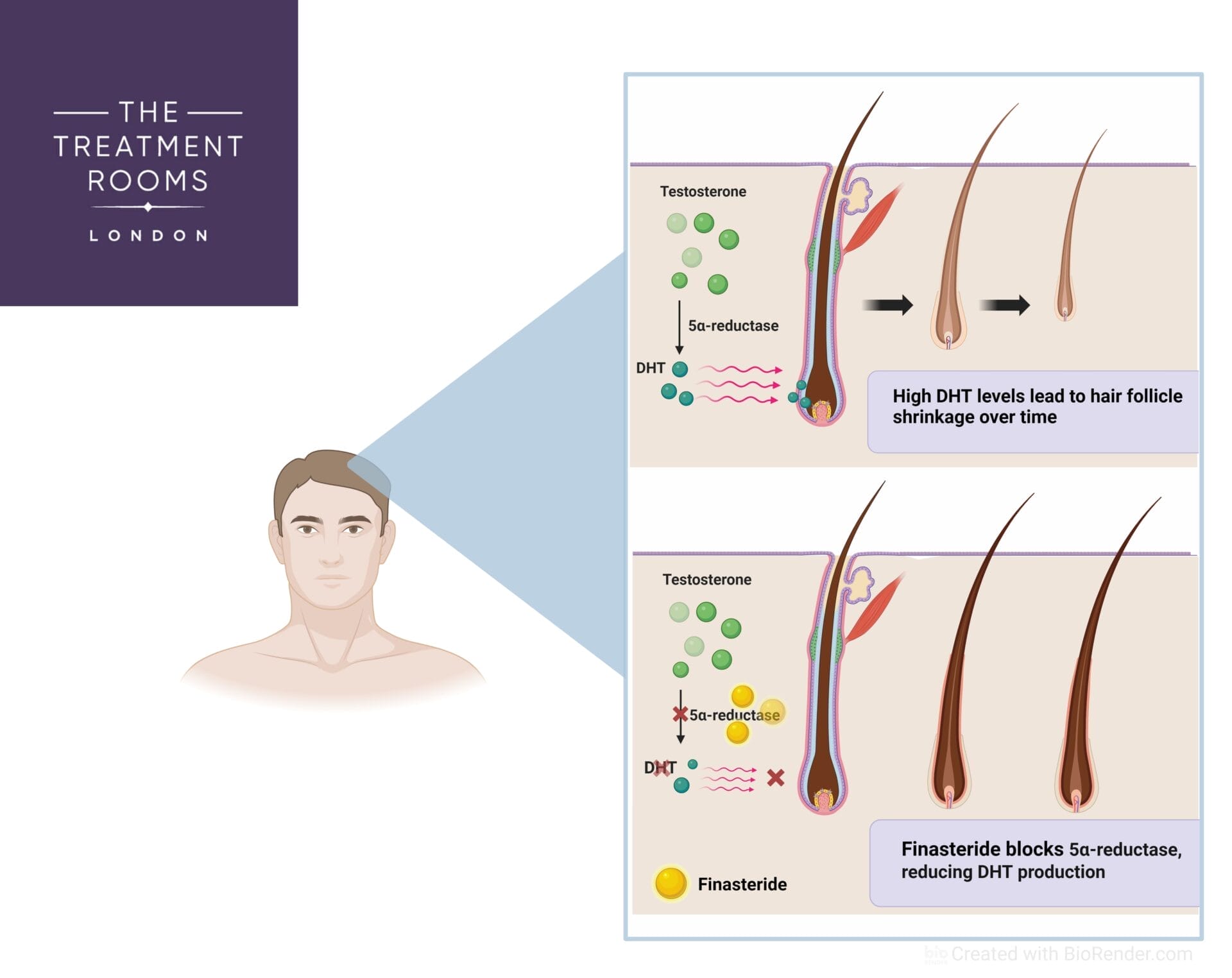
Finasteride treats hair loss by addressing the underlying cause of balding and thinning. The most common type of hair loss is androgenetic alopecia. In this condition, the hormone involved is DHT (dihydrotestosterone), which causes hair thinning and shedding over time. DHT is a by-product of testosterone, and in people who are genetically sensitive to it, it causes hair follicles to gradually shrink in the hairline, temples and crown. As the follicles become smaller, hairs grow thinner, weaker, and eventually stop growing altogether.
Finasteride works by blocking 5-alpha reductase, an enzyme that converts testosterone into DHT. By reducing scalp DHT levels, finasteride helps slow or stop further hair loss, supports the preservation of existing hair, and can improve hair thickness over time in some people.
Finasteride is most commonly taken as a 1 mg oral tablet once a day and marketed under brand names like Propecia) and is only available with a prescription.
It is FDA and Medicines and Healthcare products Regulatory Agency (MHRA) approved for the treatment of male pattern baldness, and it is not routinely prescribed to women, particularly those who are pregnant or trying to conceive, due to potential hormonal and pregnancy-related risks.
How Minoxidil Works
Minoxidil works differently from finasteride. Rather than affecting hormones, it acts directly on the scalp and hair follicles. It helps widen tiny scalp blood vessels, improving blood flow. This allows more oxygen and nutrients to reach the hair follicles, creating a healthier environment for hair growth.
By improving blood supply to the scalp, minoxidil helps keep hairs in their active growth phase longer, encourages dormant or weakened follicles to resume producing hair, and can gradually increase hair thickness and overall density with consistent use.
Minoxidil is most commonly used as a topical treatment, available as a foam or liquid solution in strengths of 2% or 5%. The topical form is available over the counter without a prescription and is approved for use in both men and women.
In some cases, minoxidil may also be prescribed as an oral medication, but this is considered off-label use and should only be taken under medical supervision due to potential side effects.
Many of my patients take Finasteride and Minoxidil to help manage their long-term risk of hair loss. Every consultation I have with my patients, I will take them through the considerations of these medications if they are not taking them already.
Dr Fernando, Co-founder and Surgeon at the Treatment Rooms London
Can You Use Finasteride and Minoxidil Together?
Yes, you can use Finasteride and Minoxidil together, and for many patients, this is the most effective approach. These two medications work in different ways; their effects complement each other rather than overlap, making combination therapy more effective than either treatment alone.
Other Combination Options Available
Some patients may not fully respond to the standard oral finasteride + topical minoxidil regimen, or they may prefer alternatives for convenience or tolerability.
They include;
- Topical minoxidil with added topical finasteride
- Compounded oral tablets containing both drugs
While both medications are FDA-approved individually, compounded combination products are not approved as single formulations, though they are commonly prescribed.
Which Is More Effective for Hair Loss?
The effectiveness of finasteride and minoxidil depends on the type of hair loss and whether the patient is male or female.
For Men With Androgenetic Alopecia
In men with male pattern baldness, finasteride is generally more effective at slowing or stopping further hair loss because it reduces DHT, the hormone that causes follicle shrinkage. Minoxidil supports hair regrowth by improving hair thickness and density.
Studies show that combining finasteride and minoxidil results in greater improvements in hair density, hair diameter, and overall hair response than either treatment alone. 1
For Female Pattern Hair Loss
For women with pattern hair loss, minoxidil is the preferred first-line treatment. It promotes hair growth without affecting hormones and is suitable for long-term use. Finasteride may be considered in limited cases, such as post-menopausal women, but only under specialist supervision. It is not recommended during pregnancy or for women who could become pregnant due to the risk of harm to a developing foetus.
Which Should I Choose?
| Hair Loss Type | Recommended Treatment | Notes |
| Male Pattern Hair Loss (Androgenetic Alopecia) | Finasteride ± Minoxidil | Finasteride slows thinning; minoxidil supports regrowth. A combination often works best. |
| Female Pattern Hair Loss | Minoxidil | First-line option. Finasteride may be considered only in post-menopausal women under specialist supervision. |
| Telogen Effluvium (temporary shedding) | Minoxidil | Stimulates follicles while underlying cause (stress, illness, hormonal change) resolves. |
| Alopecia Areata (patchy autoimmune hair loss) | Minoxidil | Can encourage regrowth; finasteride is not effective. Additional therapies may be needed. |
| Chemotherapy-Induced Hair Loss | Minoxidil | Helps accelerate regrowth once treatment is complete. Finasteride is not used. |
| Beard or Eyebrow Hair Loss | Minoxidil | Encourages thicker growth in targeted areas. Finasteride has no effect here. |
Side Effects of Finasteride and Minoxidil
Finasteride Side Effects
Most men take finasteride without significant issues, but a small percentage may experience side effects, particularly in the early months of treatment or at higher doses. In many cases, symptoms improve or resolve after stopping the medication.
Potential side effects include:
- Reduced libido
- Erectile dysfunction
- Reduced ejaculatory volume
- Mood changes (rare)
- Breast tissue changes (very rare)
Side effects are dose-dependent and more common with higher doses.
Minoxidil Side Effects
Topical minoxidil is generally well tolerated because it works locally on the scalp rather than affecting hormones or being widely absorbed into the bloodstream.
When applied as directed, only a small amount enters the body, which limits the risk of systemic side effects. For this reason, most reactions are confined to the scalp and are usually temporary, especially during the early weeks of treatment.
Topical minoxidil side effects include:
- Scalp irritation or dryness
- Temporary increased shedding at the start
- Unwanted hair growth if applied incorrectly
Oral minoxidil has more side effects than the topical version of Minoxidil. This is because the tablet acts on the whole body. As a result, side effects of oral Minoxidil include:
- Fluid retention
- Headaches
- Low blood pressure
- Palpitations
- Increased body hair growth
How Long Do Results Take?
Hair growth is a gradual process, so it takes time to see the full effects of finasteride and minoxidil being used together.
Everyone responds differently, but most people follow a predictable pattern of shedding, early regrowth, and gradual thickening. Understanding the typical timeline can help set realistic expectations and encourage consistency with treatment.
Typical Timeline
- 1–2 months: Possible increased shedding (normal and temporary)
- 2–4 months: Early signs of regrowth
- 6 months: Noticeable improvement in density
- 12 months: Full visible results
Stopping either treatment usually leads to a recurrence of hair loss within months.
Who should avoid using both finasteride and minoxidil?
The following people should avoid using the combination because of the reasons listed below;
1. Women who are pregnant, breastfeeding, or trying to conceive because of possible birth defects
2. Individuals with liver disorders
3. Individuals who have had depression or sexual dysfunction in the past- Finasteride can increase these problems.
4. Individuals who have cardiac conditions- Oral minoxidil can be dangerous.
5. People who lose non-hormonal hair loss (e.g. alopecia areata) – Finasteride will have little chance of working.
6. Any person known to have an allergy to either Finasteride or Minoxidil- Use is not recommended.
Are there alternatives to using both treatments?
Yes, there are alternatives to finasteride and minoxidil for hair loss, but they might not work as well for everyone or have a greater risk of side effects. The alternatives include;
- Dutasteride: It has a greater effect in reducing DHT levels than Finasteride and can theoretically cause more side effects than Finasteride.
- Low-level laser therapy can stimulate hair follicles with specific wavelengths of light.
- Platelet-Rich Plasma (PRP) therapy: PRP involves injecting high levels of enriched platelets from your blood into the scalp, which can promote hair growth.
- Spironolactone: The drug may also be used off-label in the treatment of hair loss in women, especially in cases of androgenetic alopecia.
- Ketoconazole shampoo: This shampoo, traditionally taken as a therapy against dandruff, will also be able to reduce inflammation and, perhaps, enhance hair growth.
- Lifestyle Changes: Stress, dietary management, and application of suitable hair care products have a positive effect on hair health.
Summary
Finasteride and minoxidil remain the gold standard treatments for pattern hair loss. While finasteride targets the hormonal cause of thinning hair, minoxidil stimulates follicle activity and regrowth. Used together, they offer the best chance of slowing hair loss, maintaining density, and encouraging regrowth, particularly for men with androgenetic alopecia.
Early treatment, consistency, and proper medical guidance are key. Before starting either medication, it’s always advisable to consult a qualified healthcare professional or hair loss specialist to ensure the treatment is appropriate and safe for you.
References
- Chen, L., Zhang, J., Wang, L., Wang, H. & Chen, B. (2020) ‘The efficacy and safety of finasteride combined with topical minoxidil for androgenetic alopecia: a systematic review and meta‑analysis’, Aesthetic Plastic Surgery, 44, pp. 962–970. Available at: https://doi.org/10.1007/s00266-020-01621-5 (Accessed: 26 July 2025)
- Harris, S., 2024. Finasteride Takes on Minoxidil for Female Pattern Hair Loss. MedPage Today. Available at: https://www.medpagetoday.com/reading-room/aad/general-dermatology/109705 [Accessed 23 Jul. 2025].
- Hindley, D., Dawe, R., Green, A. and Sinclair, R. (2023) ‘Effectiveness of combined oral minoxidil and finasteride in male androgenetic alopecia: a retrospective service evaluation’, Cureus, 15(10), e46989. Available at: https://www.cureus.com/articles/330964-effectiveness-of-combined-oral-minoxidil-and-finasteride-in-male-androgenetic-alopecia-a-retrospective-service-evaluation (Accessed: 23 July 2025).
- Hu, R., Xu, F., Sheng, Y., Qi, S., Han, Y., Miao, Y., Rui, W. & Yang, Q. (2015) ‘Combined treatment with oral finasteride and topical minoxidil in male androgenetic alopecia: a randomized and comparative study in Chinese patients’, Dermatologic Therapy, 28(5), pp. 303–308. DOI: 10.1111/dth.12246. PMID: 26031764. Available at: https://pubmed.ncbi.nlm.nih.gov/26031764/ (Accessed: 26 July 2025).
- International Society of Hair Restoration Surgery (ISHRS) (2024) Minoxidil – treatment, effectiveness and side effects. Available at: https://www.ishrs.org/patients/treatments-for-hair-loss/medications/minoxidil/ (Accessed: 26 July 2025).
- LloydsPharmacy Online Doctor, 2023. Using finasteride and minoxidil together. [online] Available at: https://onlinedoctor.lloydspharmacy.com/uk/hair-loss-advice/using-finasteride-and-minoxidil-together [Accessed 23 Jul. 2025].
- Mysore, V. (2012) ‘Finasteride and sexual side effects’, Indian Journal of Dermatology, 57(5), pp. 411–412. Available at: https://www.ncbi.nlm.nih.gov/pmc/articles/PMC3481923/ (Accessed: 23 July 2025).
- NHS, 2023. How and when to take finasteride. [online] NHS. Available at: https://www.nhs.uk/medicines/finasteride/how-and-when-to-take-finasteride/ [Accessed 23 Jul. 2025].
- ScienceDirect (n.d.) Minoxidil – an overview. Available at: https://www.sciencedirect.com/topics/chemistry/minoxidil (Accessed: 26 July 2025).
Share:
Authored by

Dr Roshan Vara
Dr. Roshan Vara is a renowned hair transplant surgeon in London and the Co-Founder of our award winning hair transplant clinic, The Treatment Rooms London.He has over 10 years of experience in hair transplant surgery and is recognised for delivering natural-looking results through ethical, patient-centred care. He is a Full Medical Member of BAHRS and an Associate Member of ISHRS, reflecting his commitment to the highest standards in modern hair restoration.
Reviewed by

Dr Dilan Fernando
Dr. Dilan Fernando is regarded as one of the best hair transplant surgeons in London and Co-Founder of The Treatment Rooms London. He has over 10 years of experience in hair transplant surgery and is known for his meticulous technique and commitment to ethical practice. He served on the Executive Committee of BAHRS from 2020 to 2024, helping to shape industry standards for patient safety and quality of care. Dr. Fernando personally performs each surgery, ensuring natural results built on trust and experience.
Book a Consultation
Related Blogs

Steve Carell Hair Transplant: Before, After, and His New Hairline
March 2, 2026
Steve Carell, best known as Michael Scott in The Office, began sparking curiosity amongst fans when his…

What Is Nutrafol and Does It Really Work for Hair Growth?
February 24, 2026
Key Takeaways Hair thinning can feel frustrating and confusing. You might notice more hair falling out in…

Peppermint oil for hair growth: Evidence, Benefits, Uses & Safety
February 24, 2026
Key Takeaways What Is Peppermint Oil? Peppermint oil, also known as Mentha piperita oil, is an essential…

Why Winter Hair Loss Happens and All You Need to Know
February 6, 2026
Key Takeaways As temperatures drop and indoor heating kicks in, many people notice their hair feels drier,…
Does Finasteride Cause Erectile Dysfunction?
February 3, 2026
Key Takeaways Finasteride can cause erectile dysfunction in some men, but it isn’t common. Most men who…
What is a Hair Transplant? How it Works, Success Rate & What to Expect
February 2, 2026
Key Takeaways Cost: Varies from £3,000 to £10,000, depending on the number of grafts and the technique….
What Causes Hair Loss During Menopause?
February 2, 2026
Key Takeaways Many women notice increased hair shedding and thinning during menopause. This happens because hormonal changes…

Can a Norwood 7 Get a Hair Transplant? All You Need to Know
February 2, 2026
Key Takeaways Yes, someone with Norwood 7 hair loss may be able to have a hair transplant,…
The Healthy Hair Diet: What to Eat, Drink and Avoid
February 1, 2026
Key Takeaways Strong, shiny hair is an indicator of good health. Although genetics, hormones, and age also…