

Key Takeaways
- Some shedding is normal. Hair loss in the shower is usually normal and part of the natural hair growth cycle.
- Most people lose around 50–100 hairs per day, and this can look like more on wash days because loose hairs are released together.
- Shampooing does not cause hair to fall out; it only releases hair that was already ready to shed.
- Patterns matter more than single days. Long-term shedding, visible thinning, or changes to the hairline may signal an underlying issue. Patients shouldn’t worry about day-to-day fluctuations of hair shedding in the shower.
- Certain conditions increase shedding; telogen effluvium and patterned hair loss are examples of long-term hair loss conditions that patients should be investigated for.
- If changes persist for more than 6 months, a GP or dermatologist can help identify the cause.
Seeing strands of hair in the shower can feel alarming, especially when they seem to collect around the drain. The good news is that some hair loss in the shower is completely normal. In most cases, what you are seeing is simply hair that has already finished its natural growth cycle and is being released during washing.
So, how much is normal? And when should you be concerned? This guide explains the hair growth cycle, what typical shedding looks like, and how to tell the difference between harmless shedding and true hair loss.
Is Hair Falling Out in the Shower Normal?
For most people, hair shedding in the shower is a normal part of the hair growth cycle.
On average, people lose 50 to 100 hairs per day. Some dermatology sources place this slightly higher, especially on wash days, when loose hairs are more likely to come out in clumps.¹
You may not notice these hairs during the day because many fall out gradually. In the shower, however, water, shampoo, and scalp massage loosen hairs that are ready to shed. This can make the amount feel sudden, even when it is not.
In other words, washing doesn’t cause the hair to fall; it just helps release hair that was already at the end of its cycle.
Why We Naturally Shed Hair
To understand why shedding happens, it helps to know how hair grows in the first place.
Each hair follicle follows a repeating growth cycle:
- Anagen (Growth): The active phase where hair grows
- Catagen (Transition): A short phase where growth slows.
- Telogen (Rest/Shed): The phase where the hair eventually falls out to make room for new growth.
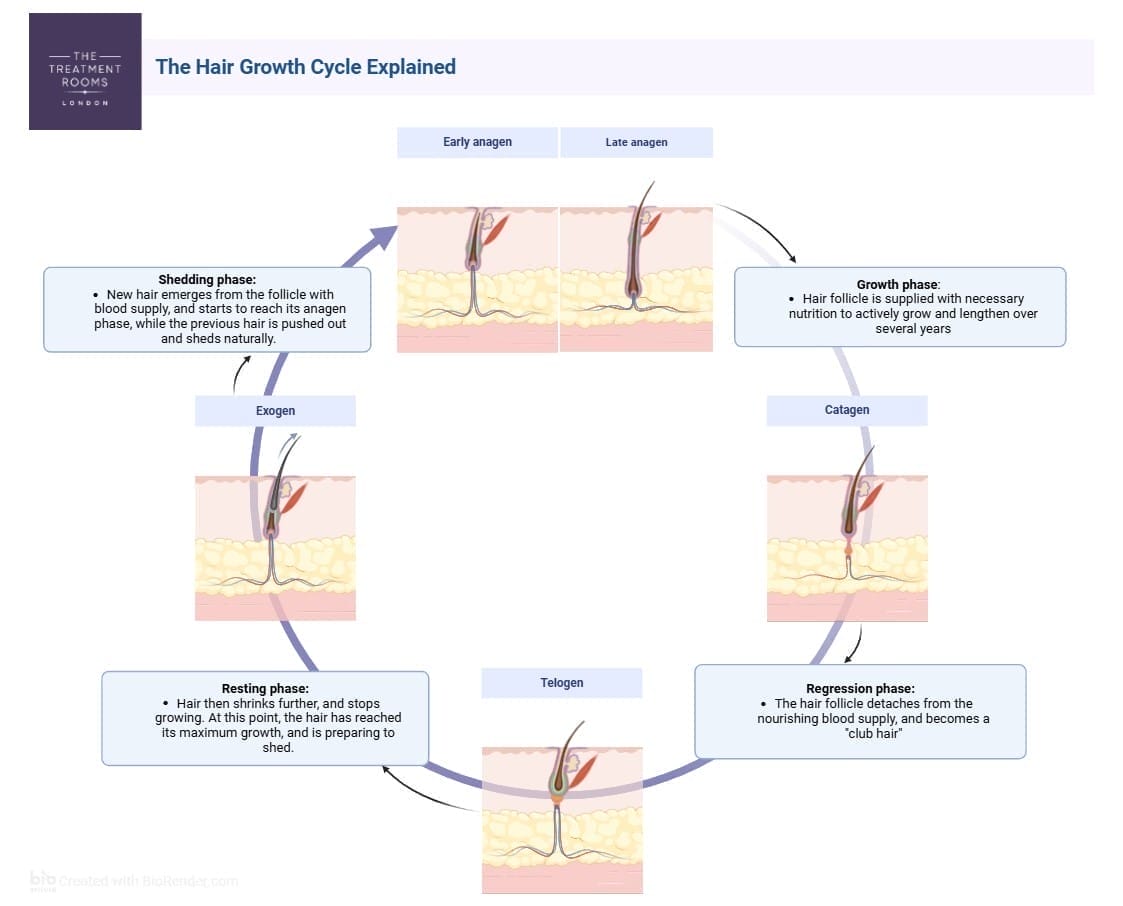
At any one time, around 10–15% of your hair is in the telogen phase.2 When these resting hairs reach the end of their cycle, they shed naturally and are replaced by new hairs.
This is why shedding is not a sign that your follicles are dying; it is part of the body’s normal renewal process.
How Much Hair Loss Is Considered Normal?
Most dermatologists agree that losing up to 100 hairs per day is within the normal range.
On wash days, especially if you do not shampoo daily, you may see more than this at once. This happens because hairs that have already shed over several days collect and are released together.
What normal shedding often looks like:
- Loose strands in the drain or on your hands
- No visible thinning or widening of the part
- No change in hairline shape
- Hair growing at a similar rate
Common Causes of Shedding More Than Usual
If you are losing more than the usual 50–100 hairs per day, it does not automatically mean permanent hair loss. Often, the body is responding to a temporary change or stressor.3
Below are some of the most common reasons:
1. Stress or illness (Telogen Effluvium): Surgery, fever, childbirth, rapid weight loss, or emotional stress can push hairs into the resting phase. Hair usually regrows once the trigger resolves.4
2. Genetics (Androgenetic Alopecia): This is a genetic condition that causes gradual thinning due to sensitivity to DHT (dihydrotestosterone), a hormone derived from testosterone.5
3. Scalp Conditions: Inflammatory or infectious scalp disorders can increase shedding, including seborrheic dermatitis (inflamed, flaky scalp), folliculitis (inflamed hair follicles) and psoriasis.
4. Tension from tight hairstyles (Traction Alopecia):
Repetitive tight hairstyles weaken the hair at the root. When wet in the shower, these strands are more likely to break or fall.
5. Environmental or lifestyle factors: Poor nutrition, ageing, or seasonal changes6 can influence increased shedding.
6. Hormonal Changes: Hormonal fluctuations, such as those that occur during pregnancy, childbirth, or menopause, can impact the hair growth cycle and lead to temporary hair shedding.7
7. Medical treatments or illnesses: Certain medications or cancer treatments can disrupt hair growth.
Many of my patients ask me about their hairs they notice on their hands when showering and whether that is normal? I explain to them that it is normal to shed hair whilst showering and not to worry about it unless they are noticing some recession to their hairline or balding in their crown. This suggests there is an underlying hair loss condition affecting their hair growth over time and this can be treated.
Dr Roshan Vara, Co-Founder and Surgeon at The Treatment Rooms London
Hair Breakage vs Hair Loss: What’s the Difference?
Seeing large amounts of hair in the shower does not always indicate true hair loss. In many cases, what appears to be shedding is actually hair breakage, which is far more common and usually reversible. Wet hair is more fragile, and aggressive brushing, excessive heat styling, or poor conditioning can cause strands to snap, especially at the ends.
Understanding whether hair is falling from the root or breaking along the shaft is important because the causes and treatments are very different.
Hair loss starts at the scalp when a follicle releases a strand, often due to genetics, hormones, or health issues. Over time, this can cause your hair to thin.
Hair breakage is a symptom of stress in the growing hair shaft. The follicle under the skin is healthy, but the growing hair strand snaps due to damage from heat, chemicals, friction, or dryness.
A quick way to tell the difference: shed hairs have a small white or black bulb; broken hairs are shorter, uneven, and bulb-free.
The distinction matters because the fixes are different. Hair loss may need medical treatment, while breakage usually improves with gentler care and proper moisture.
Does Shampooing Too Often Cause Hair Loss?
Shampooing does not damage hair follicles or make them stop producing hair.8
The real issue is not how often you wash, but how you wash. Very harsh shampoos, hot water, and aggressive scrubbing can weaken the hair fibre and cause breakage, which may appear as hair loss even when the follicles remain healthy.
This shifts the focus from shampoo frequency to hair-strand protection. While shedding is biological, breakage is largely preventable, and that’s where the right care routine makes a real difference.
How Can You Reduce Shower Breakage?
While you can not stop natural shedding, you can reduce mechanical damage and breakage.
| Problem | Prevention Strategy |
| Water Temperature | Use lukewarm water. Extremely hot water can strip the hair of protective oils, making it brittle. |
| Aggressive Scrubbing | Massage your scalp with the pads of your fingers, not your nails. This prevents damage to the epidermis (the outer layer of skin). |
| Conditioning | Apply conditioner only to the mid-lengths and ends. Applying it to the roots can weigh hair down and make the scalp greasy. |
| Wet Brushing | Hair is most fragile when wet. Avoid brushing in the shower unless using a dedicated wide-tooth comb to gently detangle. |
When Should You See a Doctor?
While some daily shedding is normal, certain patterns may suggest an underlying issue. You may want to seek medical advice if you notice:
- A sudden or significant increase in shedding
- Patchy hair loss, especially with scalp redness, itching, or pain
- Gradual thinning along the crown or temples
- Bald patches, widening of your hair parting or a noticeably shrinking ponytail
A medical assessment can identify whether the cause is temporary, nutritional, hormonal, genetic, or inflammatory.
Conclusion
Seeing hair in the shower is rarely a problem in itself. What matters is the pattern you notice over time.
If shedding continues, your hair looks thinner, or your hairline or part starts to change, it may be worth looking into the cause.
In those cases, treatment will depend on what’s driving it. Some people benefit from medical options like minoxidil or prescription therapies, while others may need to address nutritional or scalp-related factors with their GP or dermatologist.
A small amount of daily shedding is expected. It’s persistent or visible changes in your hair that deserve attention.
References
1. Johnson J. How much hair loss is normal? Brushing, washing, and more [Internet]. Medical News Today; 2019 Dec 3 [cited 2026 Jan 26]. Available from: https://www.medicalnewstoday.com/articles/327188#hair-falling-out-while-washing
2. Alonso L, Fuchs E. The hair cycle. J Cell Sci. 2006 Feb 1;119(Pt 3):391–393. doi:10.1242/jcs.02793.
3. Lin RL, Garibyan L, Kimball AB, Drake LA. Systemic causes of hair loss. Ann Med. 2016;48(6):393–402. doi:10.1080/07853890.2016.1180426.
4. Malkud S. Telogen effluvium: a review. J Clin Diagn Res. 2015 Sep 1;9(9):WE01–WE03. doi:10.7860/JCDR/2015/15219.6492. PMID:26500992; PMCID: PMC4606321.
5. Ho CH, Sood T, Zito PM. Androgenetic Alopecia. In: StatPearls [Internet]. Treasure Island (FL): StatPearls Publishing; 2025 Jan–. Available from: https://www.ncbi.nlm.nih.gov/books/NBK430924/
6. Kunz, M., Seifert, B. & Trüeb, R. M. (2009) ‘Seasonality of hair shedding in healthy women complaining of hair loss’, Dermatology (Basel), 219(2), pp. 105-110. Available at: https://pubmed.ncbi.nlm.nih.gov/19407435/
7. Grymowicz, M., Rudnicka, E., Podfigurna, A., Napierala, P., Smolarczyk, R., Smolarczyk, K. & Meczekalski, B. (2020) ‘Hormonal effects on hair follicles’, International Journal of Molecular Sciences, 21(15), pp. 5342. Available at: https://www.ncbi.nlm.nih.gov/pmc/articles/PMC7432488/
8. Punyani S, Tosti A, Hordinsky M, Yeomans D, Schwartz J. The impact of shampoo wash frequency on scalp and hair conditions. Skin Appendage Disord. 2021;7(3):183–193. doi:10.1159/000512786. PMID:34055906; PMCID: PMC8138261.
Share:
Authored by

Dr Roshan Vara
Dr. Roshan Vara is a renowned hair transplant surgeon in London and the Co-Founder of our award winning hair transplant clinic, The Treatment Rooms London.He has over 10 years of experience in hair transplant surgery and is recognised for delivering natural-looking results through ethical, patient-centred care. He is a Full Medical Member of BAHRS and an Associate Member of ISHRS, reflecting his commitment to the highest standards in modern hair restoration.
Reviewed by

Dr Dilan Fernando
Dr. Dilan Fernando is regarded as one of the best hair transplant surgeons in London and Co-Founder of The Treatment Rooms London. He has over 10 years of experience in hair transplant surgery and is known for his meticulous technique and commitment to ethical practice. He served on the Executive Committee of BAHRS from 2020 to 2024, helping to shape industry standards for patient safety and quality of care. Dr. Fernando personally performs each surgery, ensuring natural results built on trust and experience.
Book a Consultation
Related Blogs

Steve Carell Hair Transplant: Before, After, and His New Hairline
March 2, 2026
Steve Carell, best known as Michael Scott in The Office, began sparking curiosity amongst fans when his…

What Is Nutrafol and Does It Really Work for Hair Growth?
February 24, 2026
Key Takeaways Hair thinning can feel frustrating and confusing. You might notice more hair falling out in…

Peppermint oil for hair growth: Evidence, Benefits, Uses & Safety
February 24, 2026
Key Takeaways What Is Peppermint Oil? Peppermint oil, also known as Mentha piperita oil, is an essential…

Why Winter Hair Loss Happens and All You Need to Know
February 6, 2026
Key Takeaways As temperatures drop and indoor heating kicks in, many people notice their hair feels drier,…

Can You Take Finasteride With Minoxidil For Hair Loss?
February 5, 2026
Key Takeaways Consistency Matters: Stopping treatment often leads to a recurrence of hair loss; ongoing medical guidance…
Does Finasteride Cause Erectile Dysfunction?
February 3, 2026
Key Takeaways Finasteride can cause erectile dysfunction in some men, but it isn’t common. Most men who…
What is a Hair Transplant? How it Works, Success Rate & What to Expect
February 2, 2026
Key Takeaways Cost: Varies from £3,000 to £10,000, depending on the number of grafts and the technique….
What Causes Hair Loss During Menopause?
February 2, 2026
Key Takeaways Many women notice increased hair shedding and thinning during menopause. This happens because hormonal changes…

Can a Norwood 7 Get a Hair Transplant? All You Need to Know
February 2, 2026
Key Takeaways Yes, someone with Norwood 7 hair loss may be able to have a hair transplant,…