

Quick Summary:
Key takeaway: According to studies, up to 30-50% of men will experience some form of male-pattern baldness by age 50. Hair loss tends to stabilise between the ages of 30 and 50.
According to the American Hair Loss Association, the vast majority of these cases (95%) are due to androgenic alopecia. The factors that influence hair loss in men include genetics, age, and hormonal changes[1]. It often results in recession of the hairline, temples, and thinning of the crown.
Many reports state that hair loss can potentially stabilise between the ages of 30 and 50. However, many men will experience ongoing hair thinning even after they reach age 45.[2]
In this article, we explore everything you’ll need to know about hair loss in men, including when it starts and stops, as well as some measures that could actually help you prevent hair loss.
Understanding the Hair Growth Cycle
Hair growth is a dynamic process that progresses through three main stages. These stages are absolutely fundamental to maintaining hair health and volume.[2]
Here’s a quick overview of these three stages:
- Anagen (Growth Phase) – This is the most active stage, where hair grows approximately 1 cm per month. This phase lasts between 2 and 7 years and is subject to genetic factors.
- Catagen (Transitional Phase) – A short phase that only lasts two weeks. During this phase, hair detaches from its blood supply, which stops hair growth.
- Telogen (Resting Phase) – Approximately 10-15% of scalp hair is in this dormant phase at any time. The telogen phase lasts about 3 months before the hair sheds, and the cycle renews.
The first step to fully understand hair loss in men and whether it stops with age is to understand these three cycles.
When Does Hair Loss Start in Men?
Most men experience some degree of hair loss with age, and it often starts in their 20s. However, the onset and severity vary greatly between individuals. The table below provides a detailed overview of when and how hair loss starts in different age groups.
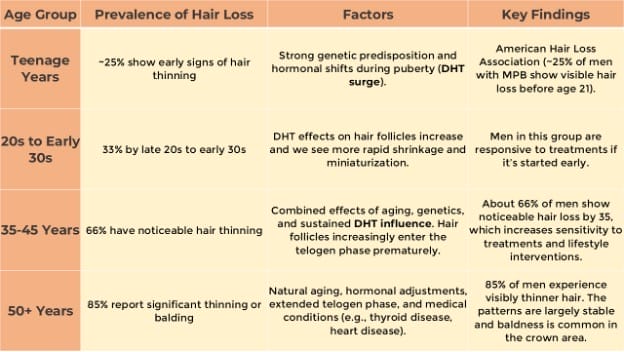
Does Hair Loss Stop? Understanding Hair Loss Stabilisation
Hair loss may stabilise for some men after an initial period of rapid loss. In general, this occurs around their late 30s or 40s, especially in those with milder genetic predispositions. However, men with strong genetic markers for hair loss will most likely continue to lose hair at a slower rate as they age.
The factors that determine at what age hair loss stops in men include:
- Genetics – Men with significant genetic predispositions tend to experience more rapid and prolonged hair loss.[3]
- Hormonal influence – High levels of DHT cause hair follicles to shrink over time. Hormonal shifts that occur later in life may reduce DHT’s impact on the scalp.[4]
- Lifestyle factors – Healthy habits (e.g., diet, exercise, stress management) play an indispensable role in whether your hair loss will stop with age.[5]
Patterns and Stages of Male Pattern Baldness
Male pattern baldness progresses in a characteristic pattern that’s defined by the Hamilton-Norwood scale. The scale classifies the stages of hair loss from minimal recession to severe baldness based on where thinning begins and how it advances.[6]
The table below details each stage and what to expect:

What influences the severity of hair loss?
Scientists identified numerous factors that contribute to the pattern, severity, and timing of hair loss. If you understand these factors, you’ll be able slow down the progress of hair loss. However, some of these factors are unmodifiable (i.e., there is nothing you can do to change them):
- Genetics and Heredity:
- Male pattern baldness (MPB) is hereditary and accounts for about 95% of male hair loss cases. A strong family history of early hair loss increases risk.
- Male pattern baldness (MPB) is hereditary and accounts for about 95% of male hair loss cases. A strong family history of early hair loss increases risk.
- Age-Related Changes:
- Hair follicles become increasingly sensitive to DHT as men age. This results in more gradual follicle miniaturisation, albeit some men experience stabilisation with time.
- Hair follicles become increasingly sensitive to DHT as men age. This results in more gradual follicle miniaturisation, albeit some men experience stabilisation with time.
- Hormonal Factors:
- DHT plays a vital role in hair thinning and follicle shrinkage. Men with naturally high levels of DHT or testosterone may experience faster hair loss.
- DHT plays a vital role in hair thinning and follicle shrinkage. Men with naturally high levels of DHT or testosterone may experience faster hair loss.
- Health Conditions:
- Medical issues (e.g., hypothyroidism, anaemia, certain autoimmune disorders) can cause temporary or permanent hair loss.[7]
- Medical issues (e.g., hypothyroidism, anaemia, certain autoimmune disorders) can cause temporary or permanent hair loss.[7]
- Medications:
- Hair loss is a common side effect of chemotherapy drugs, antidepressants, beta-blockers, and certain blood pressure medications.[8]
- Hair loss is a common side effect of chemotherapy drugs, antidepressants, beta-blockers, and certain blood pressure medications.[8]
- Lifestyle Factors:
- Poor diet, stress, smoking, and inadequate sleep can negatively affect follicle health, accelerating hair loss in individuals with a genetic predisposition.
Available Treatments to Slow or Reverse Hair Loss
There are numerous treatments on the market to aid men with hair loss. The effectiveness of these treatments varies significantly from one individual to another. Additionally, factors such as the stage of hair loss, the patient’s age, and their health status play a role in this matter.
Let’s go over the most common treatment options for male pattern baldness:
Pharmacological Drugs – Minoxidil and Finasteride
- Minoxidil is an approved treatment for hair loss, with the topical form available over the counter. It works by enhancing blood flow to the hair follicles, providing them with the nutrients needed to push them to their anagen (growth) phase and grow healthily.[9]
- The second pharmacological treatment is finasteride, which reduces DHT levels and slows follicle shrinkage.[9] The diagram below simplifies how finasteride works:

Low-Level Laser Therapy (LLLT)
Laser therapy stimulates follicles and may improve hair density. However, the results of this therapy vary widely.[10]
Hair Transplantation
Follicular Unit Transplantation (FUT) and Follicular Unit Excision (FUE) are surgical options that relocate hair from dense areas to thinning spots. This is the preferred treatment option for many men who have experienced a receding hairline or balding crown.
Lifestyle Changes
Diet, scalp care, and stress management may support follicle health and delay hair loss progression.
Platelet-Rich Plasma
Platelet-rich plasma (PRP) and topical antiandrogens are newer treatments that produce promising results. For example, PRP uses growth factors from the patient’s blood to encourage regrowth.[11]
Conclusion
Hair loss is a common and progressive condition in men that stems from genetic, hormonal, and lifestyle factors. It often stops or slows between the ages of 30 and 50. Although male pattern baldness is inevitable for most individuals, lifestyle changes and medical treatments provide potential ways to stop hair loss.
Make sure to consult with your healthcare provider early on to prevent further hair loss with various intervention strategies (e.g., dietary choices, stress management, medical treatments).
References
- Asfour L, Cranwell W, Sinclair R. Male Androgenetic Alopecia. [Updated 2023 Jan 25]. In: Feingold KR, Anawalt B, Blackman MR, et al., editors. Endotext [Internet]. South Dartmouth (MA): MDText.com, Inc.; 2000-. Available from: https://www.ncbi.nlm.nih.gov/books/NBK278957/
- Al Aboud AM, Syed HA, Zito PM. Alopecia. [Updated 2024 Feb 26]. In: StatPearls [Internet]. Treasure Island (FL): StatPearls Publishing; 2024 Jan-. Available from: https://www.mdpi.com/2077-0383/12/3/893
- Hagenaars, S. P., Hill, W. D., Harris, S. E., Ritchie, S. J., Davies, G., Liewald, D. C., Gale, C. R., Porteous, D. J., Deary, I. J., & Marioni, R. E. (2017). Genetic prediction of male pattern baldness. PLoS genetics, 13(2), e1006594. https://doi.org/10.1371/journal.pgen.1006594
- Kische, H., Arnold, A., Gross, S., Wallaschofski, H., Völzke, H., Nauck, M., & Haring, R. (2017). Sex Hormones and Hair Loss in Men From the General Population of Northeastern Germany. JAMA dermatology, 153(9), 935–937. https://doi.org/10.1001/jamadermatol.2017.0297
- Rajput R. J. (2022). Influence of Nutrition, Food Supplements and Lifestyle in Hair Disorders. Indian dermatology online journal, 13(6), 721–724. https://doi.org/10.4103/idoj.idoj_175_22
- Wirya, C. T., Wu, W., & Wu, K. (2017). Classification of Male-pattern Hair Loss. International journal of trichology, 9(3), 95–100. https://doi.org/10.4103/ijt.ijt_46_17
- Hussein, R. S., Atia, T., & Bin Dayel, S. (2023). Impact of Thyroid Dysfunction on Hair Disorders. Cureus, 15(8), e43266. https://doi.org/10.7759/cureus.43266
- Mounessa, J., Caravaglio, J. V., Domozych, R., Chapman, S., Dellavalle, R. P., Dunnick, C. A., & Norris, D. (2023). Commonly prescribed medications associated with alopecia. Journal of the American Academy of Dermatology, 88(6), 1326–1337.e2. https://linkinghub.elsevier.com/retrieve/pii/S019096221730155X
- Rossi, A., & Caro, G. (2024). Efficacy of the association of topical minoxidil and topical finasteride compared to their use in monotherapy in men with androgenetic alopecia: A prospective, randomized, controlled, assessor blinded, 3-arm, pilot trial. Journal of cosmetic dermatology, 23(2), 502–509. https://doi.org/10.1111/jocd.15953
- Pillai, J. K., & Mysore, V. (2021). Role of Low-Level Light Therapy (LLLT) in Androgenetic Alopecia. Journal of cutaneous and aesthetic surgery, 14(4), 385–391. https://jcasonline.com/role-of-low-level-light-therapy-lllt-in-androgenetic-alopecia/
- Paichitrojjana, A., & Paichitrojjana, A. (2022). Platelet Rich Plasma and Its Use in Hair Regrowth: A Review. Drug design, development and therapy, 16, 635–645. https://doi.org/10.2147/DDDT.S356858
Share:
Authored by

Dr Roshan Vara
Dr. Roshan Vara is a renowned hair transplant surgeon in London and the Co-Founder of our award winning hair transplant clinic, The Treatment Rooms London.He has over 10 years of experience in hair transplant surgery and is recognised for delivering natural-looking results through ethical, patient-centred care. He is a Full Medical Member of BAHRS and an Associate Member of ISHRS, reflecting his commitment to the highest standards in modern hair restoration.
Reviewed by

Dr Dilan Fernando
Dr. Dilan Fernando is regarded as one of the best hair transplant surgeons in London and Co-Founder of The Treatment Rooms London. He has over 10 years of experience in hair transplant surgery and is known for his meticulous technique and commitment to ethical practice. He served on the Executive Committee of BAHRS from 2020 to 2024, helping to shape industry standards for patient safety and quality of care. Dr. Fernando personally performs each surgery, ensuring natural results built on trust and experience.
Book a Consultation
Related Blogs

What to Eat and Avoid After a Hair Transplant
August 7, 2026
Key Takeaways: After a hair transplant, you can resume your usual diet as soon as you feel…

Gabriel Magalhães Hair Transplant: His Journey and Our Full Expert Analysis
August 3, 2026
Key Takeaways: 1. Did Gabriel Magalhães have a hair transplant? Gabriel Magalhães confirmed his hair transplant in…
What to Know About Stress and Alopecia Areata
August 3, 2026
Key Takeaways: Alopecia areata is an autoimmune condition in which the immune system attacks the hair follicles,…

Female Hair Transplant Guide
July 9, 2026
If you’re a female experiencing hair loss, you may be considering getting a female hair transplant. We…
Dr Vara featured on ITV’s This Morning
June 17, 2026
When ‘Nice Hair Transplant’ Isn’t The Compliment You Were Hoping For… When our repair surgery patient Shaun…
2026 World Cup Stars and Hair Transplant Speculation: 5 Footballers to Watch Out For
June 9, 2026
Key Takeaways As the 2026 FIFA World Cup approaches, some of football’s biggest names will once again…

A Guide To Double Crowns: What Are They?
June 5, 2026
Quick Summary of Double Crowns What is a Double Crown? The crown of your head refers to…
Finasteride and Its Side Effects: What You Need to Know
June 4, 2026
Quick Summary: Finasteride and Its Side Effects Finasteride for Hair Loss: Originally developed for prostate enlargement, Finasteride…
Minoxidil For Eyebrows – Does It Work?
June 3, 2026
Key Takeaways: Understanding Eyebrow Hair Loss: Eyebrow hair loss is commonly caused by over-plucking, but other autoimmune…