

Key Takeaways:
- How much hair loss is normal for a woman? Each woman will have their own normal range, but as a guide, somewhere around 100 hairs is an average amount to fall out in a day.
- What’s the difference between shedding and hair loss? Shedding is the natural release of individual hairs as part of the hair growth cycle. Hair loss involves a change in overall density because hairs are not growing from the follicle as they should.
- What can increase normal shedding? The normal hair cycle can be disrupted and lead to more shedding by illness, surgery, childbirth, hormonal changes, nutritional deficiency, rapid weight loss, some medicines, and significant emotional stress.
- When should I be concerned? You should be concerned if the shedding is ongoing and heavier than usual, your hair parting is widening, your scalp becomes painful or shows signs of redness, infection, scaling, or shiny patches.
- What should I do? Look for changes in density and patterns rather than fixating on exactly how many hairs you lose each day. Seek an assessment by a qualified doctor if the change continues or you have other concerns.
How Much Hair Loss Is Normal Each Day?
We lose on average 50-100 hairs each day1. This is a normal pattern of hair shedding we all undergo.
This is because certain hairs have reached the end of their life cycle and must be shed to allow for new growth. You will often notice this hair fall off when you wash, brush, or style your hair, as hairs can fall out yet remain attached and caught between other strands until they are physically removed.
As a woman, if you have long hair, this shedding can look more substantial given the length of each strand. If you happen to go days without washing your hair, several days’ worth of hair may be removed in one go.
The important thing is not to count each strand of hair you lose each day but rather assess whether that amount seems visually normal or has changed from what you usually expect.2
At What Age Does Hair Loss Stop in Women?
There is no fixed age at which hair loss stops in women. In fact, if you have hair loss, it is likely to become more noticeable with advancing age. While some causes can be reversible, others, such as pattern hair loss, are usually progressive. This can be slowed or partially reversed by some medications.
Overall, however, once it begins, it is likely to continue over time.
The Hair Growth Cycle: Why Shedding Is Normal
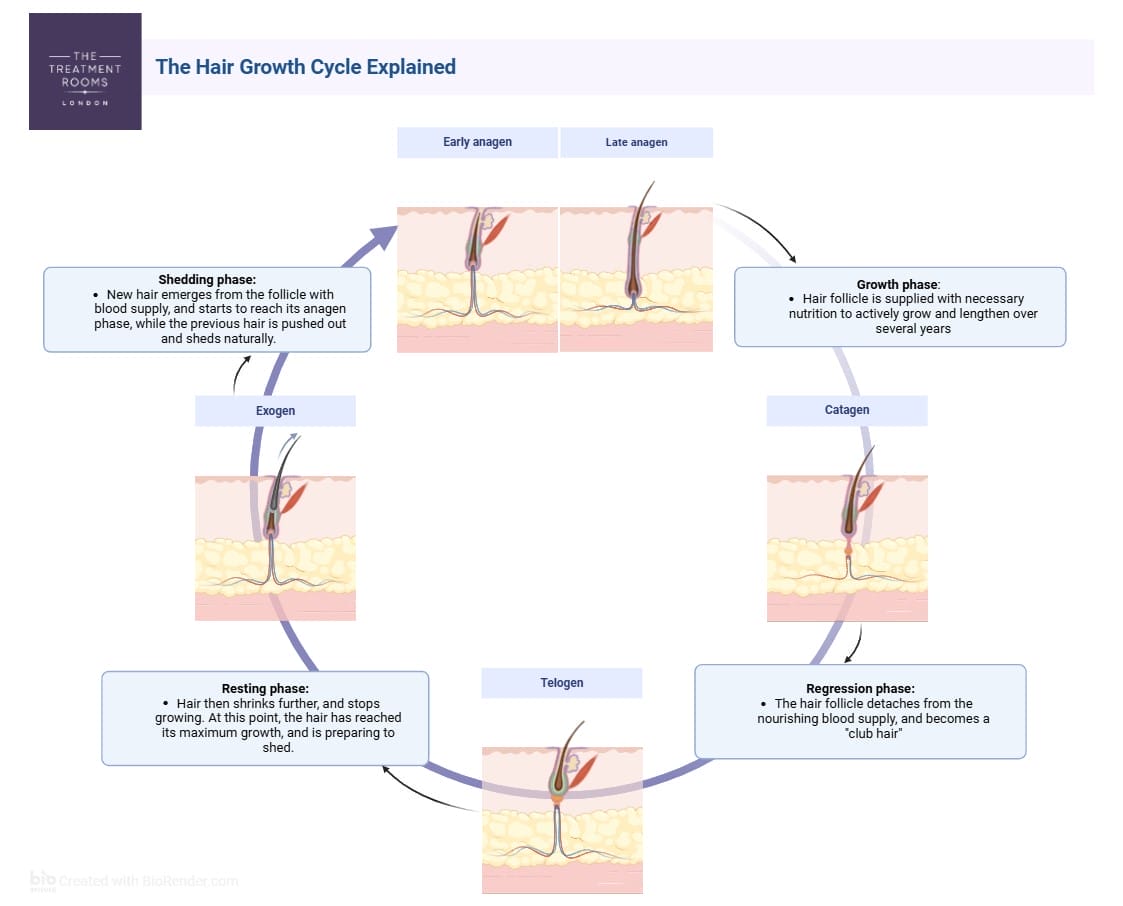
The majority of hairs on your head are actively growing in what is called the anagen phase of hair growth. This phase lasts anywhere from 2 to 6 years for each follicle.
Exactly how long each follicle is in this growth phase determines the length of your hair. Each follicle is in its own stage of this process at any given time.
After growth, there is a resting phase of a couple of months before the hair is ready to be released. This is why hairs fall out sporadically on a daily basis. These are the hairs that have completed the cycle and are now being removed to make way for others.
Around 85 percent at any given time are active; the other 15 percent are either resting or preparing to shed.3
Shedding vs Hair Loss: How to Tell the Difference
Hair shedding is the process of hairs leaving the scalp when they are at the end of their growth cycle. It can be normal or excessive, and it doesn’t tell us anything about the cause. Hair loss is when hair is not growing as it should from a follicle, which results in thinning of your hair.
You can have hair shedding, with or without actual hair loss. You may also shed hair without a loss in density.
So how can you tell normal hair shedding apart from an underlying hair loss condition?
You may also experience hair breakage. This is easily spotted as broken hairs have snapped ends. This is caused by damage to the hair from pulling on the hair strands by tight hairstyles or headwear, and other damaging causes such as excessive heat and bleaching.
What Can Temporarily Increase Shedding in Women?
Temporary increases in shedding usually result from physical or mental stress on the body, which places more follicles in the resting phase than usual (a condition known as telogen effluvium). The resting phase lasts a couple of months. This is why it can be difficult to connect the cause of the shedding to when the hair actually falls out months later.
“It is common for me to see women who are concerned about increased shedding since giving birth or having a stressful event. This can typically cause a condition called telogen effluvium, where hair will shed for approximately 6 months after the stressful event. Once it passes, the hair should recover, and you can hasten its recovery with good nutrition and the use of topical Minoxidil.”
Dr Roshan Vara, Co-Founder and Surgeon at The Treatment Rooms London
Examples of stressors which can cause increased shedding are:
Physical
This can be a high fever, significant infection, major illness, surgery or trauma, or a lot of blood loss, which can disrupt the normal hair cycle. Problems with your thyroid gland and certain medicines can also play a part; however, do not stop prescribed medication without first talking to the doctor who prescribed it about your concerns.3
Hormonal changes
Fluctuating hormone levels, such as after you give birth (postpartum shedding), can cause you to shed more hair. Stopping hormonal contraceptives can have a similar effect. Many hairs can enter the resting phase together because of shifts in hormones.
Poor nutrition
Losing weight rapidly, eating a very restrictive diet, not having enough protein, or having a deficiency in nutrients such as iron, can all cause an increase in hair shedding.
You should only supplement nutrients if you have a confirmed deficiency rather than as a general treatment for hair loss.
Emotional stress
Psychological stress such as a bereavement or divorce, and other major life events can also lead to an increase in the amount of hair falling out. Long-term background stress can also lead to the same outcome.3.
Don’t just assume this is the cause if you are feeling stressed. It is important to get assessed by your GP for other potential causes.
In this type of stress shedding (telogen effluvium), the hair loss is non-scarring. This means that the follicles remain healthy and may go on to produce new hair once the stressful event has passed. That’s why it is considered temporary.
When Is It More Than Normal Shedding?
If you spot some of these signs, things might not be quite right:
- A clear increase in shedding that doesn’t settle within 6 months
- A widening central parting and increased visibility of the scalp
- A noticeably thinner ponytail
- Smooth, round or irregular bald patches
- Recession at the front or sides of the hairline
- Loss of eyebrow or eyelash hair
- Scalp burning, itching, redness, crusting, or lumps
- Smooth, shiny patches without hair
- Irregular periods, new facial hair or acne
- Unexplained weight change or other symptoms of illness
There is a distinction to be made between scarring and non-scarring hair loss. In non-scarring conditions, hair follicles are not destroyed and so retain the ability to grow new hair. Scarring conditions are often linked with inflammation. Signs like pain, burning, crusting, and smooth, shiny skin can all point to scarring hair loss.
And once the follicles are destroyed by inflammation, there is little chance they will grow hair again. The earlier you catch it, the more follicles you are likely able to save.4
“Scarring alopecias like frontal fibrosing alopecia can be devastating for my patients. With the condition predominantly affecting women, I need to keep a close eye out for it when I see a female. Treatment for scarring alopecia requires specialist dermatological care, and it’s important to see one before embarking on plans for surgery.”
Dr Roshan Vara, Co-Founder and Surgeon at The Treatment Rooms London
What to Do If You’re Worried
If you are concerned about your hair loss, here are some practical tips:
- Consider the previous three or so months. Did you have any fever, illness, operations, medication changes, rapid loss in weight, or a major life event?
- Take consistent photographs: focus on your central parting, temples, and crown every four to six weeks using the same hairstyle, lighting conditions, and camera angle if possible.
- Treat your hair gently: Avoid tight hairstyles that pull on your roots. Try not to use excessive heat or bleaching if you notice any breakage.
- Eat adequately. Make sure your diet is balanced and contains enough protein. Do not begin taking supplements without first checking whether you have a deficiency. You can get a blood test to check whether your levels of micronutrients are within the normal range.
- Review medicines safely: If you think your hair loss is as a result of a medication, ask your GP or prescriber whether it could be contributing, but do not stop it without seeking advice first.
- Arrange an assessment if the change persists. Your GP or a Dermatologist is the best first option to examine your history and look at your hair. They will let you know whether this is something that requires further checks. You don’t have to diagnose and manage your hair loss alone. It is important to get it checked out by a professional who has experience dealing with hair loss.
Conclusion
Try not to get caught up in counting how many hairs you lose each day. Your focus should be on whether this is a sustained increase from your usual shedding or whether you have any visible loss in density or you have scalp symptoms.
Getting an accurate diagnosis will allow you to begin the appropriate treatment and give you the best chance of saving as much hair as possible and keeping your hair density intact.
References
- NHS. Hair loss [Internet]. London: NHS; [cited 2026 AUG 14]. Available from: https://www.nhs.uk/symptoms/hair-loss/
- Martínez-Velasco MA, Vázquez-Herrera NE, Maddy AJ, Asz-Sigall D, Tosti A. The Hair Shedding Visual Scale: a quick tool to assess hair loss in women. Dermatol Ther (Heidelb). 2017;7(1):155–165. doi:10.1007/s13555-017-0171-8.
- British Association of Dermatologists. Telogen effluvium [Internet]. London: British Association of Dermatologists; 2025 [cited 2026 Aug 14]. Available from: https://www.bad.org.uk/pils/telogen-effluvium.
- Filbrandt R, Rufaut N, Jones L, Sinclair R. Primary cicatricial alopecia: diagnosis and treatment. CMAJ. 2013;185(18):1579–1585. doi:10.1503/cmaj.111570.
- Birch MP, Messenger JF, Messenger AG. Hair density, hair diameter and the prevalence of female pattern hair loss. Br J Dermatol. 2001;144(2):297–304. doi:10.1046/j.1365-2133.2001.04018.x.
- Fabbrocini G, Cantelli M, Masarà A, Annunziata MC, Marasca C, Cacciapuoti S. Female pattern hair loss: a clinical, pathophysiologic and therapeutic review. Int J Womens Dermatol. 2018;4(4):203–211. doi:10.1016/j.ijwd.2018.05.001.
- British Association of Dermatologists. Hair loss—female pattern (androgenetic alopecia) [Internet]. London: British Association of Dermatologists; 2024 [cited 2026 Aug 14]. Available from: https://www.bad.org.uk/pils/hair-loss-female-pattern-androgenetic-alopecia.
- True RH. Is every patient of hair loss a candidate for hair transplant?—Deciding surgical candidacy in pattern hair loss. Indian J Plast Surg. 2021;54(4):435–440. doi:10.1055/s-0041-1739247.
Share:
Authored by

Dr Roshan Vara
Dr. Roshan Vara is a renowned hair transplant surgeon in London and the Co-Founder of our award winning hair transplant clinic, The Treatment Rooms London.He has over 10 years of experience in hair transplant surgery and is recognised for delivering natural-looking results through ethical, patient-centred care. He is a Full Medical Member of BAHRS and an Associate Member of ISHRS, reflecting his commitment to the highest standards in modern hair restoration.
Reviewed by

Dr Dilan Fernando
Dr. Dilan Fernando is regarded as one of the best hair transplant surgeons in London and Co-Founder of The Treatment Rooms London. He has over 10 years of experience in hair transplant surgery and is known for his meticulous technique and commitment to ethical practice. He served on the Executive Committee of BAHRS from 2020 to 2024, helping to shape industry standards for patient safety and quality of care. Dr. Fernando personally performs each surgery, ensuring natural results built on trust and experience.
Book a Consultation
Related Blogs

What Happens If You Stop Using Minoxidil
October 13, 2026
Key Takeaways: If you’ve been consistently applying minoxidil to support your hair growth and have been doing…

Hair Transplant After 7 Days: What To Expect
October 9, 2026
Key takeaways: 7 days after your hair transplant, you can expect to see the scabs in your…

Minoxidil Side Effects: What to Expect, Risks, and How to Manage Them
October 9, 2026
Key takeaways Medications are often a first step people take when tackling pattern baldness. They can help…
What Is A Hair Graft In A Hair Transplant?
October 7, 2026
Key takeaways: What is a Hair Graft in a Hair Transplant? Hair loss can be a distressing…

Widow’s Peak Hair Transplant for Women: Everything You Need to Know
October 6, 2026
Key takeaways: There is no absolute definition of a widow’s peak in women. It is often based…

Has Steve Carell Had a Hair Transplant? What the Evidence Really Shows
October 6, 2026
Key Takeaways Steve Carell is arguably one of the most liked and versatile actors of his generation….
When Can You Drink Alcohol After Your Hair Transplant?
October 6, 2026
Key takeaways: It’s common for our patients to ask us when it is okay to resume drinking…

Has Donald Trump Had a Hair Transplant? Expert Review and What the Evidence Shows
October 6, 2026
Key Takeaways Donald Trump’s hair is one of the most talked about aspects of his appearance; from…

Wayne Rooney Hair Transplant: Expert Analysis of His Hair Loss and Restoration
October 5, 2026
Key takeaways: Wayne Rooney is widely regarded as one of the greatest football talents from England. He…