

Key Takeaways:
- What is Alopecia Areata? Alopecia areata (AA) is an autoimmune condition which leads to inflammation of hair follicles and hair loss.
- Is stress linked to alopecia areata? Stress has been reported to be a trigger for alopecia areata. However, the extent to which it is linked remains unclear.
- Who does it affect? It can affect any person at any age, though most cases tend to begin in childhood or early adulthood. You may be more likely to have it if you have a family history of the condition. Related conditions such as asthma, hay fever, or certain autoimmune conditions, including thyroid disease, vitiligo, and psoriasis, also increase the likelihood of alopecia areata.
- What does it look like? Alopecia areata can be recognised by the way it presents. Often with a rapid onset, there is a classic appearance of a circular patch of hair loss which can appear virtually overnight. Over a few weeks, it may increase in size. An itching or tingling sensation may be felt before or after the hair loss onset. You will feel otherwise well. The extent of hair loss can vary from a small amount to large amounts of hair.
- What can you do to help? If you are worried about recent hair loss, it is important to see your doctor to rule out any serious health conditions and for further guidance.
Alopecia areata is an autoimmune condition in which the immune system attacks the hair follicles, causing patchy hair loss on the scalp, face and sometimes elsewhere on the body.
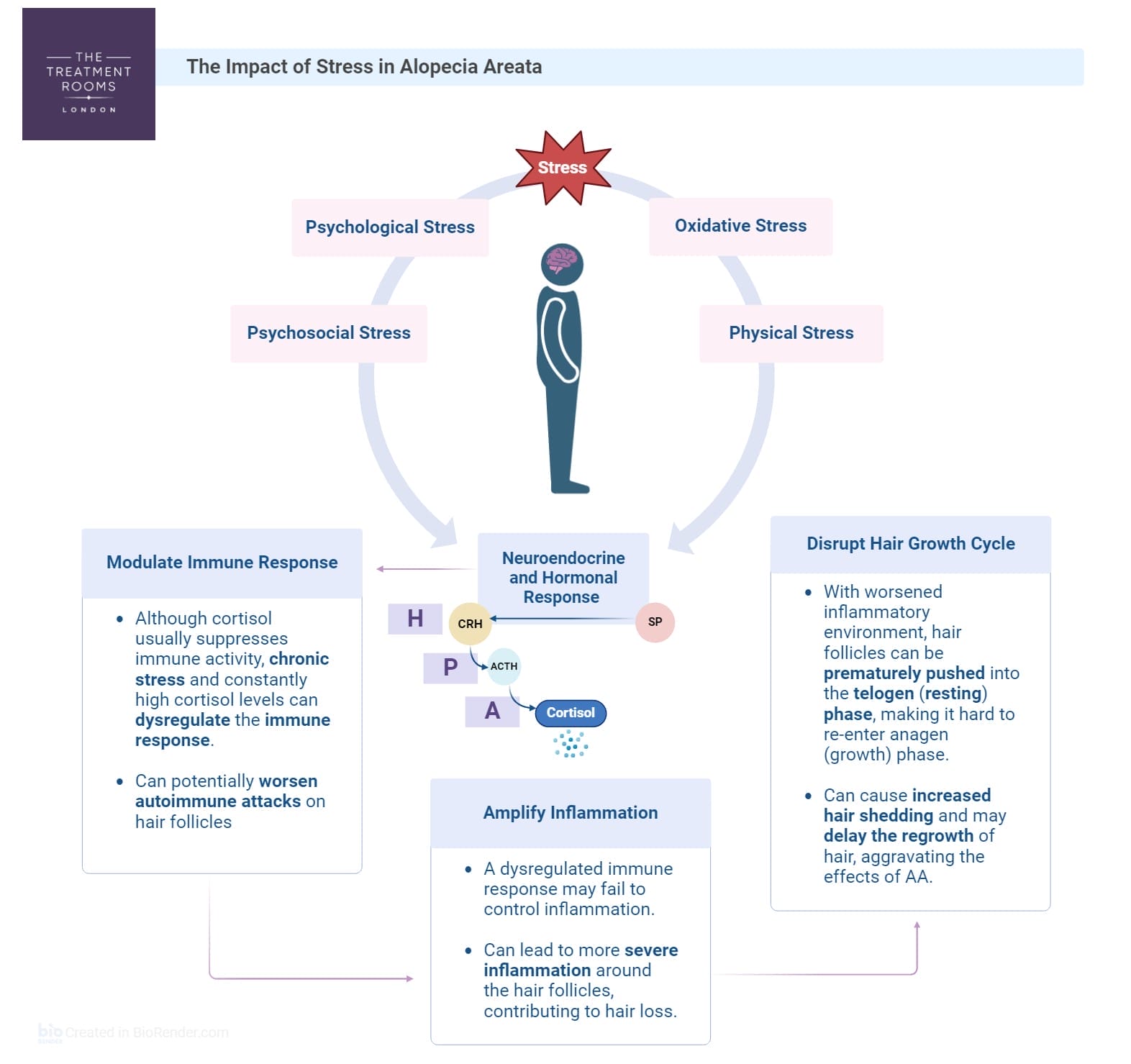
Stress is widely reported to cause alopecia areata, but whether it genuinely does is still unknown. This is partly because the relationship may run the other way: alopecia areata itself is distressing, so stress can be a consequence rather than a cause. This will need to be further studied before it can be considered conclusive.1,2
As the immune system attacks hair follicles in alopecia areata, patients will suffer from hair loss. As it is a non-scarring type of hair loss, the hair follicle is not destroyed.
As a result, there remains a possibility that the hair can grow back. The characteristic sign is the loss of hair in a circular pattern, which typically has a rapid onset. It may also have a slower onset. This varies on an individual basis.
You may notice an itching or tingling sensation in the spot before or after the hair loss itself. How the disease develops is uncertain. Some people will experience one patch of hair loss that recovers within 6 months.3
Others will develop secondary patches of hair loss and then recover. Others still will continue to have an ongoing chronic form in which the hair loss is persistent. In rarer cases, the total scalp or body hair is lost. 3,4
Can Stress Cause or Trigger Alopecia Areata?
If you first noticed hair loss when you were going through a difficult or stressful time in your life, it is perfectly natural to wonder whether the two are connected. Many people with alopecia areata have the same question, not least because losing hair can be stressful in itself. If we look at the evidence, we can observe what is currently known from what is conjecture.
Emotional stress is an often self-reported trigger for the condition by patients. While it is potentially a cause, there is no established evidence to say this is the case. Most often, alopecia areata has no obvious trigger. Perhaps we may find the link in the future, but as yet, we cannot establish that connection for certain.
Occasionally I will see a patient suffering from alopecia areata, where they have oval shapes of hair loss in their scalp or their beard. In these circumstances, the patient often reports a highly stressful period in their life with work or with family. This often triggers their alopecia areata. In these patients, we cannot perform hair transplant surgery because the grafted follicles are at risk of being attacked by the immune system too.
So instead, we advise on other medications such as steroid creams, which are best discussed with a Dermatologist. After a short period of time and once the stressful event has passed, hair should regrow, and the patient should not need to have surgery to the area that was affected by alopecia areata.”
Dr Roshan Vara, Director and Hair Transplant Surgeon, The Treatment Rooms London
The best evidence reports a potential link which will have to be studied further.
The proposed mechanism for stress-related onset is due to an increase in inflammatory compounds in the brain linked to stress. Again, whether this is the case specifically for alopecia areata remains to be discovered. It has been proposed as a mechanism for many different types of autoimmune diseases, which is why it is also suggested as a mechanism for AA. 1,2,5
In reality, stress is much more closely linked to a condition called telogen effluvium than AA. This is where more hair than usual falls out due to physical or mental stress on the body. The two conditions can often be confused, seeing as they both present primarily with hair loss. The hair loss in telogen effluvium will most often present with hair thinning as it is more spread out over the scalp, whereas alopecia areata is usually more focused, causing loss of complete, often circular, patches of hair.6
What Causes Alopecia Areata?
Exactly what causes alopecia areata remains unknown. What we do know is that there is inflammation of the hair follicles, typically believed to be autoimmune. The hair follicles are normally protected from recognition and attack by the body’s immune system. However, in alopecia areata, it appears this protection is lost, allowing the hair follicles to be targeted and hair to fall out.
There appears to be a genetic link, as people with an affected family member have a higher chance of developing the condition themselves. There also appears to be a link to other autoimmune conditions such as type 1 diabetes, vitiligo, and thyroid disease.7,8
As with most conditions, there could also be an environmental trigger. This is potentially stress, whether mental or physical, which is often self-reported by patients. These are not simple direct causes, and in many people the causative spark is not known.1,3
What Are the Signs and Symptoms of Alopecia Areata?
Alopecia areata typically develops rapidly, usually over only a few days. The first sign you may notice is one or more patches of hair loss that are clearly outlined. Over time, more patches may develop. Existing patches of hair loss may also regrow with hair or get worse and grow larger.
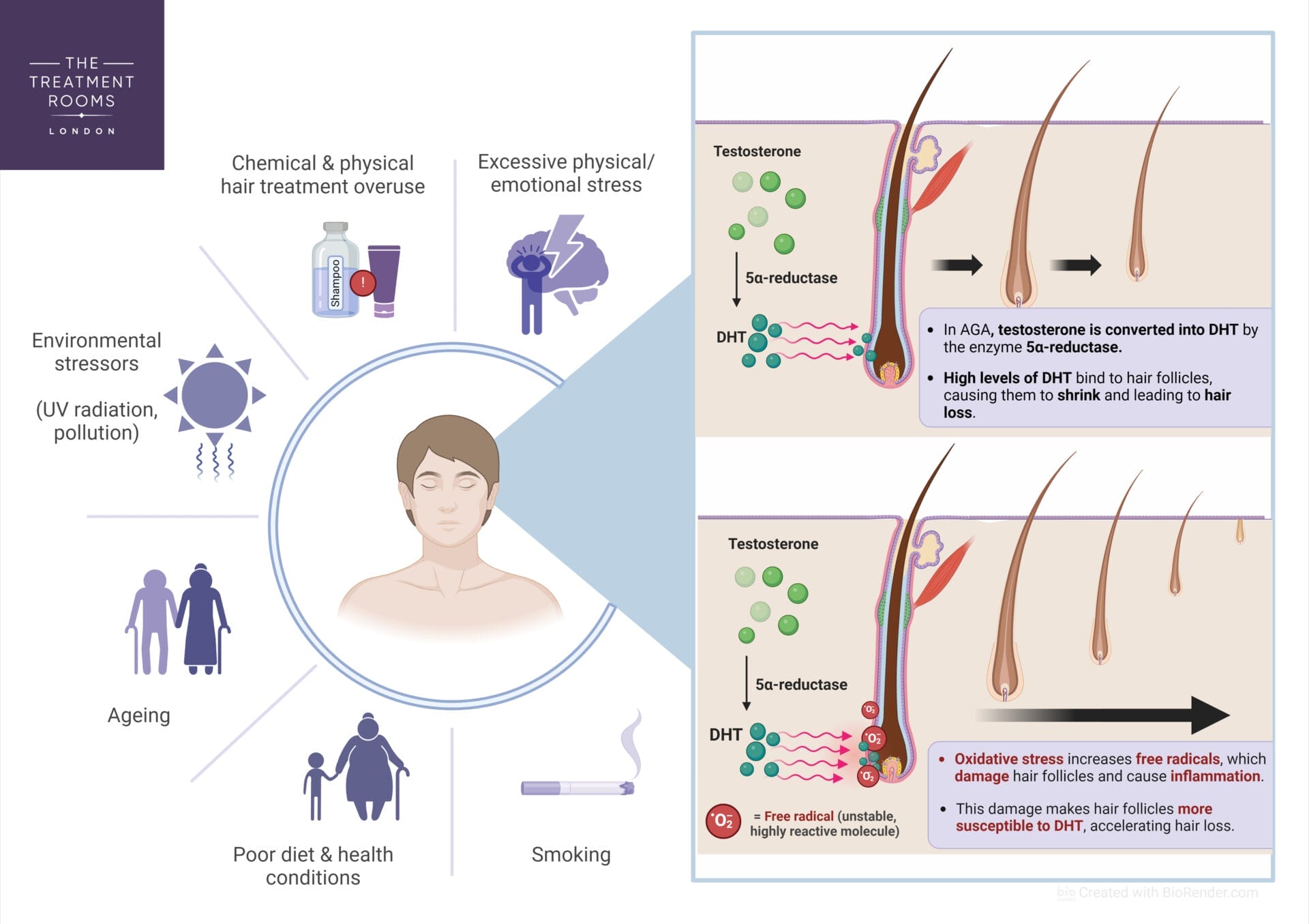
Alopecia Areata presents as a sudden, patchy hair loss which often appears in a round or oval shape. Patients may experience some tingling or itching sensation around the time of hair loss. They may also notice some areas of loss regrowing new hair while in some areas it is still falling out.
They need to be careful, however, to identify symptoms that are not related to Alopecia areata. For example, hair loss associated with rashes or scaling on the scalp, gradual hairline recession or widening of the middle parting, feeling generally unwell, fever, and aches and pains in the body. If they notice any of these symptoms, the cause might be something else that needs to be looked at by a GP or a Dermatologist.
Dr Bijaya Laxmi Gurung, Hair Transplant Surgeon, The Treatment Rooms London
Smooth, round patches of hair loss
The first thing you may notice is usually one or more oval spots of hair loss. The loss is usually complete and well-defined, described frequently as a coin shape. They are not always coin-sized, as they can show up larger or smaller than that. The skin of the affected scalp will be smooth. There won’t be any redness, scarring, or scaling on the underlying skin.
Scalp sensations
You may notice strange sensations on your scalp either before or after the hair loss takes place. This includes tingling or itching, tenderness, or a burning sensation.
Hair loss beyond the scalp
The hair loss does not always affect the scalp. It can also involve the eyelashes, beard, eyebrows, and other bodily hair such as that on the arms and legs.
Nail changes
Nail changes may be seen. Small dents in the nail known as pitting can show up. Your nails can be more brittle than usual, with long ridges formed on them. 1,3
Diagnosis
Diagnosis of alopecia areata is made largely with the presenting features and a physical examination by a doctor.
Your doctor will most likely ask questions to try and rule out any conditions that may have similar signs. However, in alopecia areata, the main sign is hair loss, and you are likely to feel otherwise physically well.
The doctor may also carry out some of the following tests to rule out other conditions:
- Skin biopsy (small sample of skin for further inspection): To rule out fungal infection or other autoimmune causes.
- Blood tests: These are to check for thyroid and other autoimmune conditions.
- Trichoscopy: This involves using a microscope-like device to examine the skin and hair follicles in greater detail.
Testing is a simple and accurate way to help confirm the diagnosis of alopecia areata and begin implementing strategies that will improve your wellbeing, allay any anxieties or fears caused by the hair loss, and improve your quality of life.1
How Is Alopecia Areata Treated?
While there is no definitive treatment, the focus of medical treatments is on changing the immune system’s inflammatory response in the hope that it will allow the hair to regrow in places where it has fallen out.
Treatment options may include the following:
- Contact sensitisation treatment such as diphencyprone (DPCP). This is when a substance that causes an inflammatory reaction is applied to the scalp in a weak form. The resulting inflammation is then regularly reapplied and maintained. In some cases, the irritation caused by the inflammation stimulates hair regrowth.
- Corticosteroids (topical steroids, steroid injections, prednisone, and clobetasol). These steroids, applied topically (on the skin surface) or perhaps taken in tablet form or injected, might be able to suppress the immune response and allow the hair to grow back.
- JAK inhibitors (Ritlecitinib). A newer class of tablets that impact the immune system. They dampen down the immune response and help reduce inflammation and hopefully also the symptoms of alopecia areata in those aged 12 and over. This is very much a newer treatment, and we are only beginning to build up real-world experience of this medication. Any decision to start this should be taken after careful consideration with your doctor.6
- Minoxidil. Oral or topical minoxidil may be considered as treatment alongside the other options due to its known ability to wake up resting hair follicles. It seems most successful in supporting hair growth once the regrowth has been established. Whether this is a suitable additional treatment is something that should be discussed with and guided by your doctor.
The functional and psychological impacts of the hair loss on you as an individual should be discussed, which will also help to guide the priorities for treatment.
“Alopecia areata is incredibly distressing for our patients; however, if promptly treated, hair loss can recover relatively quickly. Hair transplant surgery is not a treatment option for alopecia areata, and the treatments will often revolve around immune system modulation to prevent the hair follicles from being mistakenly attacked by it.
Patients are often prescribed steroid medications as a first-line treatment, under the care of a Dermatologist. This is then stepped up to stronger creams and medications if patients don’t respond. Patients can also use Minoxidil to help quicken the regrowth of their hair once the immune system has been suppressed in the area of hair loss.”
Dr Roshan Vara, Director and Hair Transplant Surgeon, The Treatment Rooms London
The important thing to remember is that treatments for AA take time. Results are not likely to be seen straight away. Usually, it will be at least a few months before you notice any changes.
Treatment response varies from person to person. Some patients may see regrowth, while others may have little or no response.
Each also carries its own risks of side effects. It is best to discuss the benefits, limitations, and risks of treatment options with a GP or dermatologist before starting treatment.1,9-11
Is Hair Transplant Recommended for Alopecia Areata?
A hair transplant is not recommended to treat alopecia areata because it is an immune-mediated phenomenon. This means that the transplanted hair follicles would also be subject to the same process that has impacted existing hair follicles.12
We advise that you get in touch with your GP or dermatologist with any concerns you may have about your symptoms.
Conclusion
In conclusion, there is no definitive link between stress and alopecia areata. So far, most associations have been self-reported, and there is not currently enough information supporting this link.
References
- Harries MJ, Ahmed A, Ascott A, et al. British Association of Dermatologists living guideline for managing people with alopecia areata 2025. Br J Dermatol. 2026;194(2):e56–e73. doi:10.1093/bjd/ljaf452
- Bai JQA, McMullen E, Sibbald C, et al. The role of psychological stress in hair loss: a review. JAAD Reviews. 2026;7:9–19. doi:10.1016/j.jdrv.2025.10.002
- Ungar B, Renert-Yuval Y, Dlova NC, et al. Alopecia areata. Nat Rev Dis Primers. 2025;11:77. doi:10.1038/s41572-025-00664-9
- Tosti A, Bellavista S, Iorizzo M. Alopecia areata: a long-term follow-up study of 191 patients. J Am Acad Dermatol. 2006;55(3):438–441. doi:10.1016/j.jaad.2006.05.008
- Ahn D, Kim H, Lee B, Hahm DH. Psychological stress-induced pathogenesis of alopecia areata: autoimmune and apoptotic pathways. Int J Mol Sci. 2023;24(14):11711. doi:10.3390/ijms241411711
- British Association of Dermatologists. Telogen effluvium. Patient information leaflet. Updated October 2025. BAD telogen-effluvium guidance
- Krajewski PK, Jastrząb B, Szepietowski JC, Jankowska-Konsur A, Saceda Corralo D. Immune-mediated disorders in patients with alopecia areata: systematic review and meta-analysis. Int J Dermatol. 2025;64(11):2029–2037. doi: 10.1111/ijd.17895.
- Huang Y, Jee E, Kim M, Liu X, Jiang X. Familial patterns of alopecia areata: a systematic review and meta-analysis. J Autoimmun. 2025;151:103378. doi: 10.1016/j.jaut.2025.103378.
- Mateos-Haro M, Novoa-Candia M, Sánchez Vanegas G, Correa-Pérez A, Gaetano Gil A, Fernández-García S, Ortega-Quijano D, Urueña Rodriguez MG, Saceda-Corralo D, Bennouna-Dalero T, Giraldo L, Tomlinson J, Vañó-Galván S, Zamora J. Treatments for alopecia areata: a network meta-analysis. Cochrane Database Syst Rev. 2023;10:CD013719. doi:10.1002/14651858.CD013719.pub2
- National Institute for Health and Care Excellence. Ritlecitinib for treating severe alopecia areata in people 12 years and over. Technology appraisal guidance TA958. Published 27 March 2024. NICE TA958
- Majewski M, Gardaś K, Waśkiel-Burnat A, Ordak M, Rudnicka L. The role of minoxidil in treatment of alopecia areata: a systematic review and meta-analysis. J Clin Med. 2024;13(24):7712. doi:10.3390/jcm13247712
- Saceda-Corralo D, et al. Consensus document on the clinical management of alopecia areata. Actas Dermosifiliogr. Published online 2026. doi:10.1016/j.ad.2026.104609
Share:
Authored by

Dr Roshan Vara
Dr. Roshan Vara is a renowned hair transplant surgeon in London and the Co-Founder of our award winning hair transplant clinic, The Treatment Rooms London.He has over 10 years of experience in hair transplant surgery and is recognised for delivering natural-looking results through ethical, patient-centred care. He is a Full Medical Member of BAHRS and an Associate Member of ISHRS, reflecting his commitment to the highest standards in modern hair restoration.
Reviewed by

Dr Dilan Fernando
Dr. Dilan Fernando is regarded as one of the best hair transplant surgeons in London and Co-Founder of The Treatment Rooms London. He has over 10 years of experience in hair transplant surgery and is known for his meticulous technique and commitment to ethical practice. He served on the Executive Committee of BAHRS from 2020 to 2024, helping to shape industry standards for patient safety and quality of care. Dr. Fernando personally performs each surgery, ensuring natural results built on trust and experience.
Book a Consultation
Related Blogs
What is DHT & Its Role in Hair Loss?
September 17, 2026
Key Takeaways The most common cause of hair loss in men is ‘androgenetic alopecia’ or ‘male pattern…

Did Daniel Craig Have a Hair Transplant? Here is What Our Experts Think
September 16, 2026
Key Takeaways: Daniel Craig is one of the most recognisable actors of his generation: the English superstar…

Jürgen Klopp Hair Transplant: Expert Analysis of His Hair Loss and All You Need to Know
September 16, 2026
Key Takeaways Jürgen Klopp is one of football’s most celebrated managers. He made his name through his…

Elton John and His Hair Transplant Journey: Expert Analysis and All You Need to Know
September 15, 2026
Key Takeaways: Sir Elton John has had, quite simply put, a great music career to date. Since…
Minoxidil For Eyebrows – Does It Work?
September 15, 2026
Key Takeaways: Eyebrows are a hugely important feature in humans for communication, facial expression, and identity. They…

Did Antonio Conte Have a Hair Transplant? Expert Analysis of His Hair Loss and Recovery
September 14, 2026
Key Takeaways: Antonio Conte is a successful football manager with extensive managerial experience and trophies to his…

When Can I Shave My Head After a Hair Transplant?
September 11, 2026
Key Takeaways: After your hair transplant, there can be a noticeable contrast between the closely cropped donor…
How Much Hair Loss Per Day Is Normal for Men
September 10, 2026
Key Takeaways: Perhaps you have noticed extra hair in the shower after you have finished washing or…

Gordon Ramsay Hair Loss: Expert Analysis and Before & After Pictures
September 10, 2026
Key Takeaways: Gordon Ramsay is arguably Britain’s most recognisable chef. Michelin-starred and famously fiery. He has been…