

Key Takeaways:
- What are the four stages of the hair growth cycle? Anagen, Catagen, Telogen, and Exogen are the four stages of the hair growth cycle.
- How long does the hair growth cycle last? The longest part of the hair growth cycle is the active growing phase, which lasts from 2 to 8 years. The catagen, or transition, phase usually lasts only 2 weeks, and the telogen, or resting phase, lasts around a few months before hairs are shed from the scalp.
- Is daily hair shedding normal? Yes. Because different hair follicles are in different stages of the cycle at any given time, it is natural for a portion of these to be actively releasing hair each day. An average amount you can expect to fall out in a day is around 100 hairs.
- When should changes in hair growth be assessed? If you develop sudden or persistent shedding, rapid or patchy hair loss, progressive thinning, scalp pain, redness, scaling, or hair that does not regrow, you should seek advice from your GP or dermatologist.
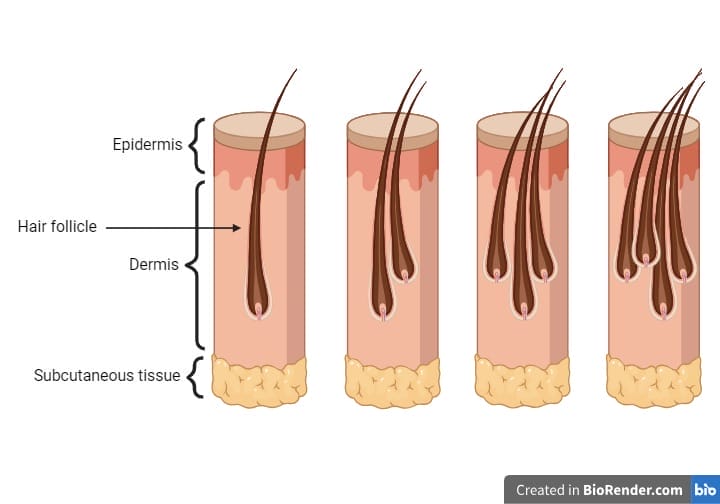
Each hair follicle is a small, self-renewing structure that goes through periods of growth, transition, rest, and shedding. They work independently of each other, on their own timelines, meaning there are always hairs on your scalp in different phases of the cycle at any given moment.
Learning about how the hair cycle works can help us understand why some shedding is normal and why growth may take time after an illness, hormonal changes, or a hair transplant.

The stages of the hair cycle
The hair follicle goes through four distinctly recognised phases of growth. These are explained in detail below:
1. Anagen: the active growth phase
Anagen is the stage where hair is being actively produced.
There are certain cells at the base of the follicle, called matrix cells. They divide rapidly to form the main length of the hair, called the hair shaft. These cells keep adding from the bottom and make the hair longer over time.
The anagen phase typically lasts from 2 to 8 years. The more time the hair follicle spends in the anagen phase, the longer the resulting hair will become. Someone with a short anagen phase may have difficulty growing longer hair even when the rate of growth is normal. This is because the hair’s final length is determined by how long the follicle stays in the anagen phase.
Most healthy scalp follicles will be in this active growth phase, called anagen, at any given time, which amounts to roughly 85-90% of all the hairs on your head.1,2
2. Catagen: the transition phase
Catagen is a short transition between active growth and rest.
During this stage, the hair follicle shrinks due to the removal of its blood supply. This cuts off the oxygen and nutrients needed to actively grow the hair.
A bulb of keratin attaches to the bottom of the hair to keep it in place while another hair begins growing beneath it. We call this a club hair, due to the shape of the familiar small white ball at its base. This phase lasts an average of 2 weeks.
3. Telogen: the resting phase
Telogen is the period where the hair follicle rests while the hair it produced remains in place. The hair shaft is no longer growing, but it remains anchored by a bulb of keratin for 2 to 4 months before it is released.
This phase is central to a condition called telogen effluvium, where more hairs than normal enter this resting phase. This can cause sudden, diffuse shedding across your scalp a few months after a triggering event.3
4. Exogen: the shedding phase
Exogen is the stage in which the old hair is released from the follicle. This happens in a much more controlled way than the hair simply falling out.4
The visible hair strand is released in this stage, but the viable follicle remains beneath and usually has already begun producing new hair.
Typically, an average of 100 hairs fall out in a day.5 This can change depending on your washing routine and grooming habits.
5. The cycle begins again
The cycle begins anew and follows the same four-step process to make more hair. Each follicle repeats this cycle many times over a lifetime. Even though it is presented in simple stages, in reality there may be an overlap between stages rather than a clear and neat end to each one.
What can disrupt the hair cycle?
The hair cycle can be disrupted by biological and medical factors. Such influences include:
- Genetics and sensitivity to hormones
- Acute illness, particularly involving a high temperature
- Major surgery or physical trauma
- Physical or emotional distress
- Pregnancy, childbirth, and other hormone changes
- Rapid weight loss, restrictive diets, or nutritional deficiencies
- Certain medicines or changes in hormonal medication
When your body is under stress from any of the reasons listed above, more follicles than usual can enter the resting phase of hair growth together. They are then shed together a few months after the onset of the stressor, which can make it hard to link the trigger to the hair actually falling out.
The hair cycle and progressive thinning
When you have a condition that causes progressive thinning, such as pattern hair loss, the quality of the hair cycle is changed.
Hormones influence susceptible follicles and provoke a shortened growth phase. This makes the follicle unable to produce a full-sized hair.6 This is different from normal shedding, as the follicle is shrinking over time, meaning each subsequent hair produced is thinner and shorter than the last.
The hair cycle after a hair transplant
It is normal for newly transplanted hair follicles to shed hair after the surgery. Moving the follicle causes it to enter a resting stage where the hair then falls out. This is perfectly normal, and the transplanted follicles remain beneath the scalp, actively working to produce new hair growth. This new growth will take a few months to become apparent.
At The Treatment Rooms London, we remind our patients that it is not unusual to see uneven or delayed growth after the procedure. When hairs begin growing out, they may initially grow with a coarse or coily texture. These hairs will soften over the next 12-18 months after surgery and become more in keeping with your natural hair texture.
When changes in the cycle need assessment
A change from your usual hair shedding is most informative here. You will know what that normally looks like for you.
Arrange for an assessment with a GP or dermatologist if you notice:
- Sudden or excessive shedding
- Shedding that persists or repeatedly returns
- Your scalp is rapidly becoming more visible
- Your hairline receding or your hair parting
- Round or clearly defined patches of hair loss
- Your scalp shows signs of redness, itching, burning, pus-filled lumps, or persistent scaling.
- Your scalp has smooth or shiny areas.
Scalp changes are especially important to watch out for, as they can be signs of inflammatory scalp disease. In these cases, early diagnosis is important to avoid the risk of permanent damage to the hair follicles.7
Conclusion
The hair growth cycle has four main stages: anagen for active growth, catagen for transition, telogen for rest, and exogen for shedding.
Daily shedding of around 100 hairs is an expected and natural part of this process. More noticeable shedding can happen after a strong physical or emotional stress is placed on the body.
If shedding becomes sudden or persistent, thinning progresses, bald patches appear, or your scalp is inflamed, you should leave it to a medical professional to help diagnose the cause. Your potential regrowth and treatment options will depend on the diagnosis and assessment made by your doctor.
References
- Natarelli N, Gahoonia N, Sivamani RK. Integrative and mechanistic approach to the hair growth cycle and hair loss. J Clin Med. 2023;12(3):893. doi:10.3390/jcm12030893
- Jimenez F, Alam M. The proportion of catagen and telogen hair follicles in occipital scalp of male androgenetic alopecia patients: challenging the established dogma. Exp Dermatol. 2024;33(10):e70001. doi:10.1111/exd.70001.
- British Association of Dermatologists. Telogen effluvium: patient information leaflet [Internet]. Updated 2025 Oct [cited 2026 Aug 26]. Available from: https://www.bad.org.uk/pils/telogen-effluvium.
- Higgins CA, Westgate GE, Jahoda CAB. From telogen to exogen: mechanisms underlying formation and subsequent loss of the hair club fibre. J Invest Dermatol. 2009;129(9):2100–2108. doi:10.1038/jid.2009.66.
- American Academy of Dermatology Association. Do you have hair loss or hair shedding? [Internet]. 2026 [cited 2026 Aug 26]. Available from: https://www.aad.org/public/diseases/hair-loss/insider/shedding.
- Chen S, Li L, Ding W, Zhu Y, Zhou N. Androgenetic alopecia: an update on pathogenesis and pharmacological treatment. Drug Des Devel Ther. 2025;19:7349–7363. doi:10.2147/DDDT.S542000.
- Cummins DM, Chaudhry IH, Harries M. Scarring alopecias: pathology and an update on digital developments. Biomedicines. 2021;9(12):1755. doi:10.3390/biomedicines9121755.
Share:
Authored by

Dr Roshan Vara
Dr. Roshan Vara is a renowned hair transplant surgeon in London and the Co-Founder of our award winning hair transplant clinic, The Treatment Rooms London.He has over 10 years of experience in hair transplant surgery and is recognised for delivering natural-looking results through ethical, patient-centred care. He is a Full Medical Member of BAHRS and an Associate Member of ISHRS, reflecting his commitment to the highest standards in modern hair restoration.
Reviewed by

Dr Dilan Fernando
Dr. Dilan Fernando is regarded as one of the best hair transplant surgeons in London and Co-Founder of The Treatment Rooms London. He has over 10 years of experience in hair transplant surgery and is known for his meticulous technique and commitment to ethical practice. He served on the Executive Committee of BAHRS from 2020 to 2024, helping to shape industry standards for patient safety and quality of care. Dr. Fernando personally performs each surgery, ensuring natural results built on trust and experience.
Book a Consultation
Related Blogs
Minoxidil for Eyebrows: Does It Work? Benefits, Risks & Results
November 26, 2026
Key takeaways Eyebrows are a hugely important feature in humans for communication, facial expression, and identity. They…

Alun Wyn Jones’s Hair Transplant at The Treatment Rooms London
November 26, 2026
Key takeaways Alun Wyn Jones is the former captain and international rugby player of Welsh rugby. His…
How to Grow FTM Facial Hair: Methods, Timelines, and Tips
November 25, 2026
Key takeaways Growing facial hair is a key concern for transmasculine people who are on a gender-affirming…

Which Blood Tests Are Required for Hair Loss in Women?
November 20, 2026
Key takeaways Blood testing can help narrow down the possible causes of hair loss in women. They…

Can Excessive Exercise Cause Hair Loss?
November 18, 2026
Key takeaways You may be wondering if your workout is causing your hair loss. Oftentimes, if you…
How Much Hair Loss Per Day Is Normal for Men
November 17, 2026
Key takeaways Perhaps you have noticed extra hair in the shower after you have finished washing or…
What to Know About Stress and Alopecia Areata
November 16, 2026
Key takeaways: Alopecia areata is an autoimmune condition in which the immune system attacks the hair follicles,…

Understanding Hair Loss in People with Trichotillomania
November 13, 2026
Key Takeaways: What Is Trichotillomania? Trich is a mental health condition where people suffering from it experience…

Did Kyle Walker Have a Hair Transplant? Expert Review of His Hair Loss and Restoration
November 13, 2026
Key Takeaways: Kyle Walker is a widely known athletic superstar. He burst onto the football scene with…