

Dutasteride is a medication that can be prescribed to men suffering from male pattern hair loss (androgenic alopecia). It helps to prevent hair loss by reducing the level of dihydrotestosterone (DHT), a hormone that is pivotal in causing androgenic alopecia.
What is Dutasteride?
Dutasteride is a medication that works to prevent the conversion of the male sex hormone, testosterone, to dihydrotestosterone (DHT). It is similar to Finasteride except it blocks both type 1 and type 2 5 alpha reductase enzymes that convert testosterone to DHT.1 As a result of lowering the level of DHT, Dutasteride can also be used to treat male pattern hair loss.

Hair loss conditions
To understand how Dutasteride can work for hair loss, it is important to know about the main hair loss conditions it can help with.
There are numerous types of hair loss, but the most common one that Dutasteride is prescribed for is androgenic alopecia.
- Androgenic alopecia1
- Also known as male-pattern baldness, androgenic alopecia is the most common form of hair loss in men. It also occurs in women, commonly called female pattern baldness. It affects around 50% of men by the age of 50, and 50% of women throughout their life, especially in their post-menopausal period, with prevalence increasing with age. However, hair loss follows a unique distribution in both sexes. In men, hair loss is most commonly seen in the hairline, temples, and crown regions, while in women, it is typically observed at the crown and top of the head around their parting.
- Also known as male-pattern baldness, androgenic alopecia is the most common form of hair loss in men. It also occurs in women, commonly called female pattern baldness. It affects around 50% of men by the age of 50, and 50% of women throughout their life, especially in their post-menopausal period, with prevalence increasing with age. However, hair loss follows a unique distribution in both sexes. In men, hair loss is most commonly seen in the hairline, temples, and crown regions, while in women, it is typically observed at the crown and top of the head around their parting.
- Alopecia areata3
- In this form of hair loss, it is the body’s own immune system that attacks hair follicles and causes hair loss. It is considered an autoimmune condition. Although hair loss can affect any part of the body, it is most prominent on the head and face. Alopecia areata can affect both men and women equally. And it affects mostly people who are in their twenties and thirties. Dutasteride is not commonly prescribed in cases of alopecia areata.
- In this form of hair loss, it is the body’s own immune system that attacks hair follicles and causes hair loss. It is considered an autoimmune condition. Although hair loss can affect any part of the body, it is most prominent on the head and face. Alopecia areata can affect both men and women equally. And it affects mostly people who are in their twenties and thirties. Dutasteride is not commonly prescribed in cases of alopecia areata.
- Telogen effluvium4
- This form of hair loss is one of the common causes of temporary hair loss. It occurs due to excessive shedding of hair follicles that are at the telogen or resting phase. It is usually caused by several factors, such as severe emotional or physiological stress and the use of certain medications. It is commonly seen in women post-pregnancy. Dutasteride is not commonly prescribed for this hair loss condition.
- This form of hair loss is one of the common causes of temporary hair loss. It occurs due to excessive shedding of hair follicles that are at the telogen or resting phase. It is usually caused by several factors, such as severe emotional or physiological stress and the use of certain medications. It is commonly seen in women post-pregnancy. Dutasteride is not commonly prescribed for this hair loss condition.
Can Dutasteride prevent hair loss?
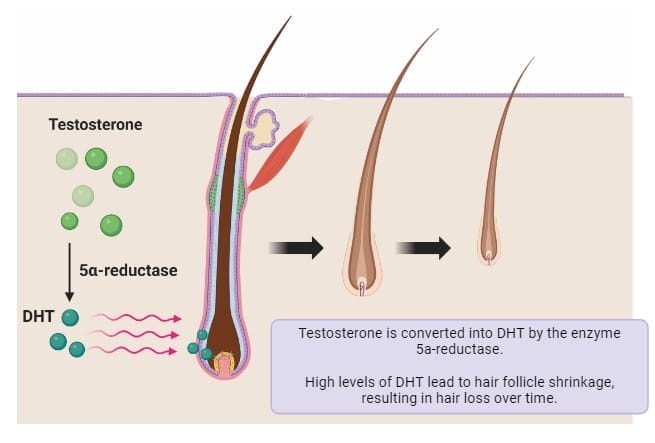
As a stronger 5-alpha reductase enzyme inhibitor than Finasteride, Dutasteride ultimately works by preventing the conversion of testosterone into DHT, which is the key hormone that drives hair loss in androgenic alopecia. It is currently not licensed for use by the FDA or MHRA. But in other countries like Japan and South Korea, Dutasteride has been approved for the treatment of male androgenetic alopecia.
When Dutasteride blocks type 1 and 2 5-alpha reductase enzymes, it prevents the formation of DHT1. DHT affects the hair growth cycle, miniaturising the hair, causing it to shorten and shrink, and eventually fall out. By preventing this process, Dutasteride can effectively prevent further hair loss. This process is summarised in the diagram below.
Dutasteride and Hair Loss Research
- In a study5 published in the Clinical Interventions in Aging Journal, Dutasteride was found to be more effective than FDA-approved finasteride in the treatment of hair loss in men with androgenetic alopecia.
- Another study6, published in the Indian Journal of Dermatology, Venereology and Leprology, further proved the efficacy of dutasteride over finasteride in the treatment of androgenic alopecia. Men who consumed dutasteride showed a higher total hair count per cm2 than those who took finasteride.
- Another study7 published as far back as 2010 in Journal of the American Academy of Dermatology, intake of 0.5 mg of dutasteride daily for 6 months in male patients suffering from androgenic alopecia was able to increase hair count by up to 12.2/cm2 — an amount that was more than double the change seen in the placebo group. The study further concluded that intake of 0.5 mg of dutasteride daily can improve hair growth. Such intake was also found to be well tolerated by patients with male androgenic alopecia.
Dutasteride Dose For Hair Loss
Dutasteride is commonly prescribed at a dose of 0.5mg once a day. Before starting Dutasteride, it is important to have a consultation with a hair loss specialist who can advise on the benefits and risks of Dutasteride. Patients may wish to start on Finasteride and assess their response before starting on Dutasteride.
Does Dutasteride Have Side Effects?
Some of the most common side effects associated with Dutasteride include:
- Ejaculation disorder that’s characterised by a decrease in the amount of semen released during sexual activity
- Testicular pain and swellings
- Increased breast size and tenderness
- Reduced sex drive or libido
- Dizziness
These are similar to Finasteride’s side effects, which you can read about here: Finasteride side effects.
Is Dutasteride the best option for hair loss treatment?
Dutasteride is an effective medication that is used to prevent hair loss and improve its growth. However, a balanced decision needs to be made between the side effects Dutasteride can give over the potential side effects of other drugs like finasteride. Patients ought to discuss with their healthcare professional to decide on the most suitable treatment option.
Dutasteride use in women
Dutasteride is not recommended for routine use in women. Much like Finasteride, Dutasteride can cause complications for any developing baby (please read Finasteride use in women). If Dutasteride is being used in women, it requires specialist supervision and guidance to ensure the patient understands the risks around pregnancy and family planning.8
How do you know if Dutasteride is working?
Regular follow-up appointments and pictures every 3-6 months can help to monitor the effectiveness of Dutasteride. We commonly advise patients to take photos in the same lighting from the front, sides, and the top to monitor the effectiveness of Dutasteride. You may also want to review your progress with Dutasteride with your prescribing Doctor to ensure you are not suffering from any side effects.
If you feel Dutasteride is not working, please consult with your doctor to explore other options for your hair loss.
When to have a hair transplant if you are on Finasteride
If you have been taking Dutasteride and you have stabilised your hair loss, you may opt to restore hair in your hairline, temples and crown with a hair transplant.
At The Treatment Rooms London, all patients are seen by their dedicated hair transplant surgeon, who is able to guide them through the decisions required.
Other treatments for hair loss
Depending on the cause and extent of the hair loss, treatments can range from behavioural and lifestyle changes to medications and advanced procedures like hair transplant surgery.
- Lifestyle changes
- Platelet-rich plasma (PRP)
- This is a form of advanced treatment that involves drawing out some quantity of your blood, concentrating the plasma, and then injecting this platelet-rich plasma into the scalp to accelerate hair growth and prevent hair loss. The evidence supporting PRP in hair loss treatment is variable, so it is important that you speak with a specialist before starting this therapy.
- This is a form of advanced treatment that involves drawing out some quantity of your blood, concentrating the plasma, and then injecting this platelet-rich plasma into the scalp to accelerate hair growth and prevent hair loss. The evidence supporting PRP in hair loss treatment is variable, so it is important that you speak with a specialist before starting this therapy.
- Hair transplant
- Hair transplants are effective in treating permanent hair loss conditions. They involve extracting hair follicles from the back or sides of the scalp and transplanting them into areas affected by hair loss. There are 2 methods of hair transplant surgery:
1. FUE hair transplant surgery
2. FUT hair transplant surgery
- Hair transplants are effective in treating permanent hair loss conditions. They involve extracting hair follicles from the back or sides of the scalp and transplanting them into areas affected by hair loss. There are 2 methods of hair transplant surgery:
- Medications
- Medications are the most common form of hair loss treatment. Numerous medications can improve hair growth and prevent hair loss. Some of these drugs include minoxidil or Regaine, and Finasteride (Propecia). Another commonly used drug is Dutasteride. However, it is yet to get approval from the FDA. As such, Doctors prescribe it as an off-label medication.
Summary
Hair loss affects a significant number of people. One of the most common methods of treating hair loss is the use of medications, especially DHT blockers. These medications include Finasteride and Dutasteride, and both have been shown by research to prevent hair loss.
Get in Touch
Ready to elevate your hair restoration journey? Book a free consultation call with our London-based FUE and FUT hair transplant clinic.
Our award-winning team, including leading London hair transplant surgeons Dr Fernando and Dr Vara, are here to support you every step of the way.
References
- https://www.rxlist.com/dutasteride/generic-drug.htm
- https://www.ncbi.nlm.nih.gov/books/NBK430924/
- https://www.niams.nih.gov/health-topics/alopecia-areata
- https://www.ncbi.nlm.nih.gov/books/NBK482293
- https://www.ncbi.nlm.nih.gov/pmc/articles/PMC6388756/
- https://pubmed.ncbi.nlm.nih.gov/27549867/
- https://pubmed.ncbi.nlm.nih.gov/20605255/
- https://pubmed.ncbi.nlm.nih.gov/25382509/
Share:
Authored by

Dr Roshan Vara
Dr. Roshan Vara is a renowned hair transplant surgeon in London and the Co-Founder of our award winning hair transplant clinic, The Treatment Rooms London.He has over 10 years of experience in hair transplant surgery and is recognised for delivering natural-looking results through ethical, patient-centred care. He is a Full Medical Member of BAHRS and an Associate Member of ISHRS, reflecting his commitment to the highest standards in modern hair restoration.
Reviewed by

Dr Dilan Fernando
Dr. Dilan Fernando is regarded as one of the best hair transplant surgeons in London and Co-Founder of The Treatment Rooms London. He has over 10 years of experience in hair transplant surgery and is known for his meticulous technique and commitment to ethical practice. He served on the Executive Committee of BAHRS from 2020 to 2024, helping to shape industry standards for patient safety and quality of care. Dr. Fernando personally performs each surgery, ensuring natural results built on trust and experience.
Book a Consultation
Related Blogs

Hair Shedding vs Hair Loss: What’s the Difference?
September 23, 2026
Key Takeaways: When you notice more hair falling out than usual, it can cause a lot of…

David Silva’s Hair Transplant: Expert Review of His Hair Loss and Recovery
September 23, 2026
Key Takeaways Born in Arguineguín on Spain’s Canary Islands in 1986, he made his name with Valencia…
Did Kyle Walker Have a Hair Transplant? Expert Review of His Hair Loss and Restoration
September 21, 2026
Key Takeaways: Kyle Walker is a widely known athletic superstar. He burst onto the football scene with…

Can Women Take DHT Blockers for Hair Loss? Benefits & Risks
September 20, 2026
Key takeaways In the UK, for example, finasteride and dutasteride, the main DHT blocking medications, are not…

Analysing Jimmy Carr’s Hair Transplant: Expert Review and All You Need to Know
September 20, 2026
Key takeaways As one of Britain’s best-known comedians, Jimmy Carr is no stranger to the public eye….

The Ludwig Scale & Female Pattern Hair Loss: Stages, Assessment & Treatment
September 19, 2026
Key takeaways: The Ludwig scale aids the description of how advanced your hair loss is. It is…

What is DHT & Its Role in Hair Loss?
September 17, 2026
Key Takeaways The most common cause of hair loss in men is ‘androgenetic alopecia’ or ‘male pattern…

Did Daniel Craig Have a Hair Transplant? Here is What Our Experts Think
September 16, 2026
Key Takeaways: Daniel Craig is one of the most recognisable actors of his generation: the English superstar…

Jürgen Klopp Hair Transplant: Expert Analysis of His Hair Loss and All You Need to Know
September 16, 2026
Key Takeaways Jürgen Klopp is one of football’s most celebrated managers. He made his name through his…