

Key Takeaways
- Hair loss in your 20s is more common than most people realise. It’s often triggered by genetics, stress, hormonal changes, or lifestyle factors. Noticing hair loss early gives you a wider range of treatment options.
- The most common cause of hair loss in both men and women is androgenetic alopecia (pattern hair loss). This is a progressive condition driven by a sensitivity to the hormone dihydrotestosterone (DHT), but it can usually be slowed or stabilised with early medical treatment.
- Evidence-based treatments work best when started early. Hair loss medications like minoxidil and finasteride can help preserve existing hair and reduce further thinning in many people.
- Hair transplants are rarely the first step in treating hair loss in your 20s. Surgery is usually considered only after hair loss has stabilised and medical treatments have been tried and tested.
- Lifestyle changes play a supporting role, not a cure. Managing stress, eating well, and avoiding damaging hair practices can improve scalp health and support long-term results.
- Getting the right medical advice matters. A GP, dermatologist or hair specialist can help identify the root cause of your hair loss and guide appropriate treatment before surgical options are explored.
Hair thinning or excessive hair shedding in your 20s is often due to genetics, stress, hormonal changes, or lifestyle factors.
While androgenetic alopecia is the most frequent cause of permanent hair loss, not all hair loss is permanent, and early intervention can help slow or even reverse the process.
This guide explains why hair loss may occur in your 20s, how to recognise the signs, and practical steps to protect and restore your hair.
What Causes Hair Loss in the Mid-20s?
Hair loss is rarely caused by a single factor; it is most often due to a combination of genetics, hormonal influences, stress, and lifestyle factors.
Androgenetic Alopecia (Genetics)
Androgenetic alopecia (male or female pattern hair loss) is the most common cause of hair loss in the world, affecting up to half of both men and women at some point in their lifetime. In men, it most commonly begins between the ages of 20 and 25,1 while in women, it usually begins a bit later, around age 40.2 In both cases, hair loss tends to become more noticeable with time if left untreated.
Androgenetic alopecia occurs when genetically predisposed hair follicles slowly shrink due to the influence of a hormone derived from testosterone, dihydrotestosterone (DHT).3
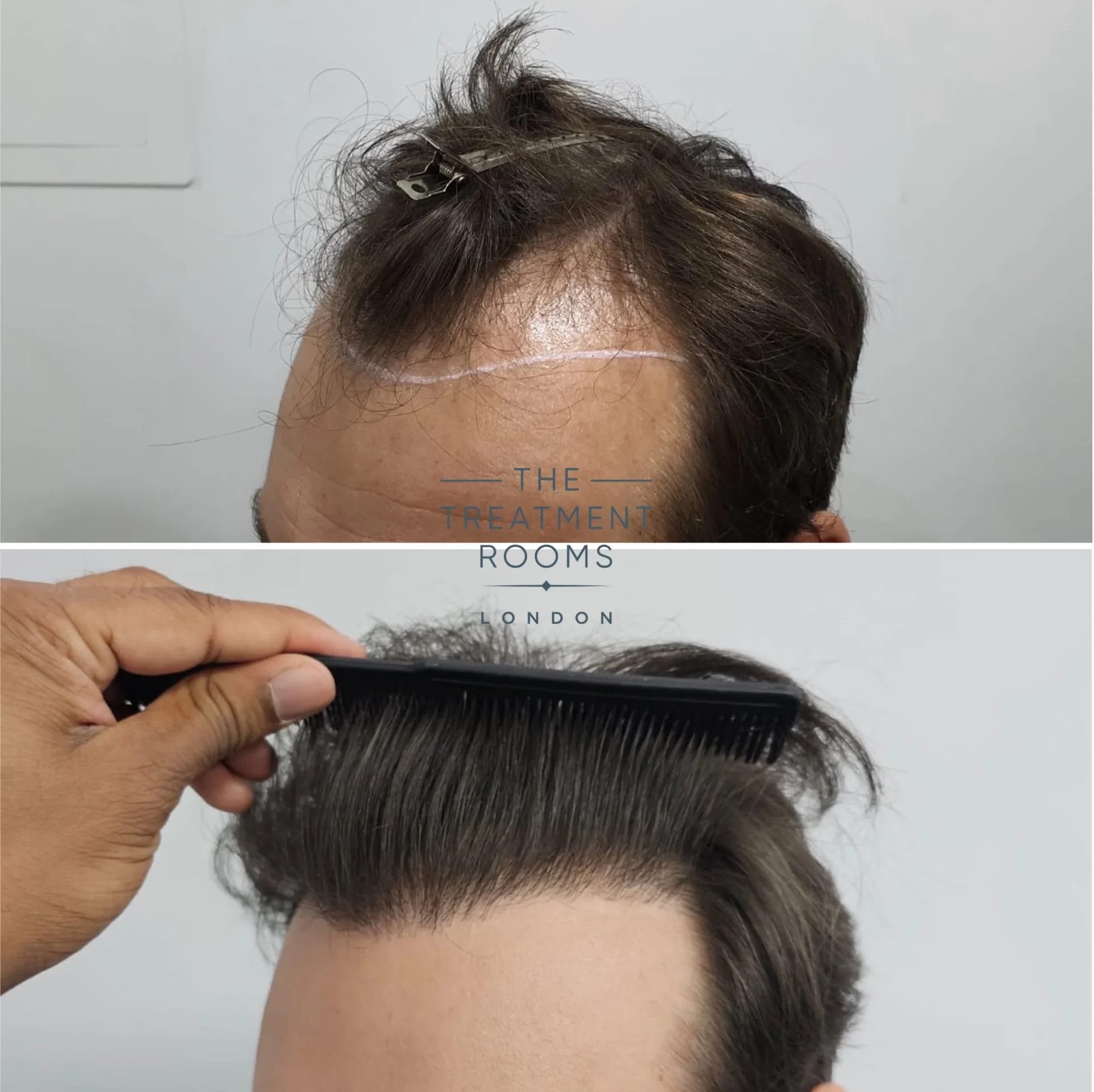
Over time, this process shortens the hair growth cycle, producing finer, weaker strands until hair growth slows or stops altogether. In men, this generally first appears as a receding hairline or thinning crown. In women, it usually appears as diffuse thinning or widening of hair partings.4
Although genetic hair loss is progressive, early recognition is important. Starting treatment early can help slow further thinning, preserve existing hair, and, in a few cases, stimulate partial regrowth.
In my patients, I find patients lament not starting treatment earlier in their lives. Ignoring hair loss for too long can result in regret later. Early recognition and intervention help to ease the psychological and financial burdens of hair loss.
Dr Pather Puroshini, Hair Transplant Surgeon, at The Treatment Rooms London
Telogen Effluvium (Stress)
Telogen effluvium occurs when physical or emotional stress pushes more hair than usual into the resting (telogen) phase of the hair growth cycle. As a result, you experience unusually excessive shedding, usually a few months after a triggering event like surgery, illness, childbirth, or a significant psychological stressor.5
The reassuring news is that telogen effluvium is usually temporary. Once the underlying trigger is resolved, hair usually regrows within 3-6 months.6
Hormonal and Medical Factors
Hormones control the hair growth cycle, so imbalances can cause thinning or shedding of hair in your 20s. Thyroid problems, for example, can push more hair follicles into the resting (telogen) phase, leading to diffuse shedding across the scalp.7 In young women, polycystic ovary syndrome (PCOS) can increase androgen levels, which convert to dihydrotestosterone (DHT) in the scalp, gradually shrinking sensitive follicles and causing female-patterned thinning.
Some autoimmune and long-term health conditions can also disrupt the hair cycle, either through inflammation or chronic stress. In these cases, hair loss may be one of the first visible signs that something isn’t quite right internally. Persistent or sudden hair loss should always be assessed by a healthcare professional.
Hair Care and Styling Practices
Repeated tension or damage to the hair shaft can lead to breakage and thinning. Tight ponytails (such as braids, cornrows, and extensions), harsh chemical treatments (such as dyes), and frequent heat styling may contribute to traction alopecia or structural hair damage.
Regrowth can occur in most cases when stressors on the hair, such as tight styles and harsh chemicals, are eliminated.
Diet
Hair follicles grow fast and need a constant supply of nutrients. When the body is under strain or the diet is poor, vital organs are always prioritised. Hair growth often takes a back seat, which can trigger increased shedding.
Young adults in their 20s may be particularly vulnerable to dietary insufficiencies due to restrictive diets, skipping meals due to a busy schedule or stress, or unbalanced nutrient intake. Deficiencies in protein, iron, zinc, vitamin D, and B vitamins have all been linked to hair thinning or increased shedding.8
Smoking
Smoking doesn’t just affect the lungs — it can also harm your hair. Smoking exposes the scalp to thousands of chemicals that reduce blood flow and increase oxidative stress. Over time, this makes it harder for hair follicles to get the oxygen and nutrients they need to grow normally, and they can weaken.9
In the UK, smoking is common amongst many young adults. Studies show that most daily smokers begin before their mid‑20s,10 meaning hair follicles may be exposed to harmful effects early in life, potentially accelerating the onset of pattern hair loss or worsening existing thinning.
Medications
Certain medications can trigger hair loss by disrupting the normal hair growth cycle. Antidepressants, steroids, and some hormonal contraceptives may push hairs into the resting (telogen) phase, resulting in temporary shedding.11 In most cases, hair regrowth occurs once the medication is adjusted or stopped under medical guidance.
You can read our article here on which medications cause hair loss.
Treatment for Hair Loss in Mid-20s
Effective treatment begins with identifying the underlying cause. Once diagnosed, there are several ways to treat early hair loss:
Minoxidil
Topical minoxidil is one of the first-line hair loss medications that enhances blood circulation to the hair follicles and, hence, prolongs their growth phase. It’s available over the counter and works for both men and women. You will usually start to notice results after 3–6 months of regular use.12
Finasteride
Finasteride is a prescription medication that lowers DHT levels and helps to slow or stop male pattern hair loss. This medication is typically used in men, due to concerns of it causing foetal abnormalities in pregnant or breastfeeding women. 13
It is most effective in the early stages of hair loss, making your 20s an ideal time to start. This medication should only be used under guidance from a healthcare professional.14 Side effects are rare and can often be managed by adjusting the dosage or by using alternatives such as minoxidil.

Adjunctive Therapies
In addition to standard medications, treatments such as Platelet-Rich Plasma (PRP) therapy and Low-Level Laser Therapy (LLLT) are viable options for hair loss in your 20s, with a healthy scalp care routine complementing these clinical approaches.
PRP therapy uses platelets from your own blood to stimulate the hair growth cycle. Typically, multiple sessions are needed to see results. It is worth noting that traditional hair-loss treatments (such as finasteride and minoxidil) often yield better, cheaper, and more pain-free results.
Low-Level Laser Therapy (LLLT) is another option. Laser caps and combs use red light to stimulate scalp cells and improve circulation. It’s generally safe, especially when paired with minoxidil or PRP.
Alongside these, good scalp care can make a noticeable difference. This includes gently washing your hair, massaging your scalp regularly, and avoiding tight hairstyles and harsh chemicals to support a healthier environment for hair growth.
When Should You Consider a Hair Transplant in Your 20s?
A hair transplant is usually not a first-line approach for younger patients. However, it may be considered in your 20s once your hair loss is stable, you’re already on medical treatments like finasteride and/or minoxidil, you have a strong donor area, and you fully understand that you may need future procedures as your hair loss progresses.
You can read more about age and suitability for hair transplants in our detailed guide.
Can Lifestyle Changes Really Make a Difference?
Lifestyle factors alone cannot reverse genetic hair loss. Still, they play a very meaningful supporting role, especially if your hair loss is linked to stress, nutrient deficiencies, or damaging hair habits.
Research suggests that, alongside genetics, lifestyle factors such as stress, diet, smoking, and having a higher BMI may play a role in early-onset androgenetic alopecia.15
Therefore, to prevent hair loss in your 20s and encourage regrowth, we would advise you to focus on a healthy lifestyle with a balanced diet, adequate hydration, stress management, and gentle haircare practices.
When Should I See a Doctor or Specialist?
You should see a doctor or specialist, such as a trichologist or dermatologist, if you experience sudden or rapid hair loss, hair falling out in clumps, patchy or non-uniform hair loss, or any other accompanying symptoms, such as itching, burning, redness, or scalp swelling. Other symptoms are fatigue or sudden weight changes.
Your doctor can arrange simple blood tests to assess iron, thyroid, and hormone levels, which will help exclude possible underlying causes.
Early intervention is very important for effective management and diagnosis of potential underlying conditions.
Is Hair Loss in the Mid-20s Reversible?
Hair loss in your 20s is common. That being said, loss in this age range can often be slowed or stabilised, and in some cases reversed, depending on the underlying cause and how early it is addressed.
Beyond the physical changes, hair loss at a young age can take an emotional toll. It’s common to feel anxious, frustrated, or self-conscious, especially when hair loss comes on unexpectedly. Talking about it with trusted friends, a support group, or even a mental health professional can help.
Remember, you’re taking proactive steps simply by reading this guide and learning more. There is a range of practical solutions, such as topical minoxidil, PRP therapy, surgery or counselling. Always remember to stay in touch with your local healthcare professional to make sure your overall health is in good shape, and soon you may be on the path to thicker, fuller hair.
References
3. Ho CH, Sood T, Zito PM. Androgenetic Alopecia. In: StatPearls [Internet]. Treasure Island (FL): StatPearls Publishing; 2025 Jan‑. Available from: https://www.ncbi.nlm.nih.gov/books/NBK430924/
4. Biology Insights. Why am I balding at 20? The science behind early hair loss. 2025 Aug 24 [cited 2026 Feb 4]. Available from: https://biologyinsights.com/why-am-i-balding-at-20-the-science-behind-early-hair-loss/
5. Hughes EC, Syed HA, Saleh D. Telogen Effluvium. In: StatPearls [Internet]. Treasure Island (FL): StatPearls Publishing; updated May 1 2024. Available from: https://www.ncbi.nlm.nih.gov/books/NBK430848/
6. Cleveland Clinic. Telogen effluvium: Symptoms, Causes, Treatment & Regrowth [Internet]. Cleveland Clinic; [updated 2024?] [cited 2025 Nov 22]. Available from: https://my.clevelandclinic.org/health/diseases/24486-telogen-effluvium
7. Hussein RS, Atia T, Bin Dayel S. Impact of Thyroid Dysfunction on Hair Disorders. Cureus. 2023 Aug 10;15(8):e43266. Available from: https://www.cureus.com/articles/163656-impact-of-thyroid-dysfunction-on-hair-disorders#!/
8. Almohanna HM, Ahmed AA, Tsatalis JP, Tosti A. The Role of Vitamins and Minerals in Hair Loss: A Review [Internet]. Dermatol Ther (Heidelb). 2018 Dec 13;9(1):51–70 [cited 2025 Oct 23]. Available from: https://www.ncbi.nlm.nih.gov/pmc/articles/PMC6380979/
9. Babadjouni A, Pouldar Foulad D, Hedayati B, Evron E, Mesinkovska N. The Effects of Smoking on Hair Health: A Systematic Review. Skin Appendage Disord. 2021;7(4):251–264. Available from: https://www.ncbi.nlm.nih.gov/pmc/articles/PMC8280411/
10. National Center for Chronic Disease Prevention and Health Promotion (US) Office on Smoking and Health. Preventing Tobacco Use Among Youth and Young Adults: A Report of the Surgeon General. Atlanta (GA): Centers for Disease Control and Prevention (US); 2012. Chapter 3, The Epidemiology of Tobacco Use Among Young People in the United States and Worldwide. Available from: https://www.ncbi.nlm.nih.gov/books/NBK99243/
11. Alhanshali L, Buontempo M, Shapiro J, Lo Sicco K. Medication‑induced hair loss: An update. J Am Acad Dermatol. 2024;90(1):e43–e52. Available from: https://www.jaad.org/article/S0190-9622(23)00719-3/fulltext
12. Suchonwanit P, Thammarucha S, Leerunyakul K. Minoxidil and its use in hair disorders: A review. Drug Des Devel Ther. 2019;13:2777–2786. Available from: https://www.ncbi.nlm.nih.gov/pmc/articles/PMC6691938/
13. U.S. Food and Drug Administration. PROPECIA (finasteride) tablets prescribing information. Silver Spring, MD: Center for Drug Evaluation and Research; 2022 Jul. Available from: https://www.accessdata.fda.gov/drugsatfda_docs/label/2022/020788s030lbl.pdf
14. Zito PM, Bistas KG, Patel P, Syed K. Finasteride. In: StatPearls [Internet]. Treasure Island (FL): StatPearls Publishing; 2025 Feb 28. PMID: 30020701. Available from: https://pubmed.ncbi.nlm.nih.gov/30020701/
15. Liu LP, Wariboko MA, Hu X, Wang ZH, Wu Q, Li YM. Factors associated with early-onset androgenetic alopecia: a scoping review. PLoS One. 2024 Mar 7;19(3):e0299212. PMID: 38451966; PMCID: PMC10919688. Available from: https://pmc.ncbi.nlm.nih.gov/articles/PMC10919688/
Share:
Authored by

Dr Roshan Vara
Dr. Roshan Vara is a renowned hair transplant surgeon in London and the Co-Founder of our award winning hair transplant clinic, The Treatment Rooms London.He has over 10 years of experience in hair transplant surgery and is recognised for delivering natural-looking results through ethical, patient-centred care. He is a Full Medical Member of BAHRS and an Associate Member of ISHRS, reflecting his commitment to the highest standards in modern hair restoration.
Reviewed by

Dr Dilan Fernando
Dr. Dilan Fernando is regarded as one of the best hair transplant surgeons in London and Co-Founder of The Treatment Rooms London. He has over 10 years of experience in hair transplant surgery and is known for his meticulous technique and commitment to ethical practice. He served on the Executive Committee of BAHRS from 2020 to 2024, helping to shape industry standards for patient safety and quality of care. Dr. Fernando personally performs each surgery, ensuring natural results built on trust and experience.
Book a Consultation
Related Blogs

A Guide to the Norwood Hamilton Scale: Understanding Hair Loss Stages
October 19, 2026
Key takeaways: The Norwood scale (also known as the Hamilton-Norwood scale) is the main classification system used…
When Do Scabs Fall Off After Having a Hair Transplant?
October 17, 2026
Key takeaways: Scabs will form immediately after having a hair transplant and should wash away after 7-10…
What Happens If You Stop Using Minoxidil
October 13, 2026
Key Takeaways: If you’ve been consistently applying minoxidil to support your hair growth and have been doing…

Hair Transplant After 7 Days: What To Expect
October 9, 2026
Key takeaways: 7 days after your hair transplant, you can expect to see the scabs in your…

Minoxidil Side Effects: What to Expect, Risks, and How to Manage Them
October 9, 2026
Key takeaways Medications are often a first step people take when tackling pattern baldness. They can help…
What Is A Hair Graft In A Hair Transplant?
October 7, 2026
Key takeaways: What is a Hair Graft in a Hair Transplant? Hair loss can be a distressing…

Widow’s Peak Hair Transplant for Women: Everything You Need to Know
October 6, 2026
Key takeaways: There is no absolute definition of a widow’s peak in women. It is often based…

Has Steve Carell Had a Hair Transplant? What the Evidence Really Shows
October 6, 2026
Key Takeaways Steve Carell is arguably one of the most liked and versatile actors of his generation….
When Can You Drink Alcohol After Your Hair Transplant?
October 6, 2026
Key takeaways: It’s common for our patients to ask us when it is okay to resume drinking…