

Key Takeaways
- What is Nizoral? It is a medicated shampoo containing an antifungal called Ketoconazole. It is used to treat fungal infections such as dandruff and seborrheic dermatitis.
- When can I use Nizoral after transplant? Most patients can restart Nizoral 10–14 days after undergoing a hair transplant.
- How will I know I am ready? You will have to wait until the scabs are cleared and the scalp appears healed. Make sure you follow your surgeon’s individual instructions concerning your hair care after a transplant.
- How should I apply it? Apply it gently and avoid scratching or vigorous rubbing. Pat your hair gently after applying and allow your hair to air dry.
- What precautions should I take? Before your first use, patch test the Nizoral on your forearm or neck to check for skin sensitivity. If it causes significant redness and irritation when applied to your scalp, stop using it and report this reaction to your surgeon. In the rare event you experience signs of a more serious allergic reaction such as hives, facial swelling, or difficulty breathing, then attend A&E without delay.
You can usually begin using Nizoral 10-14 days after a hair transplant if your scalp is healing well and the scabs have cleared. You need to wait longer if you have bleeding, marked redness, signs of infection such as swelling, tenderness, and discharge, or remaining crusting.
Not everyone heals on the same timeline, so you need to be patient and wait until it is safe rather than rushing steps, which can compromise your hair growth results in the longer term.
When you start using Nizoral, use it with a light touch with your fingertips and gently massage it onto the scalp, set the water pressure low, and use water at a lukewarm temperature. We recommend you avoid contact with hot water or any excessive heat, which can be especially damaging to hair.
What Is Nizoral and Why Does Timing Matter?
Nizoral is a medicated shampoo that contains an antifungal ingredient called ketoconazole. It is used particularly to treat conditions linked with skin yeast overgrowth such as dandruff and seborrhoeic dermatitis.1
Seborrhoeic dermatitis is an inflammatory condition that causes red and powdery flaky patches seen on oily areas of the body such as the scalp, face and chest. Ketoconazole applied to the skin is a well-known treatment for this type of yeast overgrowth.2
Timing the use of Nizoral is important because we are dealing with a scalp that has recently been operated on. Your scalp needs delicate care whilst the grafts are settling in and your skin is undergoing wound healing from the incisions made during the procedure.
Skin flaking at this stage isn’t necessarily dandruff and might not need Nizoral treatment. You may easily have crusting, dried fluid, or temporary dryness caused by the procedure and your change in washing habits.
We recommend waiting 10-14 days before using Nizoral as a cautious clinical estimate, taking into account the typical time of wound healing and for grafts to become secure, while also allowing your scalp some rest to avoid irritating newly disturbed skin. You will have individual factors and assessments which can change this range.
“Some flaking and dryness may be normal after a hair transplant; this is part of the healing process of the scalp generally on the transplant areas. Seborrheic dermatitis, on the other hand, is an inflammatory condition which may have redness, itching, and yellow scaling of the skin which can be spread throughout the scalp and could affect the regrowth of transplanted follicles. If unsure of the condition, it is best to speak to your surgeon for concerns to receive appropriate guidance.”
Dr Bijaya Laxmi Guring, Surgeon at The Treatment Rooms London
When Can I Start Using Nizoral After Hair Transplant
For most people, it will be 10-14 days after surgery. A reasonable timeframe for washing we recommend at The Treatment Rooms London is shown below:
Days 1-4
After the first day, the bandage that is placed at the back of your scalp (donor area) comes out. At this point, you are free to wash that back part of your head. You will be provided with a salt water spray that will allow you to cleanse and hydrate your transplanted hairs (recipient area)
Day 5
You should be able to fully wash your whole head at this stage gently, using a pH-balanced shampoo (non-medicated)
Days 10-14
At this point, the hairs are starting to become fully embedded in their new position. If the scabs on your scalp have cleared and the skin is fully healed and looking calm, then you can use Nizoral at this stage. Ask your clinic for advice if there is still redness, tenderness, or crusting.
After 14 days
You can most likely use Nizoral at this point, following the product directions unless you have specifically been asked not to by your surgeon.
Prioritise instructions given to you by your surgeon. They have personally examined your scalp and know exactly how the grafts were placed. They will let you know of any other precautions that must be taken for a smooth recovery.
Research Highlights
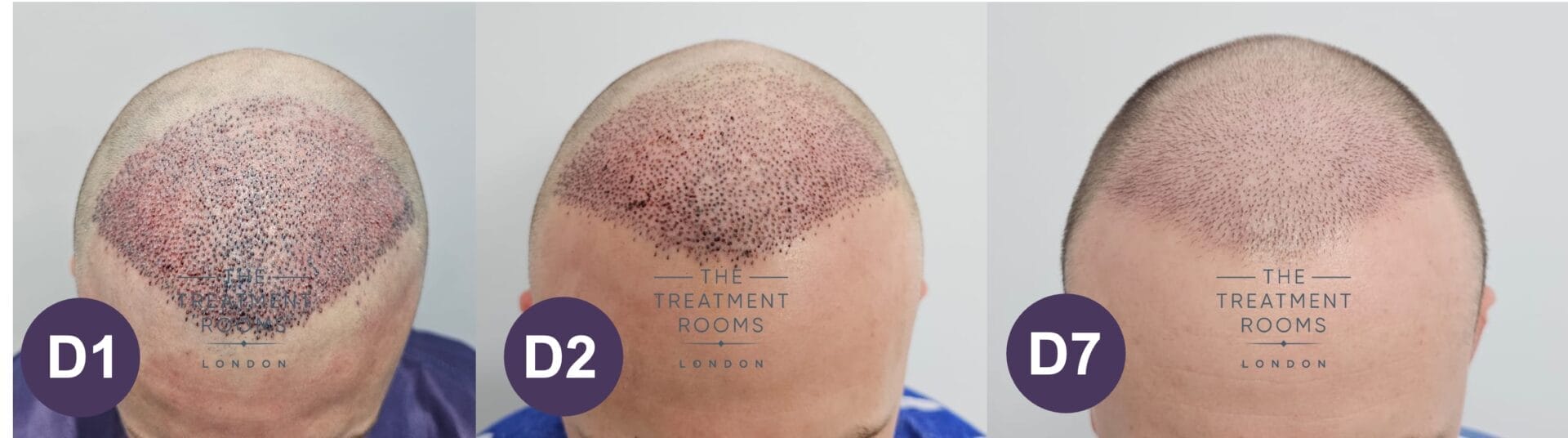
There aren’t any direct studies on Nizoral around the time of hair transplantation. We base our 10-14 day recommendation on our knowledge of the healing process of the scalp and hair follicles.
Studies show that hair follicles become fairly well embedded by day 9 post-surgery. However, these studies didn’t establish whether the skin was ready for medicated products at this point.3 In our view, it is best to wait until the incisions are fully healed, free from scabs, and the scalp looks calm before applying Nizoral to the scalp.
Guideline on Using Nizoral After a Hair Transplant
Below we discuss the correct way to apply Nizoral on a delicate scalp and how often it should be used.
Once you are advised to restart Nizoral, follow these application tips:
- Perform a patch test first on the neck or forearm to check for a potential sensitivity
- Wet the scalp using lukewarm water at a low pressure
- Place a small amount of shampoo on your palm or fingertips
- Spread it gently over your scalp without scratching or scrubbing using your fingernails. You want to gently apply it with the soft pads of your fingertips.
- Leave it in place for 3-5 minutes.4
- Rinse thoroughly with the same lukewarm water at a low pressure
- Allow the hair to air dry or pat it gently with a clean, soft towel. Do not rub it harshly with the towel.
“Once advised by your surgeon to restart Nizoral, it should be applied on the fingertips and gently massaged onto the scalp using your finger pads, taking care not to scratch or rub vigorously, especially along the recipient areas. Grafts are unlikely to get dislodged at this point; however, the recently healed scalp may be prone to irritation and small scratches. After 2 weeks, you should be able to towel dry your scalp as normal. If you have some residual redness, you may want to pat dry to avoid irritating the skin further.”
Dr Roshan Vara, Co-Founder and Surgeon at The Treatment Rooms London
How Often Should You Use It?
You should follow the usage instructions provided with the shampoo. For dandruff or seborrheic dermatitis, the Nizoral 2% shampoo is used twice a week for 2-4 weeks. It can then be used once a week or once every two weeks to prevent symptoms from returning.
Use a mild pH-balanced, non-medicated shampoo on other wash days when you are not using Nizoral.
“For some of my patients, I advise using Nizoral shampoo before surgery to treat any scaling or mild seborrhoeic dermatitis before their surgery. This can involve a twice a week application for 1 month before surgery and then continuing its application after 2 weeks have passed following their hair transplant. Depending on their scalp healing, I recommend continuing every week for 1 month after their surgery and a once-a-month application thereafter to ensure their scalp remains healthy for developing hair follicles. This protocol can vary, and I always advise my patients to reach out if they are concerned and need my help; we are always here for them.”
Dr Dilan Fernando, Co-Founder and Surgeon at The Treatment Rooms London
When Will You Start Seeing Improvement?
You should see improvements in your dandruff, itching, and flaking within the 2-4 week treatment course. Seek advice earlier if the symptoms persist or are getting worse.
Precautions
Every medicated product has a list of do’s and don’ts; pay attention to the following:
- Do not apply Nizoral to open, bleeding, or weeping skin
- Avoid scratching, scrubbing, and high-pressure shower jets
- Keep the shampoo out of your eyes and rinse carefully with water in the event of accidental contact
- Do not use it more often or for more extended times than recommended
- Do not pick or forcibly loosen crusts while shampooing
- Stop using it if you develop worsening redness, a spreading rash, blistering, or swelling
When Should You Contact a Doctor?
Contact your transplant clinic if you develop any of the following:
- Worsening or spreading redness
- Increasing pain or tenderness
- New or increasing swelling
- Bleeding that does not settle
- Yellow or green discharge
- Widespread spots
- A bad smell from the scalp
- Persistent or rapidly increasing crusting
- A rash that develops after using Nizoral
What Other Aftercare Steps Can I Consider?
Even if the grafts have become secure, it is best to continue washing gently. Avoid picking or scratching at the scalp, newly healed skin is still sensitive.
Try to restart medicated products one at a time. If you introduce several products together, it will make it harder to identify the cause if your scalp ends up becoming irritated. It is best to collaborate with your surgeon before restarting multiple treatments.
You will likely need to use some medicines applied to the scalp to continue to manage any pattern hair loss you already have and prevent further thinning to your existing native hair.
Conclusion
Most patients can use Nizoral 10-14 days after a hair transplant. This is not a fixed timeline; your individual healing process must be taken into account, and in reality the skin has to appear healed, and the scabs from your operation must be cleared first.
Nizoral is useful in controlling dandruff or seborrhoeic dermatitis. Hair regrowth follows its own cycle over the months following surgery; Nizoral doesn’t help to accelerate the growth of transplanted hairs. By following the advice provided by your transplant clinic, you should be well on your way to enjoying the benefits of your new hair look.
References
- Gupta AK, De Doncker P, Talukder M. Role of topical ketoconazole in therapeutic hair care beyond seborrhoeic dermatitis and dandruff. JEADV Clin Pract. 2025;4(4):710–718. doi:10.1002/jvc2.70026.
- Dall’Oglio F, Nasca MR, Gerbino C, Micali G. An overview of the diagnosis and management of seborrheic dermatitis. Clin Cosmet Investig Dermatol. 2022;15:1537–1548. doi:10.2147/CCID.S284671. PMID: 35967915; PMCID: PMC9365318.
- Bernstein RM, Rassman WR. Graft anchoring in hair transplantation. Dermatol Surg. 2006;32(2):198–204. doi:10.1111/j.1524-4725.2006.32033.x.
- Thornton & Ross Ltd. Nizoral 2% Shampoo: Summary of Product Characteristics. electronic Medicines Compendium. 2020. Available from: https://www.medicines.org.uk/emc/product/1510/smpc.
Share:
Authored by
Dr Roshan Vara
Dr. Roshan Vara is a renowned hair transplant surgeon in London and the Co-Founder of our award winning hair transplant clinic, The Treatment Rooms London.He has over 10 years of experience in hair transplant surgery and is recognised for delivering natural-looking results through ethical, patient-centred care. He is a Full Medical Member of BAHRS and an Associate Member of ISHRS, reflecting his commitment to the highest standards in modern hair restoration.
Reviewed by
Dr Dilan Fernando
Dr. Dilan Fernando is regarded as one of the best hair transplant surgeons in London and Co-Founder of The Treatment Rooms London. He has over 10 years of experience in hair transplant surgery and is known for his meticulous technique and commitment to ethical practice. He served on the Executive Committee of BAHRS from 2020 to 2024, helping to shape industry standards for patient safety and quality of care. Dr. Fernando personally performs each surgery, ensuring natural results built on trust and experience.
Book a Consultation
Related Blogs

Hair Transplant After 7 Days: What To Expect
October 9, 2026
Key takeaways: 7 days after your hair transplant, you can expect to see the scabs in your…

Minoxidil Side Effects: What to Expect, Risks, and How to Manage Them
October 9, 2026
Key takeaways Medications are often a first step people take when tackling pattern baldness. They can help…
What Is A Hair Graft In A Hair Transplant?
October 7, 2026
Key takeaways: What is a Hair Graft in a Hair Transplant? Hair loss can be a distressing…

Widow’s Peak Hair Transplant for Women: Everything You Need to Know
October 6, 2026
Key takeaways: There is no absolute definition of a widow’s peak in women. It is often based…

Has Steve Carell Had a Hair Transplant? What the Evidence Really Shows
October 6, 2026
Key Takeaways Steve Carell is arguably one of the most liked and versatile actors of his generation….

When Can You Drink Alcohol After Your Hair Transplant?
October 6, 2026
Key takeaways: It’s common for our patients to ask us when it is okay to resume drinking…

Has Donald Trump Had a Hair Transplant? Expert Review and What the Evidence Shows
October 6, 2026
Key Takeaways Donald Trump’s hair is one of the most talked about aspects of his appearance; from…

Wayne Rooney Hair Transplant: Expert Analysis of His Hair Loss and Restoration
October 5, 2026
Key takeaways: Wayne Rooney is widely regarded as one of the greatest football talents from England. He…

Understanding Prince Harry’s Hair Loss: Causes and Treatment Options
October 3, 2026
Key Takeaways: Prince Harry, the Duke of Sussex, has lived most of his life in the public…