

Key Takeaways
- Definition: A hair transplant permanently relocates your own hair to thinning areas.
- Techniques: FUE and FUT hair transplant surgery are the 2 main techniques, and they differ in scarring, recovery, and graft harvesting.
- Candidacy: Patients should have stable hair loss, a healthy donor area, and realistic expectations.
- Recovery: Most patients fully recover within 2 weeks, with full hair growth at 12 months.
- Risks & Aftercare: Mild side effects are common; serious complications are rare when surgery is safely done to a high quality.
Cost: Varies from £3,000 to £10,000, depending on the number of grafts and the technique.
What is a Hair Transplant?
A hair transplant is a surgical procedure that moves hair from one area of your scalp to another area where hair is thinning or missing.1 Unlike wigs or temporary fixes, it’s permanent as the hair you move continues to grow naturally.
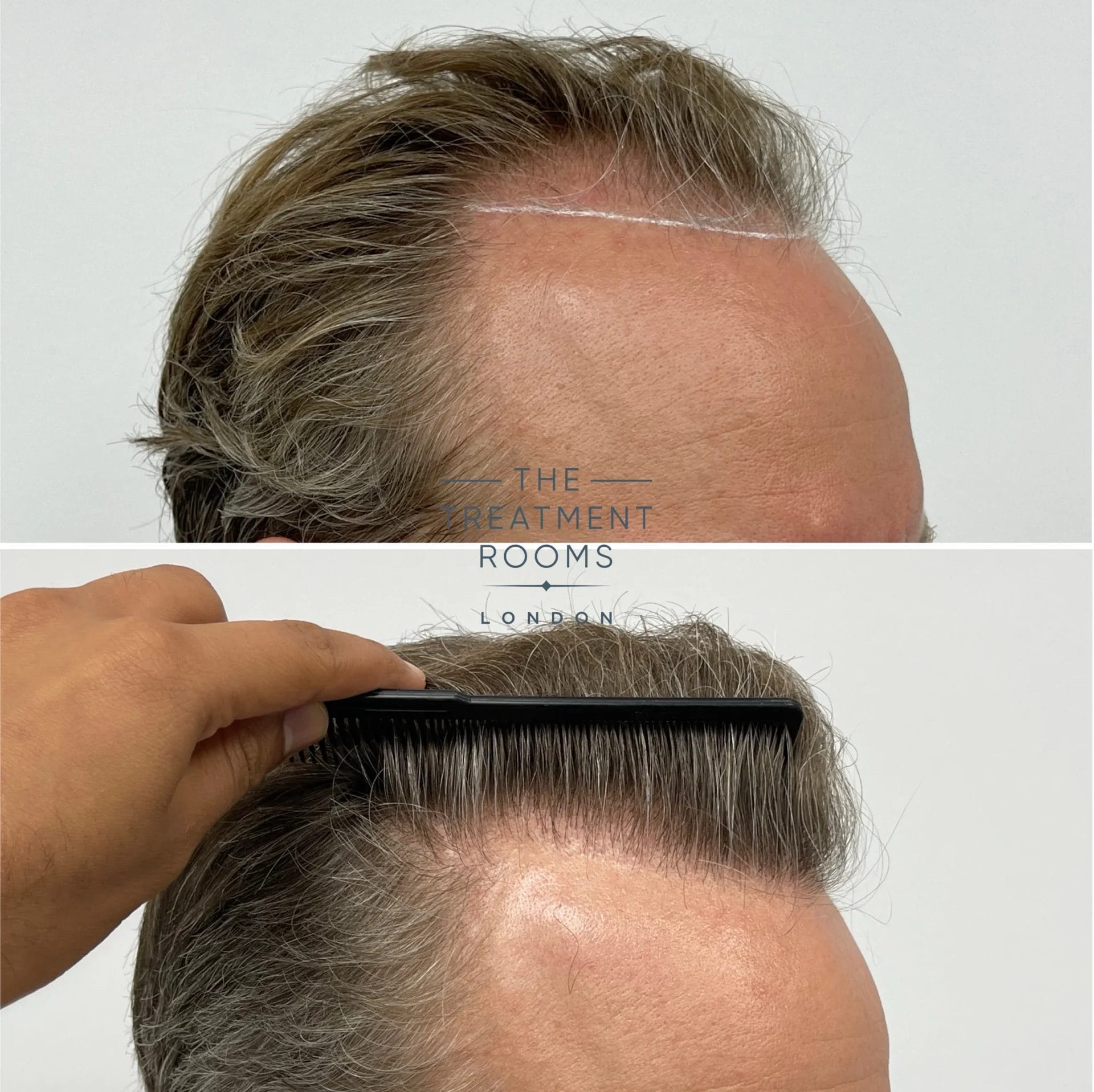
Hair transplants are increasingly popular because they offer natural-looking results that can restore density and improve appearance. Both men and women with hair loss caused by various conditions can benefit from the procedure.
A Brief History of Hair Transplant Surgery
The first recorded hair transplant was documented in 1822 in Germany, where surgeons successfully moved hair from one area of the scalp to another. However, these early techniques were not widely adopted for treating pattern baldness.
Modern hair transplantation began in Japan during the 1930s and 1940s, when dermatologists such as Dr S. Okuda described transplanting hair-bearing skin to areas affected by hair loss and scarring. These findings remained largely unknown outside Japan until after World War II.2
The foundation of modern hair restoration was established in 1959 by Dr Norman Orentreich, who introduced the principle of donor dominance. He demonstrated that hair taken from the back and sides of the scalp retains its growth characteristics when transplanted to balding areas.
Today, hair transplantation uses refined microsurgical techniques such as FUT and FUE, allowing surgeons to transplant individual follicular units with high precision. These advances have produced results that are more natural-looking, with minimal scarring and significantly improved graft survival.
How Does a Hair Transplant Work?
Not all hair is affected the same way. Male pattern baldness occurs because a hormone called Dihydrotestosterone (DHT) causes some follicles to shrink and eventually stop producing hair.
However, follicles at the back and sides of the head are genetically programmed to be resistant to DHT. When these follicles are transplanted to the thinning areas, they retain this resistance, allowing them to continue growing even in their new location.1
Hair transplantation begins with a consultation to assess your hair loss and donor area. Patients serve as their own donors; hair is never taken from another person, ensuring compatibility and eliminating the risk of rejection.
During the procedure, healthy follicles are carefully harvested from the donor area, typically the back or sides of the scalp, using one of the two main surgical methods: Follicular Unit Excision (FUE) or Follicular Unit Transplantation (FUT). Once removed, the follicles are kept in a controlled environment to maintain viability while the surgeon prepares the recipient areas. Tiny incisions are made in the thinning or bald regions, and the follicles are precisely implanted to achieve a natural-looking hairline and overall density.
After the procedure, the transplanted follicles need time to settle and establish a blood supply in their new location. Most patients start to see regrowth within a few months, with full results developing over 12 to 18 months.
Hair Restoration Techniques
In clinical practice, hair transplantation is performed using specific surgical methods designed to extract and implant follicular units with minimal trauma and optimal graft survival.
The two principal techniques used today are Follicular Unit Excision (FUE) and Follicular Unit Transplantation (FUT). These approaches differ mainly in how follicles are harvested, the type of scarring produced, and post-operative recovery.
Follicular Unit Excision (FUE)
FUE involves taking individual hair grafts from the back and sides of the head (the safe donor area) and moving them to areas of recession, such as the hairline, temples, and crown. Each graft averages 1-4 hairs.3
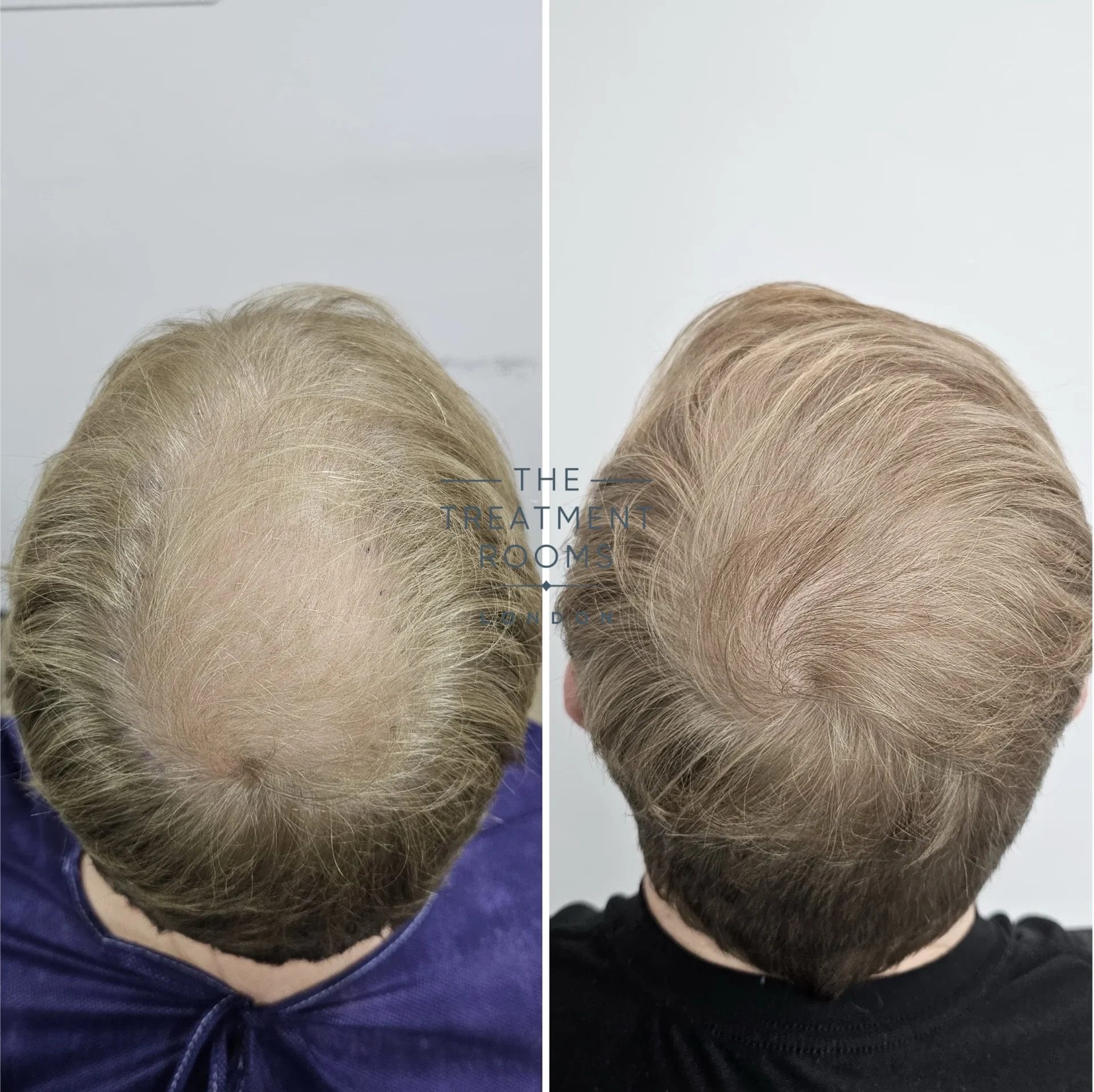
The FUE method has become highly popular due to its minimal scarring, natural-looking results, and shorter recovery time.
Follicular Unit Transplantation (FUT)
FUT, also known as the strip method, involves removing a small strip of scalp from the back of the head, from which hair follicles are then extracted and transplanted to the desired areas.4
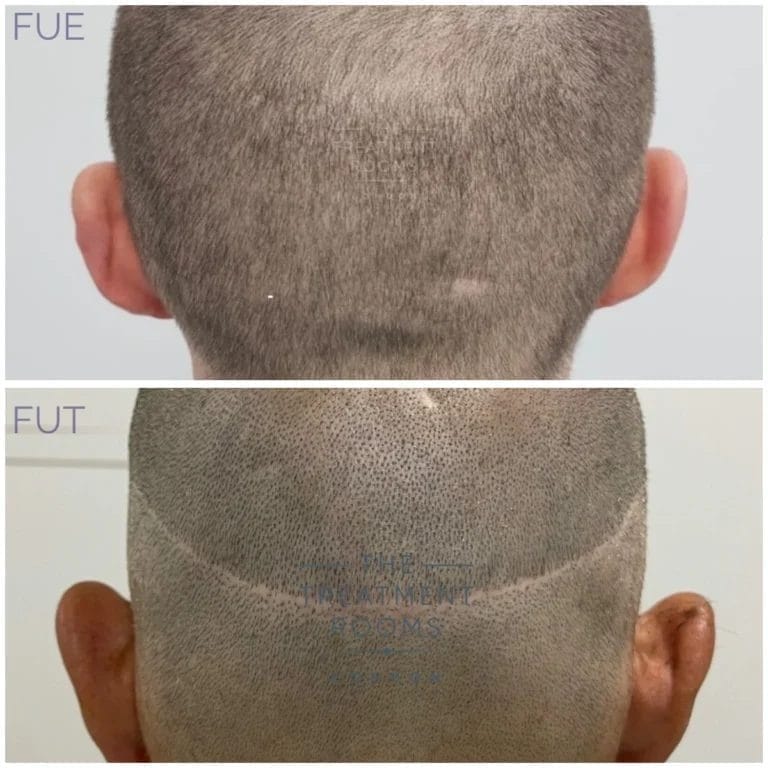
This technique can yield multiple grafts in a single session, making it beneficial for individuals with extensive hair loss. However, FUT leaves a linear scar at the donor site and has a longer recovery time than FUE hair transplant surgery.
FUT vs. FUE
The simple table below can help compare and contrast the two methods:
| FUT (Follicular Unit Transplantation) | FUE (Follicular Unit Excision) | |
| Donor Area Scarring | Linear scar | Dot-like scarring |
| Recovery Time | Longer | Shorter |
| Shave Type | Does not require a noticeable donor area shave. | Most commonly requires a donor area shave. |
| Cost | Less expensive | Slightly higher |
Who is a Good Candidate?
An ideal candidate for a hair transplant is a patient who has the following attributes:
- Stable hair loss
- Good general overall health
- A good donor area of hair
- Reasonable expectations.
- A healthy scalp
A few examples of hair loss conditions that can be addressed successfully with hair restoration surgery are:
- Most commonly, male and female pattern hair loss (also known as androgenetic alopecia)
- Pubic, facial, and body hair placement for transgender patients
- Facial hair restoration for eyebrows, beards, and sideburns after facial trauma or burns
Who Should Avoid a Hair Transplant?
While many people with pattern hair loss can benefit from a hair transplant, surgery is not suitable for everyone. Certain hair loss types, medical conditions, or personal factors can mean the surgery is not suitable or there are increased risks, and they include:
1. Active inflammatory scalp conditions
Conditions such as lichen planopilaris (LPP) or discoid lupus erythematosus cause ongoing inflammation that can destroy hair follicles and prevent transplanted hairs from taking root. This therefore, increases the risk that surgery won’t work. Surgery should only be considered once these conditions are stable.
2. Diffuse or unstable hair loss
Diffuse unpatterned alopecia or rapidly progressing hair loss can make surgical outcomes unpredictable. Medical therapy is usually recommended for 6–12 months to stabilise hair before considering a hair transplant.5
3. Insufficient hair loss or donor supply
Transplants work best when noticeable thinning has occurred, and the donor area is healthy. Young patients or those with high hair density may benefit more from medical treatments first to preserve long-term options.
4. Unrealistic expectations
Surgery can improve density, but cannot fully restore childhood hairlines. Some scalp visibility remains, and donor-area scarring may occur. Discussing realistic goals with a specialist is essential.
5. Psychological conditions
Disorders such as body dysmorphic disorder (BDD) or trichotillomania (recurrent hair-pulling) can affect satisfaction with results and complicate post-surgical care.6
6. Medical factors that may affect healing
Smoking, uncontrolled diabetes, hypertension, advanced scalp sun damage, and certain autoimmunity disorders can increase the risks and reduce graft survival.7
Hair transplant surgery takes 1 year for the results to become visible. Patients often have the impression that their result will be visible overnight, but unfortunately, it takes 9-12 months for their transplanted hair to grow through. Having patience is incredibly important for my patients.
Dr Dilan Fernando, Co-Founder and Surgeon and The Treatment Rooms London
Recovery and Aftercare
Everyone heals a little differently, but most people notice a common pattern after their hair transplant. In the first few days, mild swelling, redness, tenderness, and tiny scabs are normal. Around day four, gentle washing can usually begin as advised by your surgeon. By the end of the first two weeks, scabs fall off, tenderness eases, and patients can resume regular exercise.
Transplanted hairs may shed around two to four weeks after surgery; this is normal as follicles settle under the skin. New growth typically starts around three to four months, gradually thickening over time. Most patients see fuller, natural results by six months, with final density reached between 12 and 18 months.
Post-Operative Care
To support healing and maximise results, follow these key aftercare steps:
- Follow the surgeon’s instructions carefully for washing, handling, and grooming your hair.
- Take prescribed medications such as antibiotics or anti-inflammatories as directed.
- Protect the scalp and avoid strenuous activities for at least two weeks.
- Do not pick or scratch at scabs; allow them to wash away naturally.
- Wearing a loose-fitting hat outdoors can protect the scalp without disrupting grafts.
Hair Transplant Costs
The cost of a hair transplant varies depending on the number of grafts required and a patient’s specific surgical requirements.
The average price ranges from £3,000 to £10,000, depending on the extent of the work required.
Financing options are available to help make a procedure more affordable. You can read our blog on the cost of hair transplant.
Hair Transplant Side Effects
Like any surgery, hair transplants have side effects, but most are mild. These include temporary numbness, swelling, and redness, which usually resolve within a few days to a few weeks.
These standard hair transplant side effects are easily manageable, and serious complications are rarely seen.
When to Seek Medical Advice
Most hair transplants heal smoothly, but if you experience certain warning signs, it’s important to contact your surgeon right away. This helps address any issues quickly and safely.
- Heavy bleeding
- Sudden onset of severe rash, skin bumps, or cysts (signs of infection)
- Wound incision opening in FUT hair transplant surgery
- Skin that has turned a dusky colour and is crusty
References
1. Goldin J, Zito PM, Raggio BS. Hair Transplantation. In: StatPearls [Internet]. Treasure Island (FL): StatPearls Publishing; 2025 Jan– [updated August 2, 2025]. Available from: https://www.ncbi.nlm.nih.gov/books/NBK547740/
2. International Society of Hair Restoration Surgery (ISHRS). History of ISHRS. ISHRS [Internet]. c2026 [cited 2026 Feb 2]. Available from: https://ishrs.org/about/history/
3. Sharma R, Ranjan A. Follicular Unit Extraction (FUE) Hair Transplant: Curves Ahead. J Maxillofac Oral Surg. 2019 Dec;18(4):509–517. doi:10.1007/s12663-019-01245-6. PMID:31624428; PMCID:PMC6795649.
4. Pothula SR, Jayanth BS. Hair Transplantation. In: Oral and Maxillofacial Surgery for the Clinician. Singapore: Springer; 2021. p. 707–730. doi:10.1007/978-981-15-1346-6_34.
5. Mendoza LA, Ocampo GG, Abarca-Pineda YA, Khan MA, Ahmadi Y, Brown N, Deowan D, Nazir Z. Comprehensive review on hair loss and restorative techniques: advances in diagnostic, artistry, and surgical innovation. Cureus. 2025 Apr 25;17(4):e82991. doi:10.7759/cureus.82991. PMID: 40416167; PMCID: PMC12103887.
6. Cleveland Clinic. Body Dysmorphic Disorder: Symptoms & Treatment. Cleveland Clinic Health Library. Medically reviewed 11 Jan 2023. Available from: https://my.clevelandclinic.org/health/diseases/9888-body-dysmorphic-disorder.
7. Guo S, DiPietro LA. Factors affecting wound healing. J Dent Res. 2010 Mar;89(3):219–229. doi:10.1177/0022034509359125. PMID: 20139336; PMCID: PMC2903966. Available from: https://www.ncbi.nlm.nih.gov/pmc/articles/PMC2903966/
Share:
Authored by
Dr Roshan Vara
Dr. Roshan Vara is a renowned hair transplant surgeon in London and the Co-Founder of our award winning hair transplant clinic, The Treatment Rooms London.He has over 10 years of experience in hair transplant surgery and is recognised for delivering natural-looking results through ethical, patient-centred care. He is a Full Medical Member of BAHRS and an Associate Member of ISHRS, reflecting his commitment to the highest standards in modern hair restoration.
Reviewed by

Dr Dilan Fernando
Dr. Dilan Fernando is regarded as one of the best hair transplant surgeons in London and Co-Founder of The Treatment Rooms London. He has over 10 years of experience in hair transplant surgery and is known for his meticulous technique and commitment to ethical practice. He served on the Executive Committee of BAHRS from 2020 to 2024, helping to shape industry standards for patient safety and quality of care. Dr. Fernando personally performs each surgery, ensuring natural results built on trust and experience.
Book a Consultation
Related Blogs

Understanding Hair Loss in People with Trichotillomania
August 29, 2026
Key Takeaways: What Is Trichotillomania? Trichotillomania, also known as trich, is a condition where people cannot control…

Can Excessive Exercise Cause Hair Loss?
August 28, 2026
Key Takeaways: You may be wondering if your workout is causing your hair loss. Oftentimes, if you…

Did Rob Brydon Have a Hair Transplant? Here Is All You Need to Know
August 26, 2026
Key Takeaways Rob Brydon is one of Britain’s best-known performers with over 40 years of being in…

Did Cesc Fàbregas Have a Hair Transplant? Our Review of His Hair Loss and Restored Hairline
August 23, 2026
Key Takeaways Known as a creative central midfielder at major football clubs like Arsenal, Barcelona, and Chelsea,…
Stem Cell Hair Transplant & The Future of Hair Restoration
August 22, 2026
Key Takeaways: What Is a Stem Cell Hair Transplant? Stem cell hair transplants are a group of…

Does Finasteride Affect Your Sperm? What the Evidence Shows
August 21, 2026
Key Takeaways You may be considering or have already started using finasteride to manage your hair loss….
Does Folliculitis Cause Hair Loss? Symptoms, Causes and Treatment Options
August 20, 2026
Key Takeaways Folliculitis is the inflammation of a hair follicle (the opening in the skin from which…

How Much is Normal Hair Loss Per Day for a Female?
August 20, 2026
Key Takeaways: How Much Hair Loss Is Normal Each Day? We lose on average 50-100 hairs each…

Can a Norwood 7 Get a Hair Transplant? All You Need to Know: All You Need to Know
August 19, 2026
Key Takeaways: Hair transplantation may be possible for selected patients with Norwood 7 hair loss. Full density…