

Key Takeaways
- How does Finasteride and Dutasteride work? Both medicines lower dihydrotestosterone (DHT), a hormone involved in male pattern hair loss.
- Are they licensed for hair loss in the UK? Finasteride is licensed for male pattern baldness in the UK. Dutasteride’s use in hair loss is currently off-label.
- Which is more effective? There are two subtypes of DHT-producing enzymes. Dutasteride blocks both forms, whereas finasteride blocks one. Dutasteride is recognised as being more effective as it places a stronger block on the production of DHT.1
- How long do they take to show results? Neither treatment will work overnight, it usually takes 12 months before you see the benefits with continuous use.
- Are there any side effects? Sexual and psychiatric side effects can occur with both medicines. This is why it is important that you have a discussion about the medication and its side effects with your doctor at the time of prescription.
When it comes to hair loss, you may have heard of 2 treatments called Finasteride and Dutasteride. They are often compared in discussions about male pattern hair loss because they both share a similar mechanism of action by reducing DHT levels and both are available in tablet form.
What are finasteride and dutasteride?
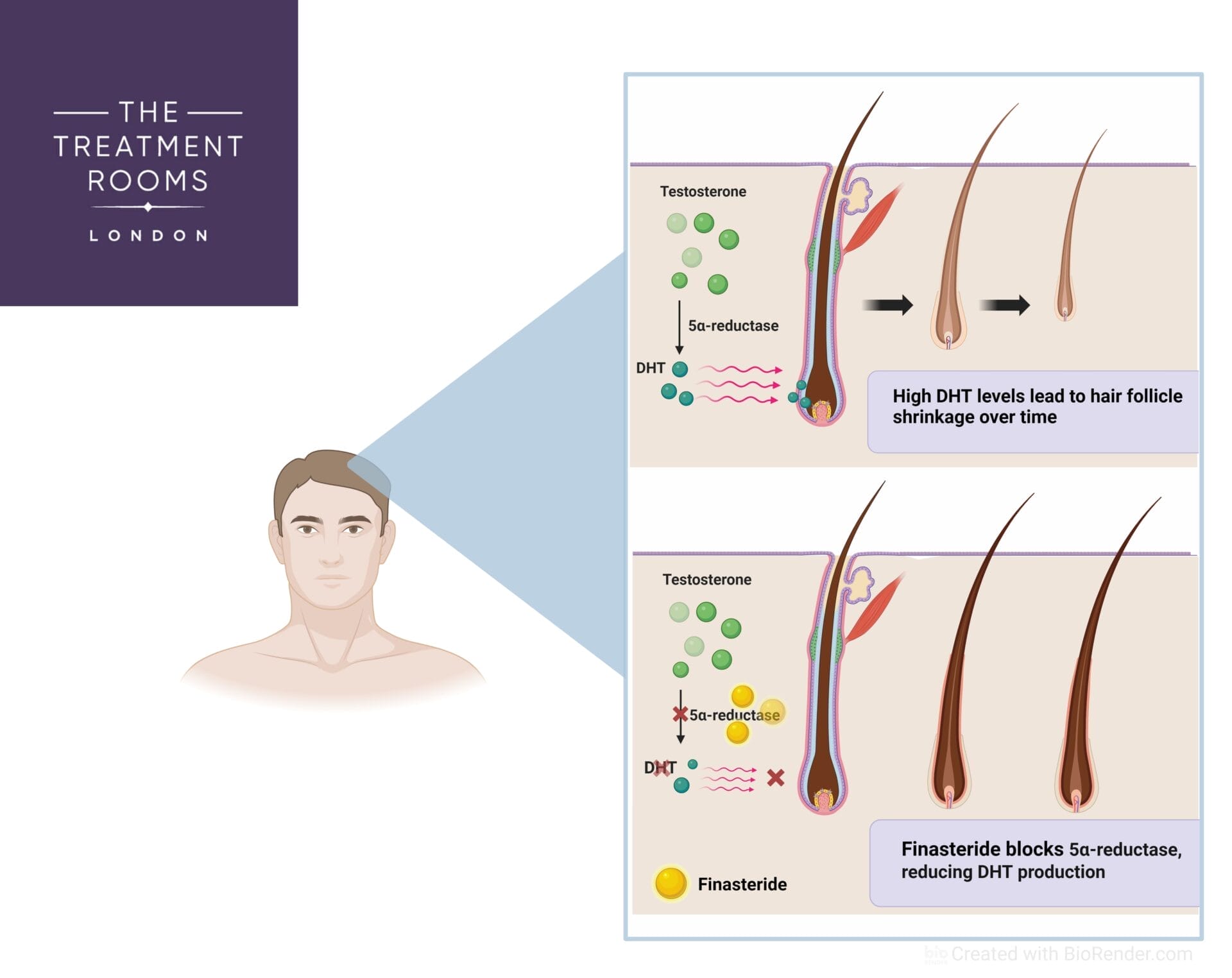
Finasteride and dutasteride belong to a group of medicines called 5-alpha-reductase inhibitors. Quite simply, they interfere with the body’s ability to produce DHT, which is the main process in male pattern hair loss.
Finasteride is licensed for use in the UK for male pattern hair loss; dutasteride is prescribed off-label for the same purpose.
Finasteride
Finasteride mainly inhibits an enzyme called type II 5-alpha-reductase, one of the enzymes that converts testosterone into DHT. In the UK, finasteride 1mg tablets are licensed for use in male pattern baldness (known medically as androgenetic alopecia). It is rarely prescribed in women and never in children.2
Finasteride for hair loss is available by private prescription rather than through routine NHS prescribing.3 Before you are issued with a prescription, your doctor will need to establish whether you actually have male pattern baldness. This can involve further examination or even referral to a dermatologist first.
Dutasteride
Dutasteride can be considered a close pharmacological relative of finasteride. It works in much the same way but casts a wider net. It inhibits both forms of the enzyme 5-alpha-reductase, type I and type II. It is mainly prescribed in the UK for moderate or severe symptoms of an enlarged prostate gland (benign prostatic hyperplasia). Hair loss is not one of its licensed uses.5
Therefore, if you are prescribed dutasteride for hair loss, it will be off-label. The doctor feels it can provide you more benefit than risk, but it doesn’t have a specific authorisation for this purpose. This does not mean it is being prescribed casually, your diagnosis will have to be confirmed first, and the reasons why it will benefit you should be clear.
A specialist may prescribe you with dutasteride if you have tried Finasteride and you have not seen much benefit. You will be made aware of the risks and benefits, including the fact that dutasteride can take months to be removed from the body after you stop taking it.
How do they work?
The underlying mechanism of these two medications is quite straightforward.
- Testosterone is converted into DHT. This is done by the enzyme 5-alpha-reductase.
- DHT acts on susceptible hair follicles. It shortens their active growth phase and drives a process called miniaturisation, whereby the hairs become thinner and shorter over time.
- Finasteride blocks type II 5-alpha-reductase. This lowers the amount of DHT in your scalp and circulating in your system.
- Dutasteride blocks types I and II 5-alpha-reductase. This leads to an even greater decrease in DHT than finasteride alone.
- Lower DHT may protect the viable hair follicles. This slows down further miniaturisation and can preserve existing hair. It may even allow weakened follicles to begin producing thicker hairs.
Neither medication can work on follicles that have already stopped hair production. The earlier you treat the miniaturisation process, the more follicles you can potentially save.
Finasteride vs dutasteride: key differences
On paper, dutasteride has a bigger impact as it blocks the largest amount of DHT from being produced. However, in practice, there are more factors that need to be weighed up.
The difference in how long each lasts in your body is the most significant. Finasteride stays in your system for hours after you stop taking it. For dutasteride, it remains in the system for weeks. This means if a side effect takes place, stopping dutasteride won’t bring the exposure to an immediate end.
Although dutasteride is pharmacologically stronger than finasteride, you will likely be advised to try finasteride first, because it is easier to clear from your system if you develop adverse effects.
“Most of our patients will start on finasteride, and that is because in the vast majority of them, they will respond well to it. If we have a patient who continues to lose hair despite taking Finasteride, we will often discuss the option of taking Dutasteride with them.”
Dr Bijaya Laxmi Gurung, Hair Transplant Surgeon at The Treatment Rooms London
What does current research show?
The evidence for finasteride is older and has been tracked over longer periods of time. One of the earlier studies was carried out over a two-year period, which showed an improvement in hair count and progress in photographs compared to not taking finasteride.6
In shorter head to head research, dutasteride has frequently come out on top when measuring hair count and the density of hair from consistent photographs.7 More recently, research has shown dutasteride to produce better results longer term as well.1
The reported rates of side effects such as reduced sex drive, erectile dysfunction, and ejaculation problems were broadly comparable between both finasteride and dutasteride.8
How are they used?
Both medicines require a prescription from a doctor. Most importantly, they need a correct diagnosis first.
For confirmed male pattern hair loss, licensed finasteride is taken once daily at a dose of 1mg, either with food or on an empty stomach. For dutasteride, there is no UK-licensed regimen for hair loss. Your prescriber will direct your dosage and how often you need a review. Most commonly, it is prescribed at a dose of 0.5mg once a day.
How long before results appear?
Hair changes can be tricky to spot. Because they happen gradually, the best way to notice any changes is by taking consistent photographs of your hair.
- Months 0–3: Usually too soon to know how well it is working for you. Make sure you take clear photographs at the beginning of treatment, keep using the medicine consistently, and look out for any side effects. You may notice some early shedding of hair, which is expected as the finasteride and dutasteride push weaker hairs out of the resting phase of hair growth to make way for thicker and healthier strands.
- Months 3–6: Shedding may ease up at this point, generally, this is when you notice the pattern of your hair looking more stable.
- Months 6–12: This is a useful assessment window of your progress to date. You can compare photographs taken in the same light, from the same angles, and with similar hair length from the beginning of the treatment.
- Longer term: In order to continue seeing benefits, you generally need to keep using the medicines. Finasteride’s effect begins to reverse within a few months after stopping its use. Dutasteride’s effects may take longer to reverse as it takes longer to leave your system.
If the hair loss ends up accelerating, the pattern changes, or you notice side effects, reach out to your prescriber with your concerns.
“Many patients start Finasteride and Dutasteride and then stop a few months later without seeing any benefit. This is because they expect the medication to be making a difference within 1-6 months, but this just isn’t the case. At our clinic, we explain that these medications take time to work, and our patients ought to wait until 1 year has passed before assessing the outcome.”
Dr Bijaya Laxmi Gurung, Hair Transplant Surgeon at The Treatment Rooms London
Side effects and safety considerations
Many men get on well with the treatment; some do not. This is why it’s important that your health is monitored to make sure everything is as it should be. Sometimes you may experience side effects. These are similar for both finasteride and dutasteride and could include:2,5,9
- Reduced sexual desire
- Difficulty getting or maintaining an erection
- Ejaculation problems or a low volume of semen
- Changed sperm count or other possible effects on fertility
- Low mood, depression, or suicidal thoughts
- Breast tenderness, breast enlargement, a lump or nipple discharge
It may be possible that sexual dysfunction may persist after you stop treatment, as has been reported in a small number of cases. It is not currently possible to know beforehand who this will affect.
There is also a possibility of some psychiatric side effects. If you take finasteride or dutasteride and are feeling depressed or having thoughts about harming yourself, then please stop the medication and contact a doctor as soon as possible.
If you feel that you may seriously harm yourself, then call 999 or go to A&E immediately. This is not common with the medication, but is something you should be aware of.3
Which treatment might be more suitable?
Finasteride is usually the first choice for many adult men who have been officially diagnosed with male pattern baldness and want treatment to reduce their DHT levels. It is licensed exactly for this purpose, and it has the benefit of being cleared from the bloodstream sooner than dutasteride if there happen to be side effects.
Dutasteride is usually an option reserved for men who have already tried finasteride and are not happy with the results. It will be prescribed after you are made aware of the benefits and risks and you are able to follow up properly with care and assessments.
Before treatment is escalated from finasteride to dutasteride, it is important to understand the reasons as to why the finasteride might not have proved beneficial.
It is a good time to reassess whether the original diagnosis of pattern baldness was the right one, whether it was taken consistently, and whether it was given enough time to take effect. After this has been explored, your doctor will decide whether you are a good candidate to try dutasteride and see what improvements it can bring.
Each option will ultimately be weighed up by your doctor before giving a recommendation of what will be best for your individual care.
Other ways to treat male pattern hair loss
When you have pattern hair loss, the choices are not solely limited to either finasteride or dutasteride. Other options may include:
Topical minoxidil
When applied directly to the scalp, this medication helps place hairs back in the active growth phase from resting. It is a well-established treatment for male pattern hair loss.
Oral minoxidil
This is similar to the topical form, however taken as a tablet. It avoids the difficulty of applying the foam directly to your scalp; however, it may have more whole-body effects such as changes in blood pressure, swelling, and increased hair growth in potentially undesirable parts of the body.
Combination
A clinician may pair treatments together. For example, you may be offered topical minoxidil alongside finasteride to get the benefits of both to improve your hair density.
More treatment does not always make for better treatment. Each additional medication should target a specific factor contributing to your hair loss.
Can you have a hair transplant?
Whether you can have a hair transplant depends on the distribution and amount of hair on your head. The pattern and cause of your hair loss also needs to be taken into account. This is not always completely separate from medical options.
Oftentimes, patients who get a hair transplant will have a medical treatment alongside in order to boost the result and prevent your native hairs from continuing to thin around the transplanted hairs.
Conclusion
Finasteride is the better established UK-licensed oral treatment for hair loss in men. It is usually chosen ahead of dutasteride.
Dutasteride has shown promise of being stronger than finasteride in promoting hair thickening and growth. Ultimately, you will be assessed according to your individual needs, and a decision will be reached which balances the benefits and risks of starting either finasteride or dutasteride.
References
- Choi GS, Sim WY, Kang H, Huh CH, Lee YW, Shantakumar S, et al. Long-term effectiveness and safety of dutasteride versus finasteride in patients with male androgenic alopecia in South Korea: a multicentre chart review study. Ann Dermatol. 2022;34(5):349–59. doi:10.5021/ad.22.027. (PubMed)
- Milpharm Ltd. Finasteride 1 mg film-coated tablets: Summary of Product Characteristics [Internet]. Electronic Medicines Compendium. Updated 17 March 2026 [cited 24 August 2026]. Available from: https://www.medicines.org.uk/emc/product/7068/smpc
- Medicines and Healthcare products Regulatory Agency. Finasteride and dutasteride—updated safety warnings for psychiatric side effects and sexual dysfunction. Drug Safety Update [Internet]. 2026;19(10):1. Available from: https://www.gov.uk/drug-safety-update/finasteride-and-dutasteride-updated-safety-warnings-for-psychiatric-side-effects-and-sexual-dysfunction
- Kinoshita-Ise M, Fukuyama M, Ohyama M. Recent advances in understanding of the etiopathogenesis, diagnosis, and management of hair loss diseases. J Clin Med. 2023;12(9):3259. doi:10.3390/jcm12093259
- Milpharm Ltd. Dutasteride 0.5 mg soft capsules: Summary of Product Characteristics [Internet]. Electronic Medicines Compendium. Updated 17 July 2026 [cited 24 August 2026]. Available from: https://www.medicines.org.uk/emc/product/9277/smpc
- Kaufman KD, Olsen EA, Whiting D, Savin R, DeVillez R, Bergfeld W, et al. Finasteride in the treatment of men with androgenetic alopecia. J Am Acad Dermatol. 1998;39(4 Pt 1):578–589. doi:10.1016/S0190-9622(98)70007-6
- Gubelin Harcha W, Barboza Martínez J, Tsai TF, Katsuoka K, Kawashima M, Tsuboi R, et al. A randomized, active- and placebo-controlled study of the efficacy and safety of different doses of dutasteride versus placebo and finasteride in the treatment of male subjects with androgenetic alopecia. J Am Acad Dermatol. 2014;70(3):489–498.e3. doi:10.1016/j.jaad.2013.10.049
- Zhou Z, Song S, Gao Z, Wu J, Ma J, Cui Y. The efficacy and safety of dutasteride compared with finasteride in treating men with androgenetic alopecia: a systematic review and meta-analysis. Clin Interv Aging. 2019;14:399–406. doi:10.2147/CIA.S192435
- Lee S, Lee YB, Choe SJ, Lee WS. Adverse sexual effects of treatment with finasteride or dutasteride for male androgenetic alopecia: a systematic review and meta-analysis. Acta Derm Venereol. 2019;99(1):12–17. doi:10.2340/00015555-3035
National Health Service. Hair loss [Internet]. NHS. Reviewed 24 January 2024 [cited 24 August 2026]. Available from: https://www.nhs.uk/symptoms/hair-loss/
Share:
Authored by

Dr Roshan Vara
Dr. Roshan Vara is a renowned hair transplant surgeon in London and the Co-Founder of our award winning hair transplant clinic, The Treatment Rooms London.He has over 10 years of experience in hair transplant surgery and is recognised for delivering natural-looking results through ethical, patient-centred care. He is a Full Medical Member of BAHRS and an Associate Member of ISHRS, reflecting his commitment to the highest standards in modern hair restoration.
Reviewed by

Dr Dilan Fernando
Dr. Dilan Fernando is regarded as one of the best hair transplant surgeons in London and Co-Founder of The Treatment Rooms London. He has over 10 years of experience in hair transplant surgery and is known for his meticulous technique and commitment to ethical practice. He served on the Executive Committee of BAHRS from 2020 to 2024, helping to shape industry standards for patient safety and quality of care. Dr. Fernando personally performs each surgery, ensuring natural results built on trust and experience.
Book a Consultation
Related Blogs

A Guide to the Norwood Hamilton Scale: Understanding Hair Loss Stages
October 19, 2026
Key takeaways: The Norwood scale (also known as the Hamilton-Norwood scale) is the main classification system used…
When Do Scabs Fall Off After Having a Hair Transplant?
October 17, 2026
Key takeaways: Scabs will form immediately after having a hair transplant and should wash away after 7-10…
What Happens If You Stop Using Minoxidil
October 13, 2026
Key Takeaways: If you’ve been consistently applying minoxidil to support your hair growth and have been doing…

Hair Transplant After 7 Days: What To Expect
October 9, 2026
Key takeaways: 7 days after your hair transplant, you can expect to see the scabs in your…

Minoxidil Side Effects: What to Expect, Risks, and How to Manage Them
October 9, 2026
Key takeaways Medications are often a first step people take when tackling pattern baldness. They can help…
What Is A Hair Graft In A Hair Transplant?
October 7, 2026
Key takeaways: What is a Hair Graft in a Hair Transplant? Hair loss can be a distressing…

Widow’s Peak Hair Transplant for Women: Everything You Need to Know
October 6, 2026
Key takeaways: There is no absolute definition of a widow’s peak in women. It is often based…

Has Steve Carell Had a Hair Transplant? What the Evidence Really Shows
October 6, 2026
Key Takeaways Steve Carell is arguably one of the most liked and versatile actors of his generation….
When Can You Drink Alcohol After Your Hair Transplant?
October 6, 2026
Key takeaways: It’s common for our patients to ask us when it is okay to resume drinking…