

Jude Law, the British actor known for roles in The Talented Mr Ripley, Sherlock Holmes, and Fantastic Beasts, has long been open about his hair loss.
However, fluctuations in his hairline over the past decade have led to recurring speculation about whether he has undergone a hair transplant. A review of publicly available photographs suggests periods of noticeable improvement, followed by renewed thinning, a pattern that warrants closer examination.
Has Jude Law Been Open About Having a Hair Transplant?
Jude Law has not been open about having a hair transplant. However, a review of his appearances from his early career through to the present day will form the basis of our assessment of the likely treatment he received.
Jude Law Before and After Hair Transplant
Signs of male pattern baldness were visible in Jude Law’s hair as early as 1994’s film Shopping, making him one of the younger celebrities to exhibit early-onset hair loss. By 1999, in The Talented Mr Ripley, Law was 26 years old and already showing a widow’s peak and mild temple recession, though his overall density remained strong.
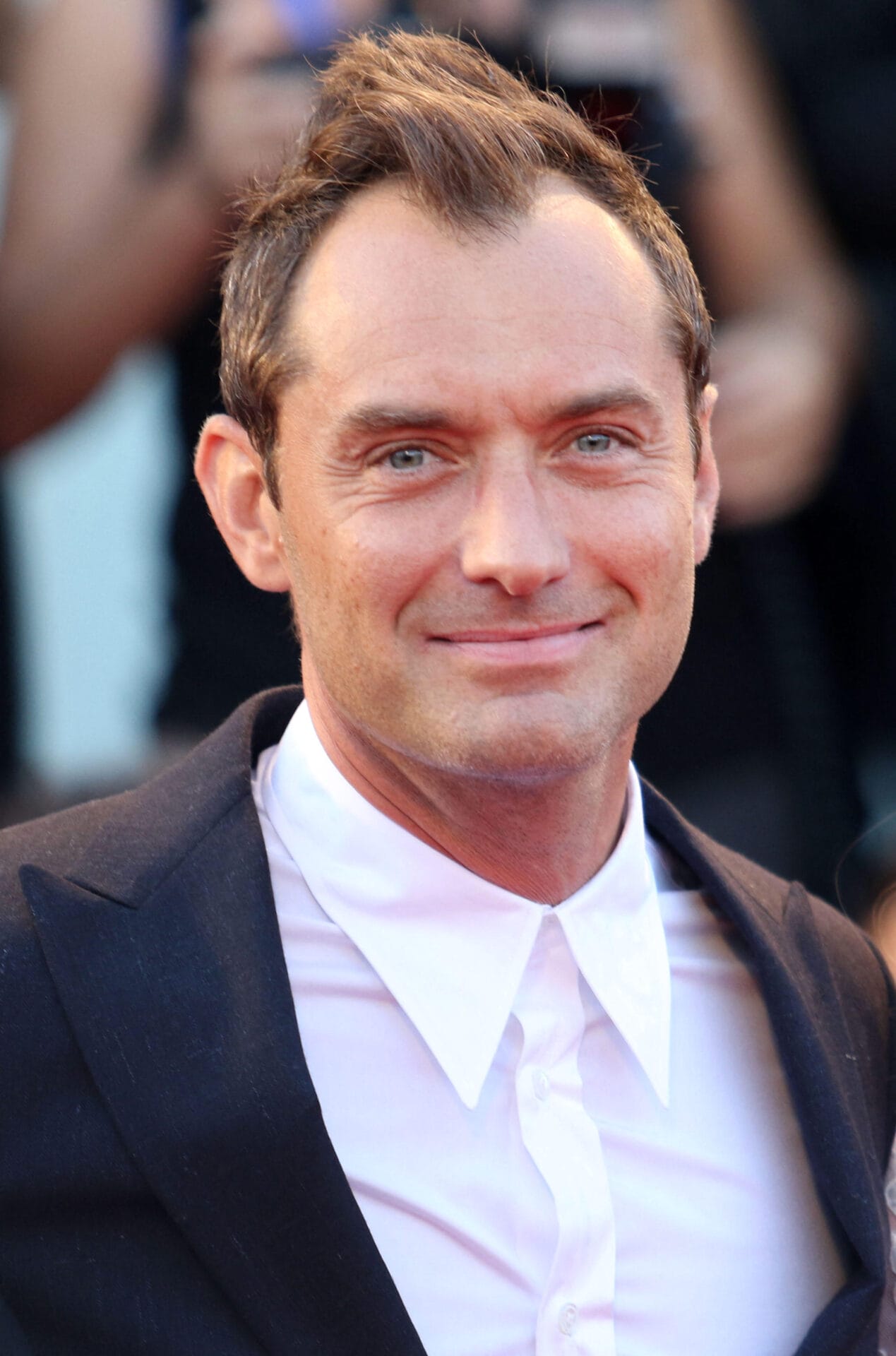
This is a common presentation caused by dihydrotestosterone (DHT), a hormone derivative that progressively miniaturises hair follicles in genetically susceptible men. Law is far from alone, as 25% of men begin experiencing some form of hair loss by the age of 21.
Through the early 2000s, his receding hairline continued to progress. By 2013, photographs showed the hairline had moved significantly further back, with the widow’s peak nearly isolated and visible thinning across the crown. At this stage, his pattern is consistent with approximately Norwood 3–4 on the Norwood Scale

By 2015, the recession had peaked. The M-shaped hairline was clearly defined, with the temple corners retreating further. This is a classic presentation of DHT-driven genetic hair loss, progressing along an established pattern.
By late 2018, around the time he played young Dumbledore in Fantastic Beasts: The Crimes of Grindelwald, there was a visible improvement. Law’s hair appeared noticeably denser, his temple recession less severe, and his frontal hairline more defined. The improvement was sufficient to prompt renewed speculation.
However, by 2024, his hair loss had returned to a similar level. This fluctuation is clinically relevant. Transplanted follicles are resistant to DHT and do not respond to it. The evidence here points toward temporary interventions rather than surgery.
Has Jude Law Had a Hair Transplant, and Why?
Based on the photographic timeline, our surgeons believe a permanent surgical hair transplant has not been confirmed and, on balance, is unlikely. Transplanted follicles are resistant to DHT and retain that resistance when transplanted to the recipient site. This means transplanted hair does not fall out. The apparent reversal seen after 2018, in which density significantly improved only to recede by 2024, is inconsistent with typical hair transplant results.
The more plausible explanation is a combination of temporary measures: hair-loss medication such as finasteride or minoxidil (effective while taken but reversible on cessation), PRP treatments, and hair systems for specific film roles. This is a well-trodden path for actors who need to present differently on screen than off.
In the public eye, appearance is important to celebrities, and they have less room for error when hiding their hair loss.
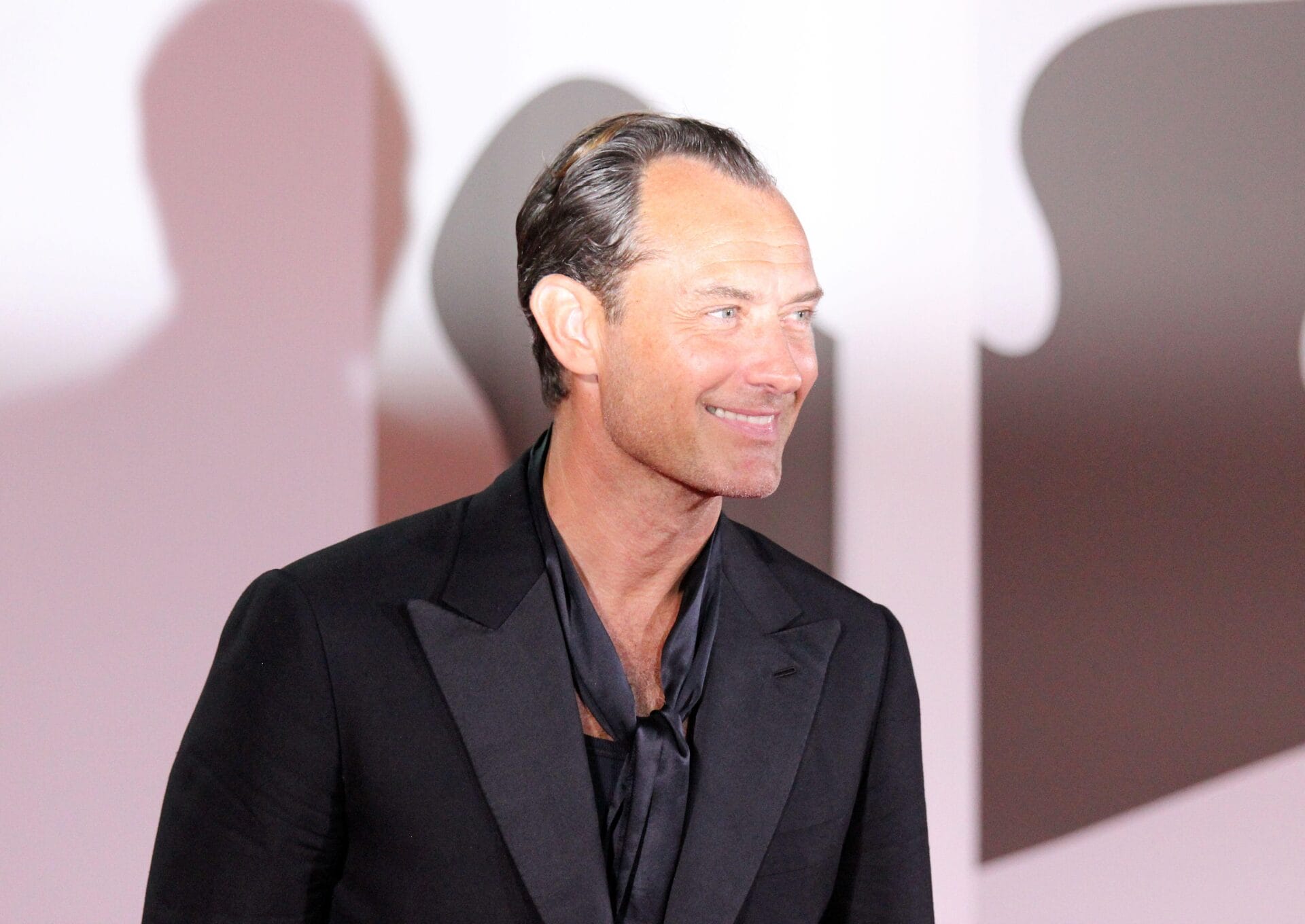
That said, Law is at the stage where a hair transplant would produce a genuinely transformative, permanent result. Many celebrities in comparable situations, including Jimmy Carr, David Beckham, Rob Holding and Ben Stokes, have taken that decision.
For many people who have had a hair transplant, one of the major benefits is the emotional freedom it brings, enabling them to feel comfortable in their own skin and style their hair as they please.
How Many Grafts Would Jude Law Need?
If Law were to undergo a hair transplant today, our surgeons estimate he would need in the region of 2,500–3,000 grafts to address his Norwood 3–4 pattern, covering the temple recession, frontal density, and crown thinning. Each graft typically contains 2–4 hairs, meaning that total restoration could range from 6,000 to 8,000 hairs.
See our gallery to find examples of comparable results, or use The Treatment Rooms London Graft Calculator to estimate your own requirements.
What Type of Hair Transplant Would Suit Jude Law?
Given there is no clear period in Law’s public career during which he visibly shaved his head, any procedure he might consider would most likely involve an unshaven FUE technique.
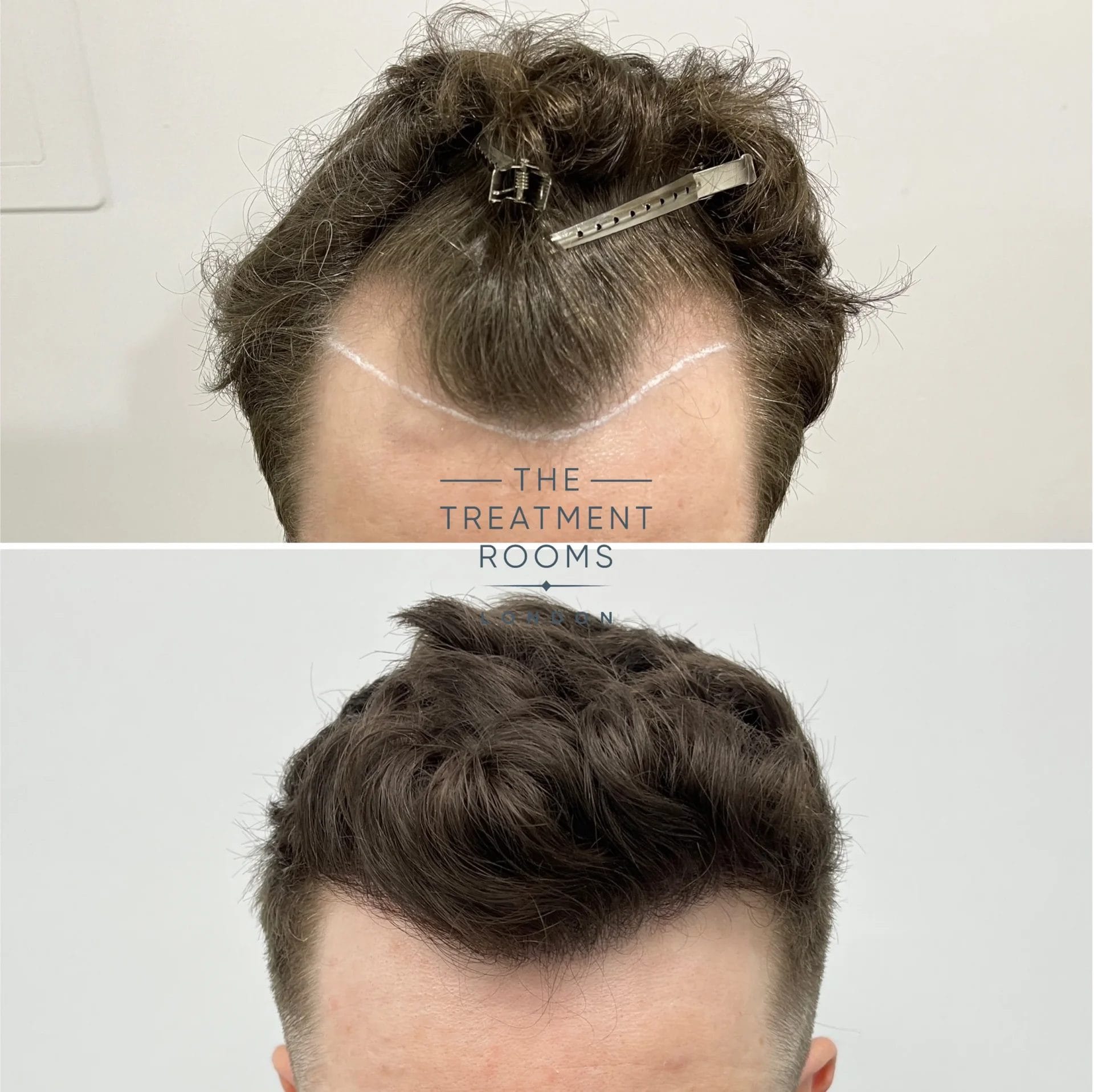
Follicular Unit Excision (FUE): FUE involves harvesting individual hair follicles from the donor area and transplanting them into the target zones — in Law’s case, the temples and frontal hairline. It leaves minimal dot-like scarring in the donor zone, heals quickly, and allows a return to camera-facing work with no visible evidence of surgery.
Follicular Unit Transplantation (FUT) Strip: FUT removes a strip of scalp from the donor site to extract follicles in high volume, useful for more advanced hair loss patterns. However, it leaves a linear scar at the back of the head, which would be visible if Law wished to wear his hair short. For a high-profile actor requiring discretion, FUT is unlikely to be the preferred approach.
Both techniques are routinely performed at The Treatment Rooms London. Unshaven FUE, in particular, allows for the most seamless recovery with minimal disruption to normal daily life.
Special Considerations for Jude Law’s Hair
Widow’s peak and natural hairline anatomy: Law has always had a pronounced widow’s peak. Any surgical restoration must respect this natural anatomy; an artificially lowered or overly straight hairline would look immediately out of place on his face. A conservative design that works within his natural hairline shape is essential.
M-shaped recession: The defined M-shaped hairline requires precise placement of single-hair grafts at the frontal edge to ensure a soft, graduated transition. Larger grafts placed too close to the hairline can create a plug-like appearance, a sign of poorly executed surgery.
Hair texture: Law’s naturally wavy, medium-calibre hair is well-suited to transplant surgery. Wavy hair provides strong surface coverage per graft due to its physical spread, and its colouring offers reasonable scalp contrast, allowing a skilled surgeon to create convincing density with a moderate graft count.
Age-appropriate design: Any restoration should produce a believable, mature result. A hairline design that is too low or too dense at his age looks artificial and may require revision later.
Where Would Jude Law Get His Hair Transplant?
Based on the evidence, Jude Law has most likely relied on non-surgical options to manage his hair loss and has, for the most part, chosen to accept it. That is a perfectly valid path.
However, for those who reach the point Law is at now, medication can only partially and temporarily address a Norwood 3–4 pattern. A hair transplant remains the only option capable of delivering a permanent result, and when that decision is made, the choice of clinic matters enormously.
At The Treatment Rooms London, our surgeons have mastered both the art and science of hair transplants, offering patients world-class care before, during, and after their procedure. Our surgeons will consider factors such as hair texture, curl pattern, and natural hairline progression to create a seamless, undetectable transition from existing hair to transplanted areas.
When considering a hair transplant, selecting a reputable, surgeon-led clinic is crucial. Top-tier clinics provide personalised assessments, employ highly skilled medical teams, and utilise cutting-edge technology to ensure precise, natural-looking results.
FAQs
Has Jude Law confirmed a hair transplant?
No. He has publicly stated he is unbothered by his hair loss and has never confirmed any surgical procedure.
What caused the improvement in his hair around 2018?
The improvement around 2018 was most likely temporary, consistent with hair loss medication, PRP treatments, or a hair system for his film role. The results did not persist through 2024, which is inconsistent with permanent transplant outcomes.
What type of hair loss does Jude Law have?
Androgenetic alopecia (male pattern baldness), presenting as approximately Norwood 3–4 with temple recession and an M-shaped hairline.
How many grafts would he need?
Our surgeons estimate that 2,500–3,000 grafts will be needed to restore his temples, frontal density, and crown.
Would a hair transplant look natural on Jude Law?
Yes. His natural widow’s peak, wavy hair texture, and overall facial structure lend themselves well to a conservative, age-appropriate result that would be entirely undetectable.
Share:
Authored by
Dr Roshan Vara
Dr. Roshan Vara is a renowned hair transplant surgeon in London and the Co-Founder of our award winning hair transplant clinic, The Treatment Rooms London.He has over 10 years of experience in hair transplant surgery and is recognised for delivering natural-looking results through ethical, patient-centred care. He is a Full Medical Member of BAHRS and an Associate Member of ISHRS, reflecting his commitment to the highest standards in modern hair restoration.
Reviewed by

Dr Dilan Fernando
Dr. Dilan Fernando is regarded as one of the best hair transplant surgeons in London and Co-Founder of The Treatment Rooms London. He has over 10 years of experience in hair transplant surgery and is known for his meticulous technique and commitment to ethical practice. He served on the Executive Committee of BAHRS from 2020 to 2024, helping to shape industry standards for patient safety and quality of care. Dr. Fernando personally performs each surgery, ensuring natural results built on trust and experience.
Book a Consultation
Related Blogs
Hair Loss In Your 20s- What You Need To Know
March 24, 2026
Key Takeaways Hair thinning or excessive hair shedding in your 20s is often due to genetics, stress,…
How Long Does a Hair Transplant Take? The Average FUE & FUT Surgery Duration Explained
March 24, 2026
Key Takeaways Are you considering a hair transplant and wondering how long the process takes? The answer…

Steve Carell Hair Transplant: Before, After, and His New Hairline
March 2, 2026
Steve Carell, best known as Michael Scott in The Office, began sparking curiosity amongst fans when his…

What Is Nutrafol and Does It Really Work for Hair Growth?
February 24, 2026
Key Takeaways Hair thinning can feel frustrating and confusing. You might notice more hair falling out in…

Peppermint oil for hair growth: Evidence, Benefits, Uses & Safety
February 24, 2026
Key Takeaways What Is Peppermint Oil? Peppermint oil, also known as Mentha piperita oil, is an essential…

Why Winter Hair Loss Happens and All You Need to Know
February 6, 2026
Key Takeaways As temperatures drop and indoor heating kicks in, many people notice their hair feels drier,…

Can You Take Finasteride With Minoxidil For Hair Loss?
February 5, 2026
Key Takeaways Consistency Matters: Stopping treatment often leads to a recurrence of hair loss; ongoing medical guidance…
Does Finasteride Cause Erectile Dysfunction?
February 3, 2026
Key Takeaways Finasteride can cause erectile dysfunction in some men, but it isn’t common. Most men who…
What is a Hair Transplant? How it Works, Success Rate & What to Expect
February 2, 2026
Key Takeaways Cost: Varies from £3,000 to £10,000, depending on the number of grafts and the technique….