

Key Takeaways
- Sudden hair shedding is often caused by telogen effluvium, a temporary condition where physical or emotional stress pushes hair follicles into the resting phase of the hair cycle at once. This resting phase is known as the telogen phase.
- Common triggers for this condition include illness, surgery, COVID-19, stress, medication, and nutritional deficiencies. Shedding of the hair usually starts 6–12 weeks after the trigger, not immediately, and you may notice more hair on your brush or in the shower drain
- Telogen effluvium is not permanent. This condition is usually temporary, and hair follicles typically recover within 3-6 months once the underlying cause is addressed.
- Treatment is not always needed, but in prolonged or distressing cases, options such as minoxidil, PRP, or correcting deficiencies may help support recovery.
Sudden hair shedding can be alarming, especially when it seems to happen out of nowhere. Many people worry about permanent hair loss, but thankfully, in many cases, it can be temporary.
What is Telogen Effluvium?
Telogen effluvium is a form of diffuse hair loss in which physical or emotional stress pushes a large number of hairs into the telogen phase of the hair growth cycle simultaneously. These hairs then shed several weeks to months later.
Importantly, telogen effluvium does not permanently damage hair follicles. Once the underlying trigger is resolved, most people see natural regrowth within a few months.
This guide explains what telogen effluvium is, what commonly triggers it, how to recognise it, and what actually helps recovery.
How Does Telogen Effluvium Happen in the Hair Growth Cycle?
To understand telogen effluvium, it helps to first understand the normal hair growth cycle. Each hair follicle goes through three main phases: 1
1. Anagen (growth phase)
This is the active growth stage, lasting anywhere from 2 to 7 years. During this time, the follicle produces new hair cells, and the hair shaft grows around 1 centimetre per month. The longer a hair stays in the anagen phase, the longer it can grow.
2. Catagen (transition phase)
This period only lasts about 2–3 weeks. During this stage, hair growth stops as the follicles begin to shrink. This ‘maintenance’ phase prepares for the resting phase.
3. Telogen (resting phase)
This phase lasts two to three months. Hair does not grow during this period and eventually detaches from the follicle, shedding (falling away), creating space for a new strand to grow. In most cases, only about 5–15% of scalp hair is in telogen at any given time
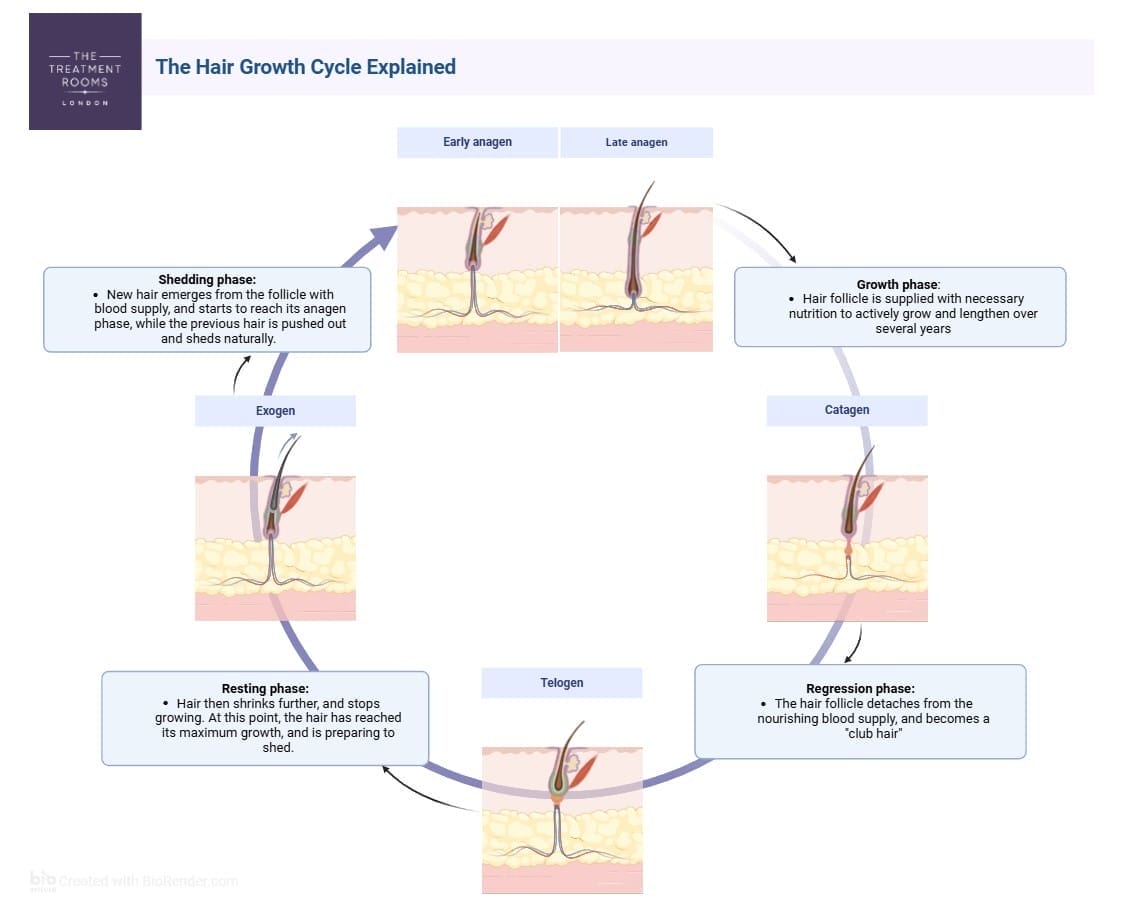
Telogen effluvium occurs when this cycle is disrupted on a large scale. Physical or emotional stress can cause an unusually high number of hairs to shift into the telogen phase simultaneously, leading to excessive shedding.2
Because telogen hairs remain in the resting phase for several weeks, shedding often feels delayed, then sudden. When new hairs begin to grow, the old ones are released, resulting in diffuse hair loss across the scalp.
What Are the Most Common Triggers of Telogen Effluvium?
Telogen effluvium is not a disease in itself but rather a response to stress. In most cases, shedding begins 1-3 months after the triggering event.3 Common triggers include the following:
Stress and Trauma
Major life stressors such as illness, surgery, high fevers, childbirth, or significant psychological stress can cause a significant number of hairs to enter the resting (telogen) phase prematurely.4
Medications
Certain medications⁵ can trigger telogen effluvium by altering follicle activity or hormonal balance. These include chemotherapy drugs, blood thinners, antidepressants, beta-blockers, retinoids, and propylthiouracil.
Diet & Nutrition
Restrictive dieting or inadequate intake of key nutrients and vitamins, particularly protein, iron, and zinc, can impair normal hair production.6 When the body lacks essential nutrients, it is unable to sustain healthy hair growth, and shedding occurs.
COVID-19, Viral Illnesses and Telogen Effluvium
COVID-19 and other significant viral illnesses are now well recognised as triggers of telogen effluvium. Many people notice sudden, diffuse hair shedding 6–12 weeks after infection, which matches the typical delay seen with stress-related hair loss.7
This happens because viral illness places the body under intense physiological stress, which can push more hairs into the resting (telogen) phase simultaneously. When these hairs shed months later, the hair loss can feel sudden and excessive.
In people with long COVID or prolonged post-viral symptoms, telogen effluvium may last longer than usual. Ongoing inflammation, fatigue, nutritional depletion, and persistent stress can delay recovery of the hair cycle, leading to continued shedding.
It is important to note that COVID-related telogen effluvium does not usually cause permanent damage to hair follicles. If the body stabilises and underlying stressors are addressed, shedding gradually settles and regrowth follows.
How Do I Know If It’s Telogen Effluvium and Not Another Hair Loss Condition?
Telogen effluvium can be confused with other hair loss conditions, but it has a distinct pattern that helps differentiate it from more permanent conditions.
The main features of telogen effluvium include:
- Diffuse hair loss across the scalp, rather than patchy or localised bald areas.
- Sudden increase in daily shedding, particularly noticeable during washing or brushing.
- Club hairs with a small white bulb at the root represent hairs that have completed the telogen phase.
- A normal-looking scalp, without scarring, inflammation, redness, or flaking.
“Hair loss of any kind can be distressing, and many people aren’t aware of the different types and what to look out for. It is always important, when experiencing hair loss, to first speak with your family physician or GP and undergo investigations to ensure there are no underlying health conditions.” Comments Dr Roshan Vara, Surgeon and Co-founder, The Treatment Rooms London.
He explains further, “Hair is very sensitive to nutritional deficiencies, and it would be the first thing to correct if abnormalities are found. Diagnosing telogen effluvium can be multi-factorial, as finding the source, whether medical or psychological, requires more careful analysis. It is difficult for one to determine alone what type of hair loss they are experiencing without an examination, so please do seek guidance before experimenting with treatment options.”
What are the Hair “Pull Test” and “Wash Test’’?
The hair pull test and wash test are simple clinical tools used to assess whether active hair shedding is occurring.
Pull test
A small group of around 40–60 hairs is gently pulled from different areas of the scalp. If more than 3–6 hairs come away with minimal force, this suggests active shedding. This can be seen in conditions such as telogen effluvium, alopecia areata, and anagen effluvium.8
Wash test
During this test, the patient skips shampooing for a few days, then washes their hair and collects any hair that has fallen out. When the number of hairs exceeds 100, it is likely to be indicative of abnormal shedding. This test can also help distinguish between telogen effluvium and androgenetic alopecia by analysing the nature of the hairs that are being lost.
Together, these tests help clinicians assess the severity and pattern of hair loss. However, these are only screening tools, and results should always be interpreted in conjunction with the clinical history and scalp examination.
How Long Does Telogen Effluvium Last and Will My Hair Grow Back?
Telogen effluvium is temporary and usually resolves within 3-6 months once the trigger is addressed.
In some cases, shedding can continue beyond six months. This is known as chronic telogen effluvium, but even then, the hair follicles usually remain healthy, and regrowth is still possible.8
Signs that your hair is returning include:
- Tiny, fine hairs appearing along the hairline or crown
- Noticeably less hair loss during washing or brushing
- Increased volume or thickness when tying hair back or styling
How is Telogen Effluvium Managed?
In many people, telogen effluvium gradually resolves as the body recovers from the trigger, allowing hair to regrow naturally without medication. However, in persistent or chronic cases, certain interventions may help support recovery.9
Minoxidil
Minoxidil is a medication to consider if shedding persists or the trigger is difficult to identify. It works by shortening the telogen phase and encouraging follicles to return to the active growth (anagen) phase, thereby reducing shedding and stimulating new hair growth.10
Adjunctive Therapies
Other treatments, such as Platelet-Rich Plasma (PRP), low-level light therapy (LLLT), and nutritional supplements, can support hair regrowth.11
Both platelet-rich plasma (PRP) and low-level laser therapy (LLLT) are growth factor-stimulating treatments that improve blood flow in hair follicles.
In cases where a nutrient deficiency causes hair loss, the appropriate supplements can help stop it. The use of therapies in combination, such as combining PRP and LLLT, can lead to even more impressive results.
Conclusion
Telogen effluvium is a temporary hair shedding condition that reflects the scalp’s response to stress, illness, or other triggers. Recovery is possible because the follicles remain healthy, and most people eventually regain their hair. Persistent or unusual shedding should prompt a professional evaluation to ensure any underlying issues are identified and managed effectively.
With the right guidance and treatment plans in place, the journey back to fuller and thicker hair is just on the horizon.
References
1. Vara R. Anagen Follicles Regrowth Cycles & All You Need to Know [Internet]. London: The Treatment Rooms London; 2026 Jan 2 [cited 2026 Jan 8]. Available from: https://www.treatmentroomslondon.com/hair/anagen-follicles/
2. Hughes EC, Elston DM. Telogen and Anagen Effluvium. In: Medscape. Updated Jan 23, 2025. Available from: https://emedicine.medscape.com/article/1071566-overview
3. Hughes EC, Syed HA, Saleh D. Telogen Effluvium. In: StatPearls [Internet]. Treasure Island (FL): StatPearls Publishing; 2025 Jan-. Updated 1 May 2024. Available from: https://www.ncbi.nlm.nih.gov/books/NBK430848/
4. Asghar F, Shamim N, Farooque U, Sheikh H, Aqeel R. Telogen Effluvium: A review of the literature. Cureus. 2020 May 27;12(5):e8320. doi:10.7759/cureus.8320. PMID: 32607303; PMCID: PMC7320655. Available from: https://pmc.ncbi.nlm.nih.gov/articles/PMC7320655/
5. Watson S. Medications that can cause hair loss. WebMD. Medically reviewed by Gardner SS, MD; 2024 Sep 18. Available from: https://www.webmd.com/skin-problems-and-treatments/hair-loss/drug-induced-hair-loss-2
6. Guo EL, Katta R. Diet and hair loss: effects of nutrient deficiency and supplement use. Dermatol Pract Concept. 2017 Jan 31;7(1):1–10. doi:10.5826/dpc.0701a01. Available from: https://www.ncbi.nlm.nih.gov/pmc/articles/PMC5315033/
7. Seyfi S, Alijanpour R, Aryanian Z, Ezoji K, Mahmoudi M. Prevalence of telogen effluvium hair loss in COVID-19 patients and its relationship with disease severity. J Med Life. 2022;15(5):631-634. Available from: https://www.ncbi.nlm.nih.gov/pmc/articles/PMC9262270/
8. Cleveland Clinic. Telogen effluvium: symptoms, causes & treatment. my.clevelandclinic.org. [cited 2025 Oct 25]. Available from: https://my.clevelandclinic.org/health/diseases/24486-telogen-effluvium
9.DermNet NZ. Telogen effluvium. DermNet. [cited 2025 Oct 25]. Available from: https://dermnetnz.org/topics/telogen-effluvium
10. Mysore V, Parthasaradhi A, Kharkar RD, Ghoshal AK, Ganjoo A, Ravichandran G, et al. Expert consensus on the management of Telogen Effluvium in India. Int J Trichology. 2019;11(3):107–112. doi:10.4103/ijt.ijt_23_19. Available from: https://www.ncbi.nlm.nih.gov/pmc/articles/PMC6580807/
11. Paichitrojjana A, Paichitrojjana A. Platelet Rich Plasma and Its Use in Hair Regrowth: A Review. Drug Des Devel Ther [Internet]. 2022 [cited 2025 Oct 25];16:635–45. Available from: https://www.ncbi.nlm.nih.gov/pmc/articles/PMC8922312/
12. American Academy of Dermatology. Hair loss in new moms: Dermatologist tips. [Internet]. [cited 2025 Oct 25]. Available from: https://www.aad.org/public/diseases/hair-loss/insider/new-moms
Share:
Authored by

Dr Roshan Vara
Dr. Roshan Vara is a renowned hair transplant surgeon in London and the Co-Founder of our award winning hair transplant clinic, The Treatment Rooms London.He has over 10 years of experience in hair transplant surgery and is recognised for delivering natural-looking results through ethical, patient-centred care. He is a Full Medical Member of BAHRS and an Associate Member of ISHRS, reflecting his commitment to the highest standards in modern hair restoration.
Reviewed by

Dr Dilan Fernando
Dr. Dilan Fernando is regarded as one of the best hair transplant surgeons in London and Co-Founder of The Treatment Rooms London. He has over 10 years of experience in hair transplant surgery and is known for his meticulous technique and commitment to ethical practice. He served on the Executive Committee of BAHRS from 2020 to 2024, helping to shape industry standards for patient safety and quality of care. Dr. Fernando personally performs each surgery, ensuring natural results built on trust and experience.
Book a Consultation
Related Blogs

Steve Carell Hair Transplant: Before, After, and His New Hairline Copy
March 2, 2026
Steve Carell, best known as Michael Scott in The Office, began sparking curiosity amongst fans when his…

What Is Nutrafol and Does It Really Work for Hair Growth?
February 24, 2026
Key Takeaways Hair thinning can feel frustrating and confusing. You might notice more hair falling out in…

Peppermint oil for hair growth: Evidence, Benefits, Uses & Safety
February 24, 2026
Key Takeaways What Is Peppermint Oil? Peppermint oil, also known as Mentha piperita oil, is an essential…

Why Winter Hair Loss Happens and All You Need to Know
February 6, 2026
Key Takeaways As temperatures drop and indoor heating kicks in, many people notice their hair feels drier,…

Can You Take Finasteride With Minoxidil For Hair Loss?
February 5, 2026
Key Takeaways Consistency Matters: Stopping treatment often leads to a recurrence of hair loss; ongoing medical guidance…
Does Finasteride Cause Erectile Dysfunction?
February 3, 2026
Key Takeaways Finasteride can cause erectile dysfunction in some men, but it isn’t common. Most men who…
What is a Hair Transplant? How it Works, Success Rate & What to Expect
February 2, 2026
Key Takeaways Cost: Varies from £3,000 to £10,000, depending on the number of grafts and the technique….
What Causes Hair Loss During Menopause?
February 2, 2026
Key Takeaways Many women notice increased hair shedding and thinning during menopause. This happens because hormonal changes…

Can a Norwood 7 Get a Hair Transplant? All You Need to Know
February 2, 2026
Key Takeaways Yes, someone with Norwood 7 hair loss may be able to have a hair transplant,…