

Quick summary: When does male hair loss start?
- Typical onset: Male hair loss often begins in the 20s or 30s, though timing can vary based on genetics and other factors.
- Genetic influence: About 95% of male hair loss is caused by androgenetic alopecia, a hereditary condition that follows a pattern of thinning and receding hair.
- Early signs: Approximately 25% of men with hereditary baldness begin losing hair before age 21.
- Progression over time:
- By age 35, about 66% of men experience some hair loss.
- By age 50, around 85% of men have significantly thinner hair.
- Pattern: Hair typically starts thinning at the temples or crown, with variations based on individual health, lifestyle, and family history.
- The seven stages of male pattern baldness: Male pattern baldness progresses in seven stages, from minimal thinning to severe balding. Hair loss typically starts at the temples or crown and advances to form a horseshoe pattern.
- Factors that influence male hair loss: genetics, age, health conditions, and stress. Diet, lifestyle, and medications can also contribute to hair thinning or loss.
- How can I prevent male hair loss? While prevention isn’t guaranteed, a balanced diet, stress management, and gentle hair care can help maintain hair health. Limiting heat styling and using mild products can also support stronger, healthier hair.
- What can you do about male hair loss? Treatment options include medications such as minoxidil and finasteride, hair transplants (FUE and FUT), low-level laser therapy, and PRP therapy.
Male hair loss, or androgenetic alopecia, is an issue many men face as they age. Although it’s a natural process, understanding when it begins and what influences it can help you take proactive steps to maintain healthy hair or reclaim lost hair. Male hair loss usually starts gradually, but the onset and rate of progression can vary significantly from one person to another. Often, the first signs appear in the 20s or 30s, but for some, it may not become noticeable until later in life.
At The Treatment Rooms in London, we specialise in treating male hair loss, providing a tailored, results-driven approach to hair restoration through procedures such as FUE hair transplant surgery. In this article, we explore the timeline and causes of male hair loss, discuss factors and risks, and offer guidance on potential preventative measures and treatments.
When does male hair loss start?
Male hair loss, also known as androgenetic alopecia or male pattern baldness, is primarily genetic and follows a predictable pattern of recession and thinning. According to the American Hair Loss Association, about 95 percent of hair loss in men is caused by androgenetic alopecia.
Approximately 25 per cent of men with hereditary male pattern baldness begin losing their hair before age 21. By age 35, around 66 per cent of men will have experienced some degree of hair loss, and by age 50, approximately 85 per cent of men will have significantly thinner hair.
For most, thinning often starts around the temples or crown, but the pattern and rate of progression can vary depending on factors such as genetics, health conditions, and lifestyle.
The seven stages of male pattern baldness
Male pattern baldness typically progresses through a series of seven stages, often described using the Norwood Scale. This classification system helps identify the extent of hair loss and can guide treatment options.
- Stage 1: Minimal or no hair loss: Hairline remains mostly intact with no noticeable hair loss or recession.
- Stage 2: Slight recession at the temples: Early signs of a receding hairline, forming an “M” shape as hair recedes at the temples.
- Stage 3: Deeper hairline recession: The “M” shape deepens, with more noticeable thinning at the temples, marking the onset of significant balding.
- Stage 4: Thinning at the crown: Hairline recession continues, and noticeable thinning or a bald spot develops on the crown of the head.
- Stage 5: Larger balding areas: The areas of thinning at the front and crown begin to merge, leaving a band of hair separating them, which becomes thinner.
- Stage 6: Advanced balding: The hair connecting the front and crown balding areas disappears, leaving a horseshoe-shaped band of hair around the sides and back.
- Stage 7: Severe balding: The horseshoe-shaped hair band thins further, leaving sparse or very thin hair around the sides and back of the head.

Factors that influence male hair loss
Genetics and family history
One of the strongest predictors of male hair loss is your genetic makeup. If you have close relatives, especially on your mother’s side, who have experienced hair loss, the likelihood that you will develop similar hair loss patterns increases. This link is often tied to the sensitivity of hair follicles to dihydrotestosterone (DHT), a hormone that shortens the hair growth cycle and leads to thinner, weaker hair strands over time. Family history largely determines when hair loss begins and the specific pattern and rate of progression.
Age
As previously mentioned, age is a natural risk factor for hair loss. While hair loss can start as early as in the 20s, the risk increases as men reach their 40s and 50s. By this age, it becomes more likely that hair thinning and balding will become noticeable.
Health conditions and medications
Certain health conditions, like diabetes, psoriasis, rheumatoid arthritis, systemic lupus erythematosus and alopecia areata, which occurs when the immune system attacks hair follicles, can all cause hair loss. Medications, particularly those used for treating high blood pressure, depression, and cancer (chemotherapy), may cause hair loss as a side effect.
Stress and lifestyle factors
Chronic stress can lead to conditions like telogen effluvium, in which hair follicles prematurely enter the resting phase, causing hair to shed. High-stress lifestyles, poor diet, and lack of exercise can all contribute to a decline in hair health, leading to potential hair thinning or loss.
How can I prevent male hair loss?
While there is no definitive way to prevent male hair loss, several approaches can help maintain hair health and slow down hair thinning:
- Follow a balanced diet: Nutrient deficiencies, particularly of vitamins like B12, iron, and zinc, can contribute to hair loss. Eating a well-balanced diet rich in these vitamins, proteins, and healthy fats can support hair growth.
- Manage stress levels: Chronic stress can disrupt your hair’s growth cycle, leading to increased shedding. Practising stress management techniques such as mindfulness, meditation, or regular physical exercise can promote hair health.
- Avoid excessive heat and harsh treatments: Frequent heat styling or use of chemical products can damage hair and weaken follicles. Minimising exposure to these can help maintain hair strength and texture.
- Use mild hair care products: Opt for shampoos and conditioners that are gentle on your scalp, free from sulfates, and designed for hair health. Avoid products with harsh chemicals that may strip your hair of its natural oils.
What can you do about male hair loss?
Medication
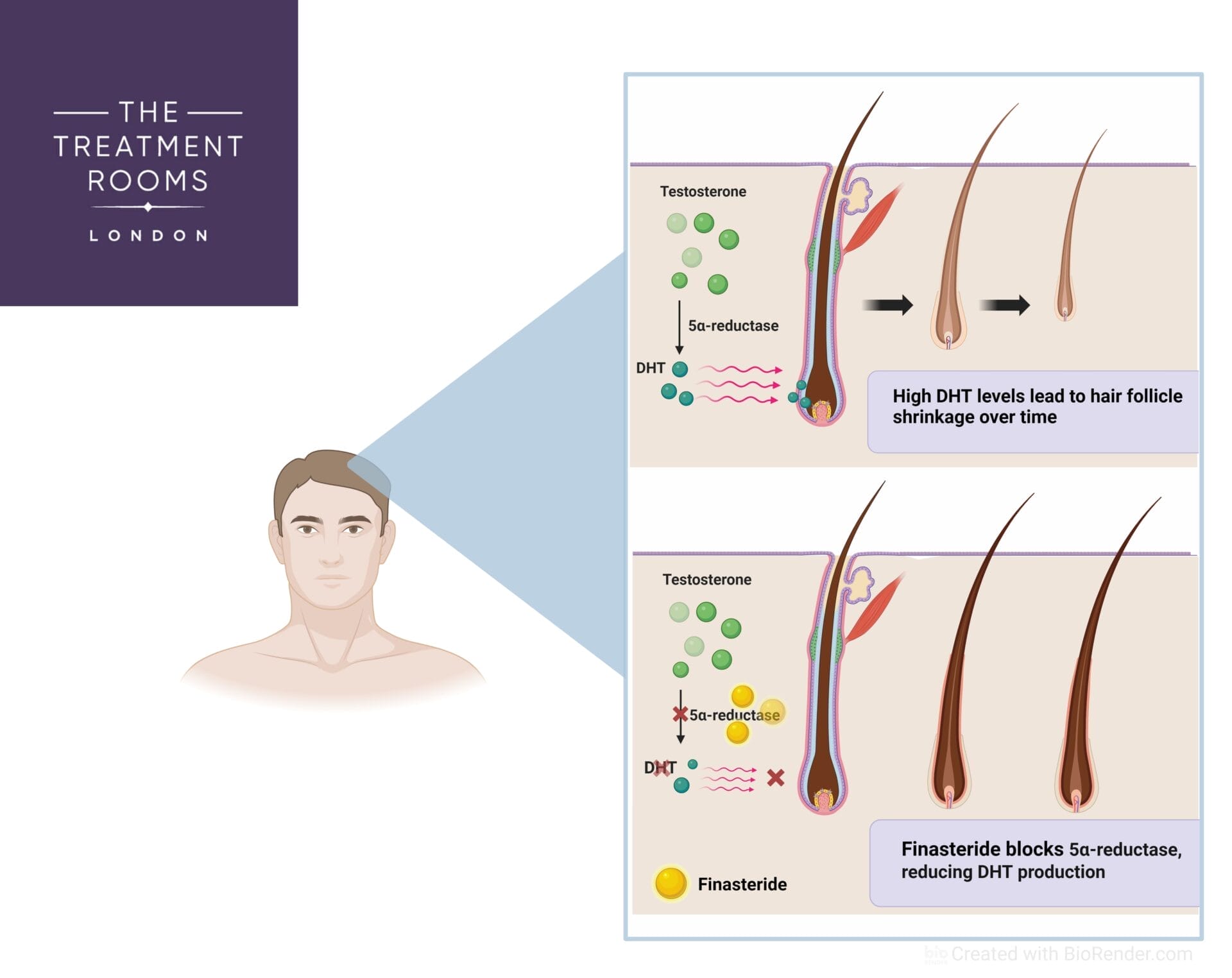
Medications like minoxidil and finasteride have shown effectiveness in slowing hair loss and, in some cases, promoting regrowth. Minoxidil is a topical solution that stimulates hair follicles, while finasteride inhibits DHT production. These medications require consistent use and are more effective in the early stages of hair loss.
Hair transplant
Hair transplant surgery is a reliable solution for restoring hair in areas experiencing thinning or balding, and it comes in two main techniques:
- FUE (Follicular Unit Excision): In FUE, individual hair follicles are carefully harvested from the back or sides of the scalp and transplanted to areas of hair loss. This leaves minimal scarring, as it doesn’t involve a linear incision and offers a natural look.
- FUT (Follicular Unit Transplantation): Also known as the “strip method,” FUT involves removing a small strip of scalp from the donor area. The strip is divided into individual follicle units, which are then transplanted. However, it results in a linear scar in the donor area.
Low-level laser therapy (LLLT)
LLLT is a non-invasive treatment that uses light to stimulate hair growth by increasing blood flow and cellular energy in hair follicles. It’s often used as an adjunct treatment for those in the early stages of hair loss. LLLT devices are available in various forms, including laser caps and combs, and have shown positive effects on hair health.
Platelet-rich plasma (PRP) therapy
PRP therapy uses your body’s platelets, which contain growth factors, to stimulate hair follicles and promote regrowth. During PRP, a small amount of your blood is drawn, processed, and then injected into the scalp. PRP has been shown to increase vascular structures around hair follicles and promote hair growth, particularly for individuals in the early stages of hair loss.
Conclusion
Understanding male hair loss and its contributing factors can help you make informed decisions about treatment and prevention. Although hair loss may be a natural part of ageing, you don’t have to let it impact your confidence.
Get in Touch
Ready to elevate your hair restoration journey? Book a free consultation call with our London-based FUE hair transplant clinic. If you are based in Birmingham, you can contact our FUEhair transplant clinic in Birmingham. We also offer virtual consultations for patients in Manchester and Leicester.
Our award-winning team, including leading London hair transplant surgeons Dr Fernando and Dr Vara, is here to support you every step of the way.
References
- American Hair Loss Association (no date) Men’s hair loss. Available at:https://www.americanhairloss.org/mens-hair-loss/.
- Wirya, C. T., Wu, W., & Wu, K. (2017). Classification of Male-pattern Hair Loss. International journal of trichology, 9(3), 95–100.https://doi.org/10.4103/ijt.ijt_46_17
- Birch, M. P., & Messenger, A. G. (2001). Genetic factors predispose to balding and non-balding in men. European journal of dermatology : EJD, 11(4), 309–314. Available at:https://pubmed.ncbi.nlm.nih.gov/11399536/
- Healthline (2024) DHT: The hormone behind hair loss, Healthline. Available at: https://www.healthline.com/health/dht.
- Forouzan, P., & Cohen, P. R. (2020). Systemic Lupus Erythematosus Presenting as Alopecia Areata. Cureus, 12(6), e8724.https://doi.org/10.7759/cureus.8724
- Saraswat, N., Chopra, A., Sood, A., Kamboj, P., & Kumar, S. (2019). A Descriptive Study to Analyse Chemotherapy-Induced Hair Loss and Its Psychosocial Impact in Adults: Our Experience from a Tertiary Care Hospital. Indian dermatology online journal, 10(4), 426–430.https://doi.org/10.4103/idoj.IDOJ_471_18
- Guo, E. L., & Katta, R. (2017). Diet and hair loss: effects of nutrient deficiency and supplement use. Dermatology practical & conceptual, 7(1), 1–10.https://doi.org/10.5826/dpc.0701a01
- McClellan, K. J., & Markham, A. (1999). Finasteride: a review of its use in male pattern hair loss. Drugs, 57(1), 111–126.https://doi.org/10.2165/00003495-199957010-00014
- Pillai, J. K., & Mysore, V. (2021). Role of Low-Level Light Therapy (LLLT) in Androgenetic Alopecia. Journal of cutaneous and aesthetic surgery, 14(4), 385–391. https://jcasonline.com/role-of-low-level-light-therapy-lllt-in-androgenetic-alopecia/
- Gentile, P., Garcovich, S., Bielli, A., Scioli, M. G., Orlandi, A., & Cervelli, V. (2015). The Effect of Platelet-Rich Plasma in Hair Regrowth: A Randomized Placebo-Controlled Trial. Stem cells translational medicine, 4(11), 1317–1323.https://doi.org/10.5966/sctm.2015-0107
Share:
Authored by

Dr Roshan Vara
Dr. Roshan Vara is a renowned hair transplant surgeon in London and the Co-Founder of our award winning hair transplant clinic, The Treatment Rooms London.He has over 10 years of experience in hair transplant surgery and is recognised for delivering natural-looking results through ethical, patient-centred care. He is a Full Medical Member of BAHRS and an Associate Member of ISHRS, reflecting his commitment to the highest standards in modern hair restoration.
Reviewed by

Dr Dilan Fernando
Dr. Dilan Fernando is regarded as one of the best hair transplant surgeons in London and Co-Founder of The Treatment Rooms London. He has over 10 years of experience in hair transplant surgery and is known for his meticulous technique and commitment to ethical practice. He served on the Executive Committee of BAHRS from 2020 to 2024, helping to shape industry standards for patient safety and quality of care. Dr. Fernando personally performs each surgery, ensuring natural results built on trust and experience.
Book a Consultation
Related Blogs
Hair Loss In Your 20s- What You Need To Know
March 24, 2026
Key Takeaways Hair thinning or excessive hair shedding in your 20s is often due to genetics, stress,…
How Long Does a Hair Transplant Take? The Average FUE & FUT Surgery Duration Explained
March 24, 2026
Key Takeaways Are you considering a hair transplant and wondering how long the process takes? The answer…

Steve Carell Hair Transplant: Before, After, and His New Hairline
March 2, 2026
Steve Carell, best known as Michael Scott in The Office, began sparking curiosity amongst fans when his…

What Is Nutrafol and Does It Really Work for Hair Growth?
February 24, 2026
Key Takeaways Hair thinning can feel frustrating and confusing. You might notice more hair falling out in…

Peppermint oil for hair growth: Evidence, Benefits, Uses & Safety
February 24, 2026
Key Takeaways What Is Peppermint Oil? Peppermint oil, also known as Mentha piperita oil, is an essential…

Why Winter Hair Loss Happens and All You Need to Know
February 6, 2026
Key Takeaways As temperatures drop and indoor heating kicks in, many people notice their hair feels drier,…

Can You Take Finasteride With Minoxidil For Hair Loss?
February 5, 2026
Key Takeaways Consistency Matters: Stopping treatment often leads to a recurrence of hair loss; ongoing medical guidance…
Does Finasteride Cause Erectile Dysfunction?
February 3, 2026
Key Takeaways Finasteride can cause erectile dysfunction in some men, but it isn’t common. Most men who…
What is a Hair Transplant? How it Works, Success Rate & What to Expect
February 2, 2026
Key Takeaways Cost: Varies from £3,000 to £10,000, depending on the number of grafts and the technique….