

Quick Summary:
Gut Health Insights: The gut microbiome, a diverse community of microorganisms in our gut, plays a vital role in overall wellness. It impacts nutrient absorption, immune function, and even hair health.
Microbiome’s Impact on Hair: A balanced gut microbiome supports the absorption of nutrients crucial for healthy hair, like biotin and vitamin B12. Imbalances may affect hair growth and scalp health.
Latest Research Highlights: Recent studies highlight the significant association between gut microbiome imbalances and autoimmune hair loss conditions like alopecia areata, as well as total body hair loss seen in Alopecia Universalis. Additionally, disruptions in the gut microbiome, known as gut dysbiosis, can contribute to various forms of alopecia, underscoring the importance of the gut-hair connection in maintaining healthy hair.
Enhancing Gut Health for Healthy Hair: Enhance your gut health for healthier hair by prioritising a diverse diet rich in fruits, vegetables, lean proteins, and whole grains, while also considering probiotic supplements to maintain gut microbial balance. Use antibiotics sparingly to avoid disrupting your gut flora, and complement your efforts with regular exercise, quality sleep, and stress management practices to support optimal gut health and promote vibrant hair growth.
Key Takeaway: Improving gut health can positively impact hair health, but it’s important to consult with a healthcare professional before making significant lifestyle and dietary changes or medication adjustments. Your doctor can provide personalised guidance based on your unique health needs and goals.

What is Gut Health?
The health of our gut can be an important cornerstone of our general physical and mental health. The intricate balance of diverse microorganisms growing within it is collectively referred to as the gut microbiome. The gut microbiome performs a myriad of essential functions, such as aiding the digestion of food, as well as shielding us from harmful pathogens. Importantly, their role extends to influencing hair health, a connection that is being researched more and more.
An imbalance in the gut microbiome can disrupt key bodily processes, like the ability to absorb and break down nutrients, immune responses, and protection against pathogens.1 Such disruptions can trigger a range of health issues, some of which may directly or indirectly impact the health of your hair. At The Treatment Rooms, we hope to help our patients understand the necessity of maintaining this complex ecosystem within our gut, as it is important not just for our overall health but also for ensuring the vitality and health of our hair.

The Role of the Microbiome: Gut Flora’s Influence on Hair
Every person has a unique microbiome. A healthy one contains a diversity of bacteria, fungi, and viruses. They help to process nutrients that are essential for healthy hair, such as biotin, folate, and vitamin B12, and play a role in the immune response that can affect scalp health and hair growth.
Research has found that diet directly shapes your gut microbiome, impacting its composition and function. These changes in the gut can influence hair health, making a balanced diet crucial for maintaining both digestive wellness and hair health.2
What’s New in Gut-Hair Axis Research: Recent Highlights
- Impact on Autoimmune Hair Loss: Recent research explored the gut’s role in autoimmune hair loss conditions like alopecia areata. Studies suggest a connection between gut microbiota imbalances and the subsequent inflammatory response to this form of hair loss. Interventions like faecal transplants and probiotics are being explored for their potential in managing hair loss, though further research is needed for clearer insights.3,4
- The Microbiome and Alopecia Universalis: In cases of Alopecia Universalis (total body hair loss), specific bacterial types are more prevalent in the gut microbiome. This discovery could pave the way for new diagnostic tools and treatment options, hinting at the microbiome’s role in this disease’s development.3
- Gut Dysbiosis and Hair Loss: Gut microbiome disruption, or dysbiosis, has been associated with various forms of alopecia, including Androgenetic Alopecia and Alopecia Universalis. While definitive evidence is still forthcoming, these links suggest that gut health may be a factor in hair-loss conditions.3
- Alopecia and Inflammatory Bowel Disease Link: A notable study found a significant association between alopecia and Inflammatory Bowel Disease (IBD). The inflammatory effects from IBD could influence certain types of alopecia, suggesting that patients with alopecia may benefit from IBD screenings.5
The Microbiome’s Impact on Hair Health
The gut microbiome’s role in hair health is multifaceted – here are a few ways that it influences our body systems:
- Inflammation Control: A balanced gut microbiome keeps inflammation in check, which is important for maintaining the anagen (growth) phase of the hair growth cycle.
- Enhanced Nutrient Absorption: Beneficial gut bacteria aid in absorbing vital nutrients necessary for strong hair, like zinc, selenium, and iron.
- Hormonal Balance: The microbiome can subtly modulate hormone levels, some of which may influence hair growth and hair loss patterns.
Below are some links currently found between gut and hair health4,6,7,8 :
Diet: Try to include foods rich in probiotics (like yoghurt and kimchi, which help provide good bacteria for gut health) and prebiotics (such as garlic, onions, bananas, and foods that are good for bacteria). This can improve gut health and positively influence hair health. A diet rich in a variety of fruits, vegetables, lean proteins, and whole grains helps provide essential nutrients to support a thriving microbiome.
Medication: Certain medications, such as antibiotics, can disrupt the microbiome, leading to a cascade of effects that may include hair thinning or loss. Be mindful of antibiotic overuse and use them only when necessary.
Pre-existing medical conditions: Certain diseases can influence the gut flora negatively and can have an effect on hair health. These conditions can be summarised below: 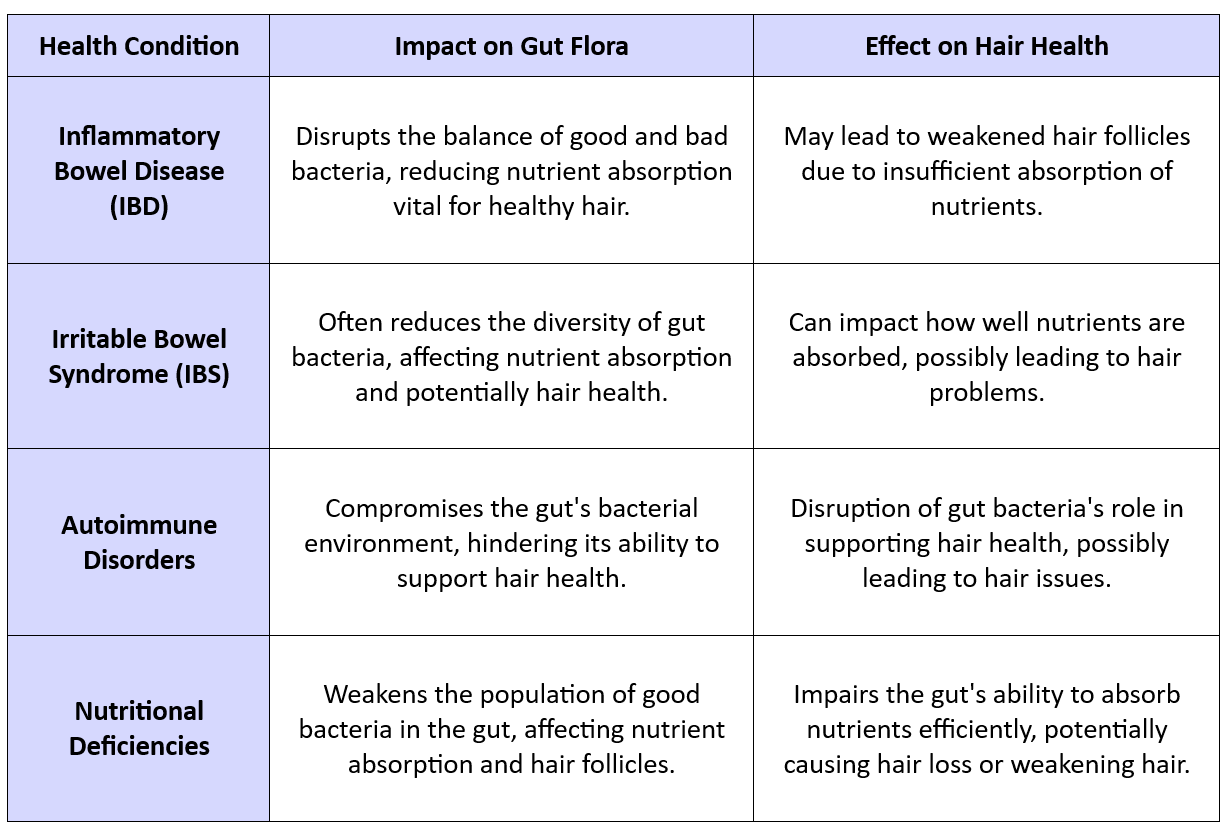
Stress: Psychological stress can upset gut flora balance, leading to digestive issues and potentially impacting hair growth cycles.
Sleep: Disrupted sleep patterns can throw off the balance of good and bad bacteria in our guts, which might affect our overall health and sleep quality. Interestingly, when sleep-deprived rats received sufficient rest, their bodies were better at repairing gut cell damage, highlighting the importance of adequate sleep for maintaining gut health.
At The Treatment Rooms London, we encourage adopting a lifestyle that promotes gut health. Regular exercise, sufficient sleep, and stress management techniques can all contribute to a balanced and resilient gut microbiome, which in turn supports healthy hair growth.
Conclusion
The link between gut health and hair health is a dynamic area of study, shedding new light on hair loss and how it is affected by the gut.
Remember, significant lifestyle changes or alterations in medication should always be discussed with a healthcare professional. Whether it’s your GP or a nutrition and lifestyle medicine specialist, seek personalised guidance to ensure any changes are in keeping with grounded evidence.
References
- Jandhyala, S., Talukdar, R., Subramanyam, C., Vuyyuru, H., Sasikala, M., & Reddy, D. (2015). Role of the normal gut microbiota. World journal of gastroenterology, 21 29, 8787-803.https://doi.org/10.3748/wjg.v21.i29.8787.
- Hills, R., Pontefract, B., Mishcon, H., Black, C., Sutton, S., & Theberge, C. (2019). Gut Microbiome: Profound Implications for Diet and Disease. Nutrients, 11.https://doi.org/10.1159/000523712.
- Carrington, A., Maloh, J., Nong, Y., Agbai, O., Bodemer, A., & Sivamani, R. (2023). The Gut and Skin Microbiome in Alopecia: Associations and Interventions.. The Journal of clinical and aesthetic dermatology, 16 10, 59-64. Available from: https://www.ncbi.nlm.nih.gov/pmc/articles/PMC10617895/
- Hayashi, A., Mikami, Y., Miyamoto, K., Kamada, N., Sato, T., Mizuno, S., Naganuma, M., Teratani, T., Aoki, R., Fukuda, S., Suda, W., Hattori, M., Amagai, M., Ohyama, M., & Kanai, T. (2017). Intestinal Dysbiosis and Biotin Deprivation Induce Alopecia through Overgrowth of Lactobacillus murinus in Mice. Cell reports, 20 7, 1513-1524 .https://doi.org/10.1016/j.celrep.2017.07.057.
- Maghfour, J., Olson, J., Conic, R., & Mesinkovska, N. (2021). The Association between Alopecia and Inflammatory Bowel Disease: A Systematic Review and Meta-Analysis. Dermatology, 237, 658 – 672.https://doi.org/10.1159/000512747.
- Hasan, N., & Yang, H. (2019). Factors affecting the composition of the gut microbiota, and its modulation. PeerJ, 7, e7502. https://doi.org/10.7717/peerj.7502
- Vijay, A., Valdes, A.M. Role of the gut microbiome in chronic diseases: a narrative review. Eur J Clin Nutr 76, 489–501 (2022).https://doi.org/10.1038/s41430-021-00991-6
- Matenchuk, B., Mandhane, P., & Kozyrskyj, A. (2020). Sleep, circadian rhythm, and gut microbiota. Sleep medicine reviews, 53, 101340. https://doi.org/10.1016/j.smrv.2020.101340
- Healthy and diseased gut microbiome illustrated using Biorender.com
Share:
Authored by
Dr Roshan Vara
Dr. Roshan Vara is a renowned hair transplant surgeon in London and the Co-Founder of our award winning hair transplant clinic, The Treatment Rooms London.He has over 10 years of experience in hair transplant surgery and is recognised for delivering natural-looking results through ethical, patient-centred care. He is a Full Medical Member of BAHRS and an Associate Member of ISHRS, reflecting his commitment to the highest standards in modern hair restoration.
Reviewed by
Dr Dilan Fernando
Dr. Dilan Fernando is regarded as one of the best hair transplant surgeons in London and Co-Founder of The Treatment Rooms London. He has over 10 years of experience in hair transplant surgery and is known for his meticulous technique and commitment to ethical practice. He served on the Executive Committee of BAHRS from 2020 to 2024, helping to shape industry standards for patient safety and quality of care. Dr. Fernando personally performs each surgery, ensuring natural results built on trust and experience.
Book a Consultation
Related Blogs

Hair Transplant After 7 Days: What To Expect
October 9, 2026
Key takeaways: 7 days after your hair transplant, you can expect to see the scabs in your…

Minoxidil Side Effects: What to Expect, Risks, and How to Manage Them
October 9, 2026
Key takeaways Medications are often a first step people take when tackling pattern baldness. They can help…
What Is A Hair Graft In A Hair Transplant?
October 7, 2026
Key takeaways: What is a Hair Graft in a Hair Transplant? Hair loss can be a distressing…

Widow’s Peak Hair Transplant for Women: Everything You Need to Know
October 6, 2026
Key takeaways: There is no absolute definition of a widow’s peak in women. It is often based…

Has Steve Carell Had a Hair Transplant? What the Evidence Really Shows
October 6, 2026
Key Takeaways Steve Carell is arguably one of the most liked and versatile actors of his generation….
When Can You Drink Alcohol After Your Hair Transplant?
October 6, 2026
Key takeaways: It’s common for our patients to ask us when it is okay to resume drinking…

Has Donald Trump Had a Hair Transplant? Expert Review and What the Evidence Shows
October 6, 2026
Key Takeaways Donald Trump’s hair is one of the most talked about aspects of his appearance; from…
Wayne Rooney Hair Transplant: Expert Analysis of His Hair Loss and Restoration
October 5, 2026
Key takeaways: Wayne Rooney is widely regarded as one of the greatest football talents from England. He…

Understanding Prince Harry’s Hair Loss: Causes and Treatment Options
October 3, 2026
Key Takeaways: Prince Harry, the Duke of Sussex, has lived most of his life in the public…