

Quick Summary of Double Crowns
- Double Crowns: A double crown, is where someone has 2 distinct spirals in their crown. It is pattern of hair growth more present in those with Afro-textured hair.
- Causes: Double crowns are determined by genetic inheritance
- Managing Double Crowns: Double crowns can make it difficult to style hair especially as the hair spirals in different directions. Speaking with a specialist can help the best approach.
- Hair Loss Concerns: Double crowns do not cause or predispose someone to more hair loss, but they make thinning areas appear more noticeable especially at an early stage of hair loss
What is a Double Crown?
The crown of your head refers to the highest point at the top and back of your head. Most people will have a central area from which hair spirals out in a circular pattern (a single crown spiral). A double crown occurs when someone has 2 areas where their hair spirals from their crown. The hair can spiral clockwise or counterclockwise and this is determined by someone’s genetic inheritance.
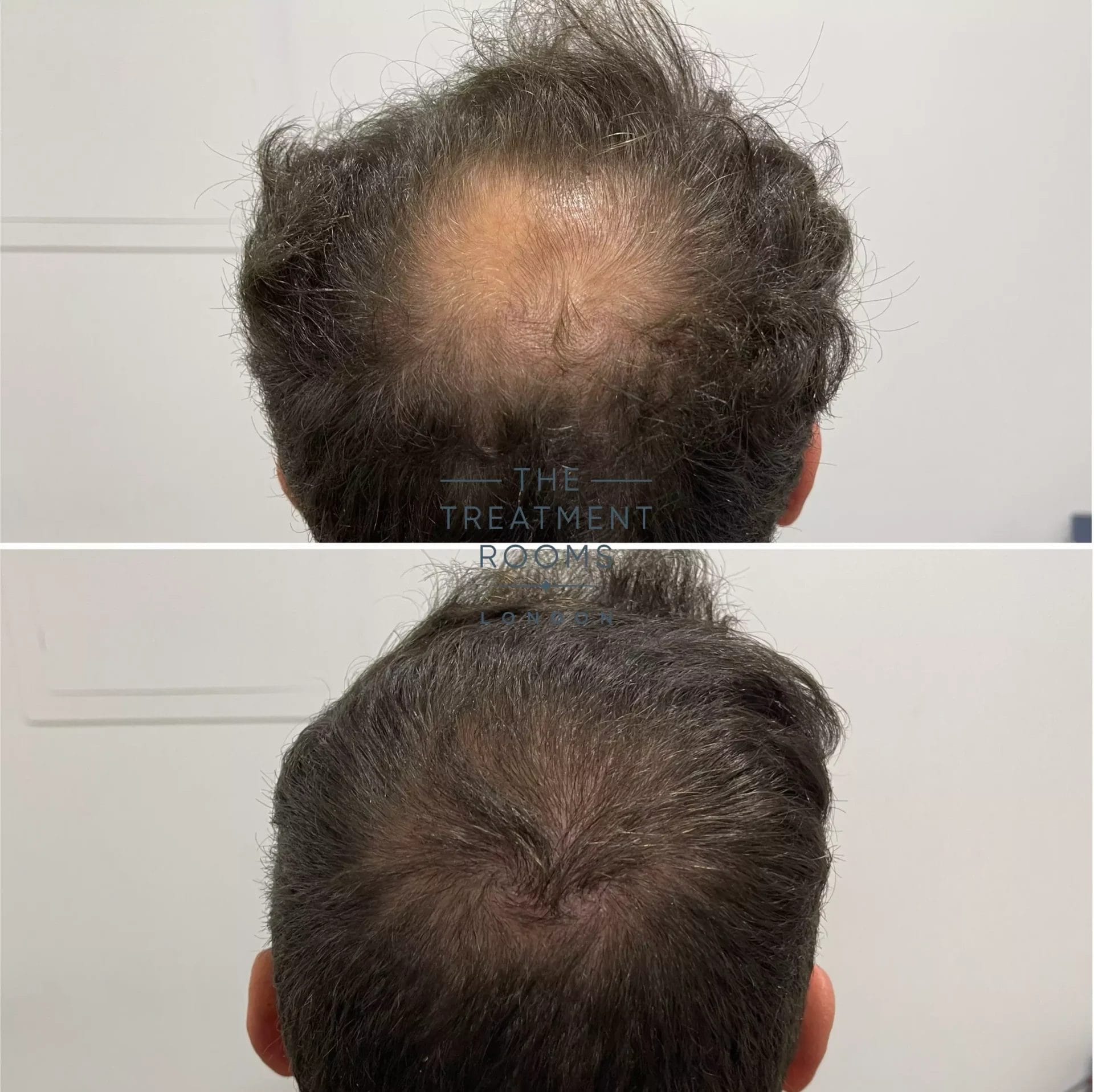
Have a double crown is not common with the appearance more prevalent patients with afro-textured hair. Most spirals will grow in a clockwise pattern (75%) compared to a counter-clockwise pattern.

What Causes Double Crowns?
A double crown is determined entirely by genetics, with the pattern visible in newborns or babies when they start growing their hair. So, if someone in your family has a double crown, you might be more likely to have one as well3.
A double crown isn’t caused by hair loss but by genetic inheritance. My patients who have one can have difficulty styling their hair which we are able to advise on
Dr Fernando, Co-founder and hair transplant surgeon at the treatment rooms london
Managing a Double Crown
Having a double crown can make it trickier to style your hair. The main reason for this is because the hair spirals in 2 areas at the back of the head and the hair converges down the middle which can make hair stick upwards in odd directions that doesn’t lend itself to easy style.
Patients may want to allow their hair grow longer, allowing more volume to cover the crown area and enable easier styling in the hairline. Other methods to manage a double crown include:
- Styling in a strategic hair parting: having a side parting that allows a side part to fall in a direction opposite to one of the spirals can help style a double crown easier
- Having a ponytail: styling your hair into a ponytail will entirely disguise and ameliorate a double crown
- Styling creams or gels can be used to hold hair in a double spiral to the style you want
Double Crowns and Hair Loss
While double crowns themselves do not cause hair loss, the spiralling of hair in 2 different areas makes any thinning more pronounced. This is particularly an issue for patients who suffer from androgenic alopecia or telogen effluvium.
Treatments for Hair Loss in Double Crowns
Treating hair loss in patients with a double crown is the same as for those patients who have a single spiral. Below we have outlined some medical treatments:
- Topical treatments: Products containing Minoxidil (Regaine) can help stimulate hair growth. The medication extends the anagen (growth) phase of the hair cycle, shortens the telogen (resting) phase, stimulates hair follicle activity, increases follicle size7.
- Prescription medications: Drugs like Finasteride are used for treating pattern baldness by reducing the hormone that triggers hair loss. Dihydrotestosterone (DHT) is a hormone that is derived from testosterone. In people with androgenic alopecia, DHT causes hair follicles to shrink and eventually stop growing back. Finasteride works by blocking the production of DHT. By reducing DHT levels, Finasteride can help prevent hair loss and promote hair regrowth8.
- Hair Transplant: Hair transplant surgery is a preferable option to individuals looking for permanent solutions. Surgery can be targeted specifically to areas of hair loss, unlike prescription medications. The procedure involves harvesting hair follicles from a donor area (usually the back of the scalp) and transplanting them to the thinning or bald areas like the crown or hairline. Two main techniques are used: Follicular Unit Transplantation (FUT) and Follicular Unit Extraction (FUE). Both methods have high success rates and can produce natural-looking results9.
- Low-Level Laser Therapy (LLLT): A non-invasive treatment that uses specific wavelengths of light to stimulate hair growth. LLLT is often delivered through different devices like caps, helmets or combs10.
- Platelet-Rich Plasma (PRP) Therapy: PRP therapy involves extracting a small amount of a patient’s blood, processing it to concentrate the platelets, and injecting the platelet-rich blood back into the scalp. Platelets contain growth factors that can help stimulate hair follicle activity and promote hair regrowth, making it a promising treatment for hair loss in areas affected by double crowns11.
Conclusion
In conclusion, double crowns are a normal growth pattern in some people where there are 2 spirals in the crown area. The phenomenon occurs due to genetic inheritance and can cause difficulty in hair styling.
References
- Wunderlich, R. C. and Heerema, N. A. (1975) ‘Hair crown patterns of human newborns’, Clinical Pediatrics, 14(11), pp. 1045–1049. Available at: https://doi.org/10.1177/000992287501401111
- Plikus, M. and Chuong, C. M. (2004) ‘Making waves with hairs’, Journal of Investigative Dermatology, 122(4). Available at: https://www.ncbi.nlm.nih.gov/pmc/articles/PMC4378646/
- Brewster, E. T. (1925) ‘The inheritance of double crown’, Journal of Heredity, 16(9), pp. 345–346. Available at: https://doi.org/10.1093/oxfordjournals.jhered.a102632
- Luo, J., Huang, H., Qiao, H., Tan, J., Chen, W. and Zhang, M. (2023) ‘GWAS identify genetic loci associated with human scalp hair whorl direction’, Journal of Investigative Dermatology, 143(10). Available at: https://doi.org/10.1016/j.jid.2023.04.008
- Androgenetic alopecia: MedlinePlus Genetics (2023) [Internet]. Available at: https://medlineplus.gov/genetics/condition/androgenetic-alopecia/
- Hughes, E. C. (2023) Telogen effluvium. U.S. National Library of Medicine. Available at: https://www.ncbi.nlm.nih.gov/books/NBK430848/
- Suchonwanit, P., Thammarucha, S., and Leerunyakul, K. (2019) ‘Minoxidil and its use in hair disorders: a review’, Drug design, development and therapy, 13, pp.2777–2786. Available at:https://doi.org/10.2147/DDDT.S214907
- McClellan, K. J., & Markham, A. (1999) ‘Finasteride’, Drugs, 57(1), 111–126. Available at: https://doi.org/10.2165/00003495-199957010-00014
- American Society for Dermatologic Surgery. Hair transplants. Available at: https://www.asds.net/skin-experts/skin-treatments/hair-transplants
- Avci, P., Gupta, G. K., Clark, J., Wikonkal, N. and Hamblin, M. R. (2014) ‘Low-level laser (light) therapy (LLLT) for treatment of hair loss’, Lasers in surgery and medicine, 46(2), pp. 144–151. Available at: https://doi.org/10.1002/lsm.22170
- Paichitrojjana, A. and Paichitrojjana, A. (2022) ‘Platelet-rich plasma and its use in hair regrowth: A review’, Drug Design, Development and Therapy, 16, pp. 635–645. Available at: https://doi.org/10.2147/DDDT.S356858
Share:
Authored by

Dr Roshan Vara
Dr. Roshan Vara is a renowned hair transplant surgeon in London and the Co-Founder of our award winning hair transplant clinic, The Treatment Rooms London.He has over 10 years of experience in hair transplant surgery and is recognised for delivering natural-looking results through ethical, patient-centred care. He is a Full Medical Member of BAHRS and an Associate Member of ISHRS, reflecting his commitment to the highest standards in modern hair restoration.
Reviewed by

Dr Dilan Fernando
Dr. Dilan Fernando is regarded as one of the best hair transplant surgeons in London and Co-Founder of The Treatment Rooms London. He has over 10 years of experience in hair transplant surgery and is known for his meticulous technique and commitment to ethical practice. He served on the Executive Committee of BAHRS from 2020 to 2024, helping to shape industry standards for patient safety and quality of care. Dr. Fernando personally performs each surgery, ensuring natural results built on trust and experience.
Book a Consultation
Related Blogs

Male To Female (MTF) HRT Hair Regrowth
September 28, 2026
Key takeaways: Hair loss can have a negative impact on your well-being, and it can affect any…

Ben Stokes’s Hair Transplant: Before, After and All You Need to Know
September 25, 2026
Key Takeaways: Ben Stokes is widely considered one of England’s greatest all-rounders in cricket. He was born…

Has Jamie Laing Had a Hair Transplant? Expert Analysis of His Hair Loss and Recovery
September 24, 2026
Key Takeaways Jamie Laing is one of Britain’s most recognisable reality TV personalities turned entrepreneurs. His first…
Jude Law Hair Transplant: Before, After, and His New Hairline
September 23, 2026
Key takeaways: Jude Law, the British actor known for roles in The Talented Mr Ripley, Sherlock Holmes,…

Hair Shedding vs Hair Loss: What’s the Difference?
September 23, 2026
Key Takeaways: When you notice more hair falling out than usual, it can cause a lot of…

David Silva’s Hair Transplant: Expert Review of His Hair Loss and Recovery
September 23, 2026
Key Takeaways Born in Arguineguín on Spain’s Canary Islands in 1986, he made his name with Valencia…

Did Kyle Walker Have a Hair Transplant? Expert Review of His Hair Loss and Restoration
September 21, 2026
Key Takeaways: Kyle Walker is a widely known athletic superstar. He burst onto the football scene with…

Can Women Take DHT Blockers for Hair Loss? Benefits & Risks
September 20, 2026
Key takeaways In the UK, for example, finasteride and dutasteride, the main DHT blocking medications, are not…

Analysing Jimmy Carr’s Hair Transplant: Expert Review and All You Need to Know
September 20, 2026
Key takeaways As one of Britain’s best-known comedians, Jimmy Carr is no stranger to the public eye….