

Key Takeaways
- TRT and hair loss: TRT does not directly cause hair loss, but it can speed up male pattern baldness in genetically susceptible men.
- Surgery safety: You can safely have a hair transplant while on TRT, but only if your hair loss is stable and well-managed.
- Transplanted hair: Grafts are DHT-resistant, but your native hair can still thin without treatment.
- Long-term success: Medical therapy (such as finasteride or minoxidil) is often essential to preserve results. However, what matters most is not TRT itself, but how well your underlying hair loss is controlled over time.
Testosterone Replacement Therapy (TRT) is commonly prescribed for men with low testosterone, a condition called hypogonadism, and can significantly improve energy, mood, libido, and overall well-being. It is also commonly used by those transitioning genders.
The concern is understandable, as TRT increases testosterone levels, and some of that testosterone is converted into dihydrotestosterone (DHT), the hormone most strongly linked to male pattern baldness.
In reality, TRT and hair transplants can safely coexist. The key lies in understanding how TRT affects hair biology, and whether your underlying hair loss is being properly managed.
What Is TRT and How Does It Affect Hair Loss?
TRT is a medical treatment used to restore testosterone levels. It is delivered through injections, gels, patches, or pellets and aims to bring testosterone back into a normal physiological range1.
For some men, TRT can influence hair loss specifically by increasing the amount of DHT available in the scalp, which can accelerate an existing genetic predisposition to male pattern baldness.
Nonetheless, testosterone plays an important role in:
- muscle and bone health
- libido and sexual function
- mood and cognition
- energy levels and motivation
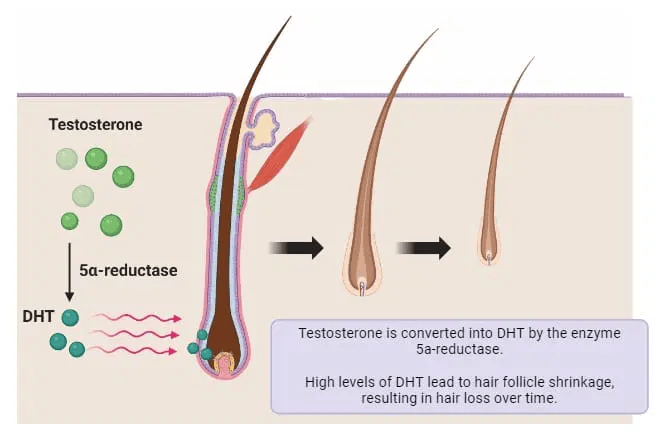
As the diagram shows, it is not testosterone itself that damages hair follicles; it is the DHT it converts into. This is an important distinction because it means TRT does not automatically lead to hair loss. What matters is how sensitive your follicles are to DHT, which is largely determined by genetics.
For men who are already predisposed to male pattern baldness, TRT can accelerate that process, but it does not create a hair loss problem where none existed.
How Does TRT Affect DHT and Cause Hair Loss?
When you start TRT, your circulating testosterone levels rise. A proportion of this testosterone is then converted into DHT within tissues such as the scalp.
DHT binds to androgen receptors in genetically susceptible hair follicles, triggering a process known as miniaturisation.2 Over time, affected follicles become smaller, produce thinner hairs, and eventually stop producing visible hair altogether.
TRT does not directly damage hair follicles. Instead, it increases the amount of DHT available, which can speed up an existing genetic process.
In practical terms, this means TRT does not “create” hair loss in someone who was never going to lose their hair. However, in men who are already genetically predisposed, it can accelerate existing hair loss or bring it forward earlier than it would have occurred naturally. For more information, you can read our full guide on how TRT causes hair loss.
Can You Have a Hair Transplant While on TRT?
Yes, in most cases, having a hair transplant while on TRT is medically safe.
The more important question is not whether TRT allows surgery, but whether your hair loss pattern is stable and predictable enough to plan surgery responsibly.
If hair loss is still actively progressing, grafts placed today may eventually become surrounded by thinning native hair.
For men on TRT, this risk is more pronounced, since uncontrolled DHT can continue to miniaturise non-transplanted follicles even after surgery.
If you are unsure whether your hair loss is stable or still progressing, speaking with a surgeon before committing to a procedure is strongly advisable.
At The Treatment Rooms London, our surgeons offer consultations to help you better understand your hair loss and determine the next steps on your hair care journey.
Before recommending surgery, a good surgeon will assess:
- your age and family history of hair loss
- the current pattern and speed of hair loss
- donor area density and quality
- whether you are on any medical hair loss treatments
The real concern is not TRT itself, but uncontrolled or rapidly progressing hair loss, which can undermine the long-term result of any transplant, regardless of hormone therapy.
Will TRT Make Transplanted Hair Fall Out?
No. Transplanted hair does not fall out because of TRT.
Hair used in transplantation is taken from the donor zone at the back and sides of the scalp. These follicles are genetically resistant to DHT and remain so even after being moved.4
However, TRT can still affect your native, non-transplanted hair, which may continue to thin if DHT is not controlled. This is why medical therapy is often recommended alongside surgery for patients on TRT, not to protect the grafts, but to preserve the surrounding hair.
See pictures of Hair Transplant Before and After
Our patients on TRT are treated similarly to those not on such therapies, just with more frequent and careful monitoring. The balancing act between the benefits of taking TRT therapy and blocking further hair loss requires more follow-up, but does not necessarily change the management plan. These patients can most certainly go on to have long-lasting and successful hair transplants.
Dr Roshan Vara, Co-Founder and Surgeon at The Treatment Rooms London
Can You Start TRT After a Hair Transplant?
Yes, though timing matters. Most surgeons recommend waiting 3 to 6 months before starting or restarting TRT following a transplant. This allows transplanted follicles to fully stabilise.
If TRT is restarted without concurrent DHT-blocking therapy, accelerated thinning in non-transplanted areas is a real possibility. It is important to discuss any planned changes to your TRT regimen with both your prescribing doctor and your hair transplant surgeon.
For more information, you can read our article on what to expect post-transplant.
How to Protect Your Hair While on TRT
To achieve good hair transplant results whilst on TRT, there are a few ways to help protect your existing hair and ensure longevity.
- DHT-Blocking Medications
There are currently two main DHT-blocking prescription medications used to reduce DHT levels in the scalp:
| Medication | Mechanism | DHT Reduction | Notes |
|---|---|---|---|
| Finasteride | Inhibits type II 5-alpha reductase | ~70–90%5 | First-line; once-daily oral tablet |
| Dutasteride | Inhibits type I and II 5-alpha reductase | Up to ~99%6 | Stronger effect; higher risk of side effects |
Both medications are prescription-only. Side effects, including changes in libido, mood, or sexual function, affect a minority of users but should be discussed with a clinician before starting.
- Minoxidil
Minoxidil works differently from DHT blockers: rather than reducing DHT, it prolongs the growth phase of the hair cycle and improves blood supply to follicles. Used alongside a DHT blocker, it provides additional benefit in slowing hair loss to native hairs.7
- Optimising Your TRT Plan
One way to minimise hair loss while on TRT is by carefully optimising your treatment plan. Using the lowest effective testosterone dose can help limit the amount of excess hormone available for conversion into DHT, which is the main driver of male and female patterned hair loss.
In addition, splitting your total weekly dose into smaller, more frequent injections (for example, twice weekly instead of one large dose) can help prevent sharp hormonal peaks. This leads to more stable testosterone levels and may reduce sudden spikes in DHT that can accelerate hair follicle miniaturisation.
Any changes to your TRT regime must be discussed with your doctor prior to.
- Scalp Care and Shampoos
Some patients use ketoconazole shampoo (2%), which has shown modest antiandrogenic activity in small clinical studies and is sometimes used as an adjunct to medical therapy.8 It is not a substitute for finasteride or dutasteride, and shampoos marketed as containing “natural DHT blockers” such as Saw Palmetto have a considerably weaker evidence base.
- Lifestyle
Maintaining healthy hair while on TRT involves a balanced diet rich in biotin, zinc, and iron, managing stress through activities like exercise or meditation, and avoiding harsh hair treatments that can damage follicles. Supplements may also help, but it’s best to consult your doctor before starting any.
What to Do Before and After Hair Transplant if You’re on TRT
If you’re on testosterone replacement therapy (TRT), planning around your hair transplant is important.
Before surgery, your hair surgeon must know you’re on TRT. They may review your current dose and blood work, especially testosterone and DHT levels, to assess your baseline risk of ongoing hair loss.
Many clinics recommend starting a DHT blocker such as finasteride ahead of surgery to help stabilise existing hair and protect the non-transplanted follicles.
After surgery, staying consistent with medical therapy, following post-operative guidance and attending your follow-up appointments are the most important things you can do to protect your result.
You should also communicate any planned changes to your TRT dose or protocol with your surgical team before making them.
The goal is not to stop TRT indefinitely, but to manage DHT carefully so the results of your transplant remain natural and stable over time.
Conclusion
Being on TRT does not prevent you from having a hair transplant. Many men successfully combine both treatments with long-lasting results.
The real issue is not whether TRT is “allowed”, but whether your hair loss is stable, predictable, and being medically managed. Without proper DHT control, ongoing thinning of native hair can compromise even the best surgical outcome.
If you would like to discuss your options for hair transplant surgery in more detail, our friendly team at The Treatment Rooms would be more than happy to advise on the next steps in your hair care journey.
References
1. Testosterone Replacement Therapy (TRT): What It Is [Internet]. Cleveland Clinic; 2025 Jan 16 [cited 2026 Feb 4]. Available from: https://my.clevelandclinic.org/health/treatments/testosterone-replacement-therapy-trt
2. Ho CH, Sood T, Zito PM. Androgenetic Alopecia. In: StatPearls [Internet]. Treasure Island (FL): StatPearls Publishing; 2025 Jan–. Bookshelf ID NBK430924. Available from: https://www.ncbi.nlm.nih.gov/books/NBK430924/
3. Owecka B, Tomaszewska A, Dobrzeniecki K, Owecki M. The hormonal background of hair loss in non-scarring alopecias. Biomedicines. 2024;12(3):513. doi:10.3390/biomedicines12030513. Available from: https://www.mdpi.com/2227-9059/12/3/513
4. International Society of Hair Restoration Surgery. Harvesting of donor hair for hair transplants. International Society of Hair Restoration Surgery; 2026 [cited 2026 Feb 10]. Available from: https://ishrs.org/harvesting-of-donor-hair-for-hair-transplants/
5. Finasteride – StatPearls – NCBI Bookshelf. Finasteride. In: StatPearls [Internet]. Treasure Island (FL): StatPearls Publishing; 2026 [cited 2026 Feb 11]. Available from: https://www.ncbi.nlm.nih.gov/books/NBK513329/
6. Clark RV, Hermann DJ, Cunningham GR, Wilson TH, Morrill BB, Hobbs S. Marked suppression of dihydrotestosterone in men with benign prostatic hyperplasia by dutasteride. J Clin Endocrinol Metab. 2004;89(5):2179–84. doi:10.1210/jc.2003-030305
7. Gupta AK, Talukder M, Venkataraman M, Bamimore MA. Minoxidil: a comprehensive review. J Dermatolog Treat. 2022;33(4):1896–906. doi:10.1080/09546634.2021.1945527
8. Pierard-Franchimont C, De Doncker P, Cauwenbergh G, Pierard GE. Ketoconazole shampoo: effect of long-term use in androgenic alopecia. Dermatology. 1998;196(4):474–7. doi:10.1159/000017904
Share:
Authored by

Dr Roshan Vara
Dr. Roshan Vara is a renowned hair transplant surgeon in London and the Co-Founder of our award winning hair transplant clinic, The Treatment Rooms London.He has over 10 years of experience in hair transplant surgery and is recognised for delivering natural-looking results through ethical, patient-centred care. He is a Full Medical Member of BAHRS and an Associate Member of ISHRS, reflecting his commitment to the highest standards in modern hair restoration.
Reviewed by

Dr Dilan Fernando
Dr. Dilan Fernando is regarded as one of the best hair transplant surgeons in London and Co-Founder of The Treatment Rooms London. He has over 10 years of experience in hair transplant surgery and is known for his meticulous technique and commitment to ethical practice. He served on the Executive Committee of BAHRS from 2020 to 2024, helping to shape industry standards for patient safety and quality of care. Dr. Fernando personally performs each surgery, ensuring natural results built on trust and experience.
Book a Consultation
Related Blogs

Hair Transplant After 7 Days: What To Expect
October 9, 2026
Key takeaways: 7 days after your hair transplant, you can expect to see the scabs in your…

Minoxidil Side Effects: What to Expect, Risks, and How to Manage Them
October 9, 2026
Key takeaways Medications are often a first step people take when tackling pattern baldness. They can help…
What Is A Hair Graft In A Hair Transplant?
October 7, 2026
Key takeaways: What is a Hair Graft in a Hair Transplant? Hair loss can be a distressing…

Widow’s Peak Hair Transplant for Women: Everything You Need to Know
October 6, 2026
Key takeaways: There is no absolute definition of a widow’s peak in women. It is often based…

Has Steve Carell Had a Hair Transplant? What the Evidence Really Shows
October 6, 2026
Key Takeaways Steve Carell is arguably one of the most liked and versatile actors of his generation….
When Can You Drink Alcohol After Your Hair Transplant?
October 6, 2026
Key takeaways: It’s common for our patients to ask us when it is okay to resume drinking…

Has Donald Trump Had a Hair Transplant? Expert Review and What the Evidence Shows
October 6, 2026
Key Takeaways Donald Trump’s hair is one of the most talked about aspects of his appearance; from…

Wayne Rooney Hair Transplant: Expert Analysis of His Hair Loss and Restoration
October 5, 2026
Key takeaways: Wayne Rooney is widely regarded as one of the greatest football talents from England. He…

Understanding Prince Harry’s Hair Loss: Causes and Treatment Options
October 3, 2026
Key Takeaways: Prince Harry, the Duke of Sussex, has lived most of his life in the public…