

It takes approximately 10-14 days for newly implanted grafts to become secure after a hair transplant. You must be extra careful not to hit or damage these newly implanted grafts in the first 10-14 days. This is important to know as it affects your hair transplant aftercare and recovery, your return to work, and your lifestyle.
In this article, we explain how and why it takes 10-14 days for your newly implanted grafts to become secure and how this affects your aftercare.
What is a hair transplant?
An FUE hair transplant or an FUT procedure involves relocating hairs from one part of the scalp or body (donor area) to a new area (recipient area). This typically involves taking hairs from the back and sides of the scalp and placing them into the crown (also known as a crown hair transplant), mid-scalp, or frontal hairline to treat areas of balding.
The hairs that are relocated should grow for life. Hair transplantation is therefore seen as a permanent solution to balding.
Whether hair loss has genetic or hormonal causes (male pattern baldness) or is due to a condition, a hair transplant can restore your head of hair, giving you a more youthful appearance and improving self-esteem.
Hair transplants are undertaken by a dermatological or hair transplant surgeon and are performed under local anaesthesia. There are two main methods of hair transplant which you are likely to come across; these are:
- Follicular unit transplantation (FUT)
- Follicular unit excision (FUE)
FUT takes a section of the scalp from the back of the head, closes the incision site, then separates the strip into small sections before implanting them into the bald area.
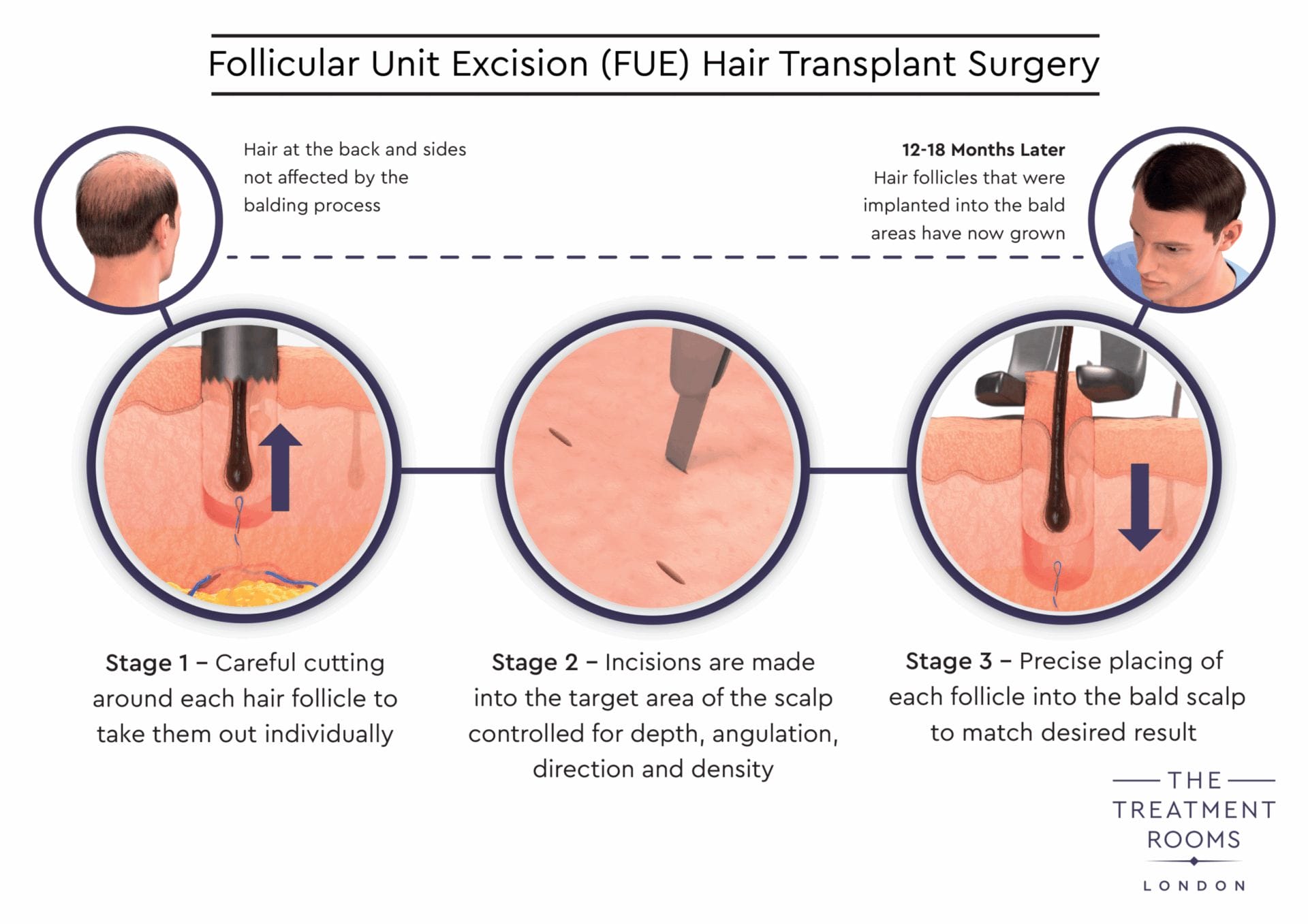
Whereas, in an FUE procedure, the surgeon carefully extracts hair follicles directly from the back of the head with a number of small punch incisions, before implanting them in tiny holes in the balding area. FUE hair transplants can be a preferred method of treatment as they are less invasive and the recovery is a lot less painful and time-consuming.
What are hair grafts?
You might be unclear as to what exactly hair grafts are, so first, let’s be sure of their definition. Hair grafts are used in surgical hair transplantation, in which healthy hair follicles are harvested and transferred to balding areas of the head.
A hair graft is a piece of skin that contains healthy hair follicles and is removed to be transplanted elsewhere on the scalp. While hair grafts can theoretically be taken from anywhere on your body, they are usually taken from the back of the head, also known as the posterior scalp.
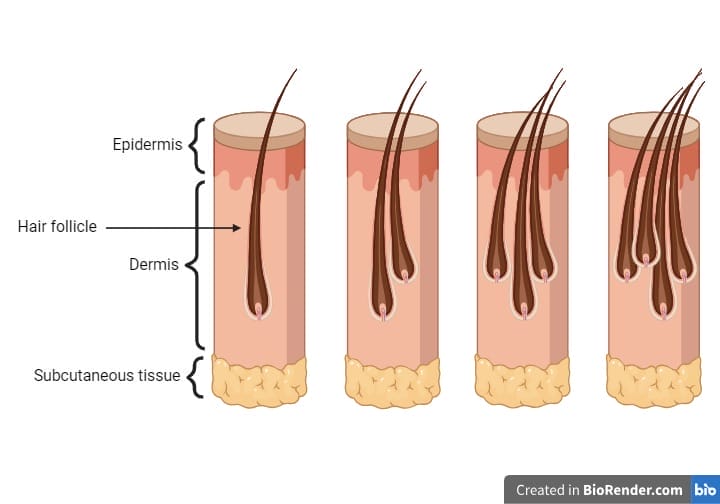
Typically, one graft sprouts 2-3 hairs as shown in the diagram above. If you look at the hair on your scalp, arm, or body, you will often see groups of hairs coming out of one graft in the skin. The size of a hair graft extracted will depend on the surgical technique being used and the tools and technology involved.
To learn more about what hair grafts are, visit our How Many Hair Grafts Do I Need For My FUE Hair Transplant? for more information.
What happens with hair grafts during hair transplant surgery?
Hair grafts are taken as individual follicles from the back of the head with hundreds, or even thousands, of small punch incisions in the FUE technique. They are then placed in a solution to keep them hydrated and cool.
Once enough hair grafts have been extracted, they are relocated to the balding area. This can be the front of the scalp, mid-scalp, or crown.
The grafts are placed into small <1mm holes in the scalp to recreate hair where there was none previously. After all the grafts have been transplanted, the back of the scalp or donor area is bandaged.
How long does it take for the grafts to become secure?
Several factors can affect the survival of hair grafts, including dehydration, oxygen deprivation, and temperature. For this reason, you must follow your surgeon’s instructions on how to look after your newly implanted grafts.
Like repotting a plant, each new graft is quite fragile in its new location. It can take a while for the graft to fully “root in”. This is typically 10-14 days, and it involves the scalp healing itself after surgery and securing each graft in its new location.
You might be advised to avoid exercise after a hair transplant to reduce redness and prevent sweat from contaminating the fragile areas, for at least 2 weeks and potentially up to 1 month. A bandage will be applied to the donor area for 24 hours. The donor area, unlike the recipient area, will heal quickly after surgery.
By day 5, the hair grafts should be secure enough for you to wash your hair gently without touching it by hand.
Caring for your grafts after a hair transplant
As we touched upon earlier, caring for your hair grafts in the days and weeks following a hair transplant is key to their survival. So here are a few things you should, and shouldn’t, do:
Do’s
- Do wash your hair daily from 4 days after the procedure, to help with healing and remove scabs
- Do keep your grafts moist, especially in the first 4 days after surgery by spraying them with a saltwater solution.
- Do use over-the-counter pain medication to ease discomfort and help you to sleep in the days following the procedure
- Do wear a hat outside for around two weeks following the procedure, to protect your hair grafts from environmental factors
Don’ts
- Don’t rub your hair with a towel made from fabric. Instead, let it air dry
- Don’t scratch or rub your scalp
- Don’t wear beanie hats
- Don’t scrub your implanted grafts heavily when showering or grooming.
- Don’t do any intense physical activity within the first 14 days after a hair transplant, as not all the hair follicles might have healed.
- Don’t have any other kind of manipulative surgery or treatment on the scalp for at least three months following your hair transplant.
- Don’t expose your hair to strong, high UV sunlight after a hair transplant for at least 2 weeks.
After 2 weeks have passed your grafts should be secure in your scalp. Contact sport is the only exercise you will need to wait a little longer for. If you are a rugby or football player you should avoid playing these sports or play a non-contact form for 4 weeks.
How long does it take to heal?
It must be remembered that several factors can influence recovery time. It’s also important to follow the aftercare and recovery instructions provided by your surgeon to achieve the best and quickest results.
Let’s look at the recovery times for the two parts of the head involved in a hair transplant – the scalp (recipient area) and the donor area.
Scalp
Due to the nature of an FUE hair transplant procedure, scalp recovery is typically faster than with FUT, with the recipient area usually healed within 5 to 14 days. During this time, you are strongly encouraged to follow the surgeon’s advice on how to keep your scalp clean and free of dirt and bacteria.
Donor area
During an FUE procedure, the surgeon will delicately make tiny incisions around each follicle and extract them individually. Because the incisions are minuscule, the donor area recovery time only takes five to seven days.
For more information about the recovery process, please visit our aftercare and recovery page.
How long will it take for my grafts to grow?
It will take approximately 8-12 months for your hair to grow after a transplant. Initially, you will see some of your hair shed in the first 2-3 months. After this initial shedding phase, your roots will begin to grow your new hair. This process is shown on our hair transplant timeline page.
To get a better understanding of the results of hair transplant surgery, visit our FUE hair transplant before and after page for more information.
How The Treatment Rooms London can help you
If you’re considering getting an FUE hair transplant and need more information, please book a consultation with one of our expert surgeons. They will be able to advise you on the best possible options and inform you about the latest treatments available, as well as answer any questions you may have. Getting a hair transplant has never been easier; contact a member of our team today.
Share:
Authored by
Dr Roshan Vara
Dr. Roshan Vara is a renowned hair transplant surgeon in London and the Co-Founder of our award winning hair transplant clinic, The Treatment Rooms London.He has over 10 years of experience in hair transplant surgery and is recognised for delivering natural-looking results through ethical, patient-centred care. He is a Full Medical Member of BAHRS and an Associate Member of ISHRS, reflecting his commitment to the highest standards in modern hair restoration.
Reviewed by
Dr Dilan Fernando
Dr. Dilan Fernando is regarded as one of the best hair transplant surgeons in London and Co-Founder of The Treatment Rooms London. He has over 10 years of experience in hair transplant surgery and is known for his meticulous technique and commitment to ethical practice. He served on the Executive Committee of BAHRS from 2020 to 2024, helping to shape industry standards for patient safety and quality of care. Dr. Fernando personally performs each surgery, ensuring natural results built on trust and experience.
Book a Consultation
Related Blogs

Steve Carell Hair Transplant: Before, After, and His New Hairline Copy
March 2, 2026
Steve Carell, best known as Michael Scott in The Office, began sparking curiosity amongst fans when his…

What Is Nutrafol and Does It Really Work for Hair Growth?
February 24, 2026
Key Takeaways Hair thinning can feel frustrating and confusing. You might notice more hair falling out in…

Peppermint oil for hair growth: Evidence, Benefits, Uses & Safety
February 24, 2026
Key Takeaways What Is Peppermint Oil? Peppermint oil, also known as Mentha piperita oil, is an essential…

Why Winter Hair Loss Happens and All You Need to Know
February 6, 2026
Key Takeaways As temperatures drop and indoor heating kicks in, many people notice their hair feels drier,…

Can You Take Finasteride With Minoxidil For Hair Loss?
February 5, 2026
Key Takeaways Consistency Matters: Stopping treatment often leads to a recurrence of hair loss; ongoing medical guidance…
Does Finasteride Cause Erectile Dysfunction?
February 3, 2026
Key Takeaways Finasteride can cause erectile dysfunction in some men, but it isn’t common. Most men who…
What is a Hair Transplant? How it Works, Success Rate & What to Expect
February 2, 2026
Key Takeaways Cost: Varies from £3,000 to £10,000, depending on the number of grafts and the technique….
What Causes Hair Loss During Menopause?
February 2, 2026
Key Takeaways Many women notice increased hair shedding and thinning during menopause. This happens because hormonal changes…

Can a Norwood 7 Get a Hair Transplant? All You Need to Know
February 2, 2026
Key Takeaways Yes, someone with Norwood 7 hair loss may be able to have a hair transplant,…